In short
GCC jobs for freshers are growing while IT services intake shrinks. How global capability centres hire differently, and how to get in front of them.
On this page
The fresher jobs moved. Most freshers didn't.
Two numbers from 2026 sit next to each other awkwardly.
In April, TCS's chief executive said the company had made 25,000 fresher offers for FY27, after hiring about 44,000 freshers in FY26. In July, foundit projected that India's global capability centres, the in-house tech, finance and operations hubs of multinational companies, would hire 510,452 people in 2026. Early-career talent, 0 to 3 years, was 30% of that hiring and the fastest-growing segment.
The fresher job market has not only shrunk. It has moved, to employers that hire in a completely different way. A plan built for IT services mass hiring, a CGPA cut-off, an aptitude test, a campus drive you wait for, mostly misses them. That is the argument of this piece, along with what to do about it.
What GCCs are and how big they have become
A global capability centre is a company's own unit in India, doing work for the parent: software at a bank, analytics at a retailer, finance operations at an insurer. They are not outsourcing vendors. The work belongs to the company itself.
According to the Nasscom-Zinnov GCC Landscape Report 2026, India had an estimated 2,117 GCCs across 3,728 units in FY26, employing about 2.36 million people and generating $98.4 billion in revenue. The number of GCCs has grown about 32% since FY21.
The shift shows up in fresher postings too. foundit's July 2026 tracker found that the IT sector's share of fresher hiring fell from 32% in 2025 to 24% in 2026, while GCCs rose from 8% to 11%, the biggest rise among the employer types it reported.
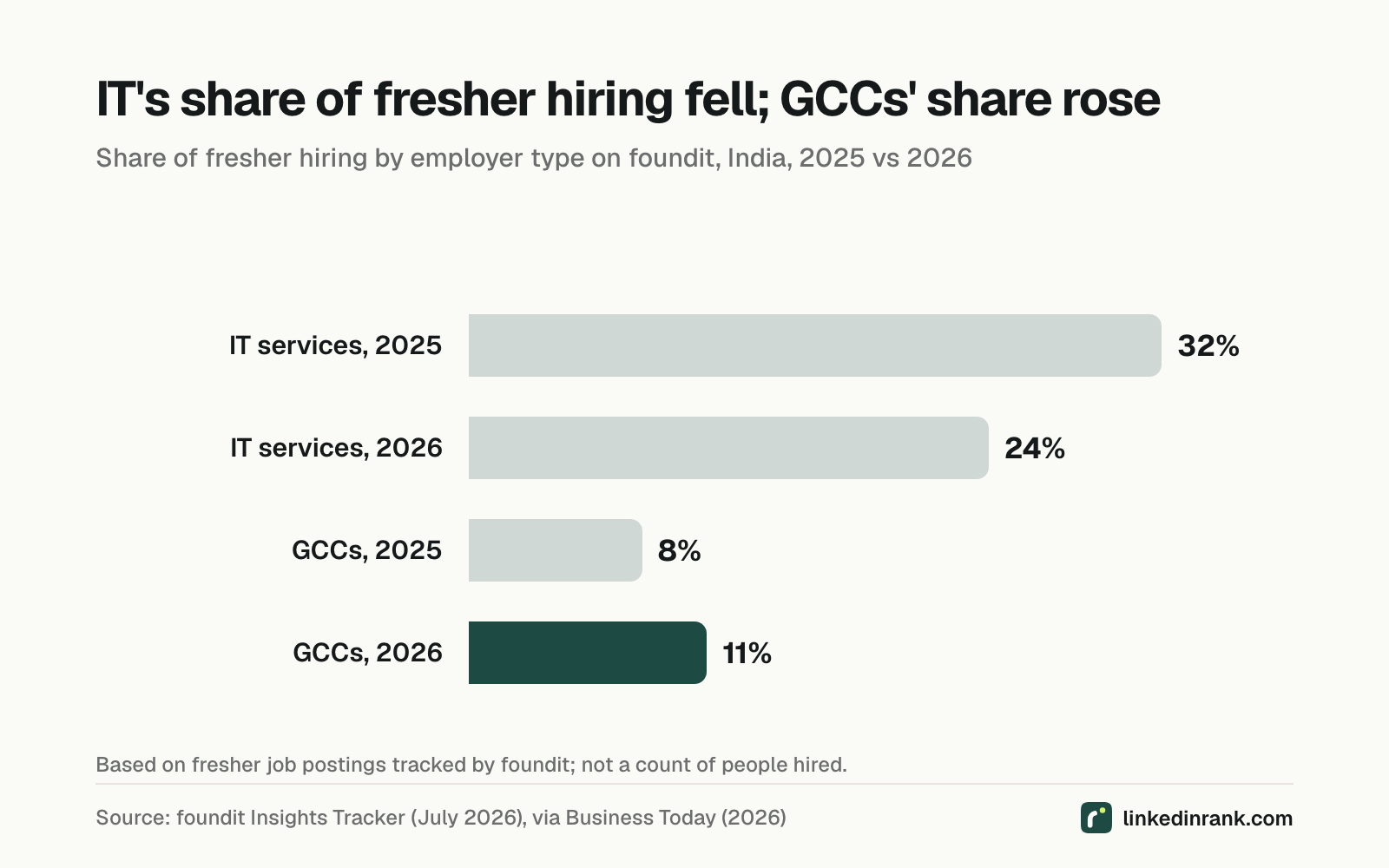
Put plainly: if every application you send goes to IT services firms, you are aiming at a slice of the fresher market that shrank by a quarter in a single year, measured by share of postings. That does not make it a bad slice. It makes it a crowded one, and it means the students who spread their applications wider are now seeing openings you are not.
Try it on your profile
The free LinkedIn Keyword Finder applies this in a minute.
The case for IT services is still real
None of this means IT services stopped hiring freshers. Infosys reaffirmed plans to hire 20,000 graduates in FY27, and the big services firms still run some of the largest single intakes in the country. If your college gets a mass drive, sit it.
And GCCs are not a safe harbour. In October 2026, Nikkei Asia reported that Visa, PayPal, Fidelity and Technicolor had each cut hundreds of roles at their Indian centres, with executives saying AI was making companies rethink large workforces. The Nasscom-Zinnov report itself has a section titled "Redeployment is replacing recruitment", and notes that several GCCs have slowed junior hiring and filled gaps with existing staff. Quess Corp's GCC talent report found that nearly 40% of GCC hiring is backfilling existing roles.
So the honest picture is this: GCCs are where fresher hiring is growing, but they will not hire you in batches of thousands. Which is exactly why the way they hire matters more than how many they hire.
How GCCs hire freshers differently
An IT services intake is built for volume. It hires for a generic trainee role and teaches the specifics later. A GCC usually hires for one team with one problem, and that changes almost everything about what a fresher has to show.
They ask for named tools, not general ability. foundit found that 64% of new GCC roles in 2026 require AI, data science or intelligent automation skills. The Nasscom-Zinnov report describes the trend as "specific frameworks in, generic labels out": mentions of Docker in open roles rose 27 percentage points, Scikit-learn 17 and PyTorch 14. "Knows Python" is a generic label. "Deployed a model in a Docker container" is a framework.
They hire mostly experienced people, so the fresher seats are fewer and contested. Professionals with 4 to 10 years make up 56% of GCC hiring. A fresher is competing for the 30% slice, often against people with an internship already on their profile. foundit found that nearly six in ten fresher job postings now prefer or require prior internship experience.
They recruit through their own channels. Many GCC roles are posted on the parent company's global careers site, filtered by an Indian city, rather than announced through a placement cell. Nasscom-Zinnov found that 90–95% of leading GCCs partner with universities, but a partnership with some campuses is not a drive at yours.
They are spread across more cities than you think. Bengaluru leads with 30% of GCC hiring, followed by Hyderabad, Pune, Mumbai, Chennai and Delhi NCR. Tier 2 cities are now 15% of GCC hiring and growing 23% a year.
Picture two final-year students in Coimbatore, both aiming at data roles (an illustration, not real people). The first waits for the placement cell, clears an aptitude test for a services firm and joins a long queue for a joining date. The second has read twenty GCC postings, noticed that SQL, Python and one dashboard tool appear in almost all of them, built a small analysis of public transport data with exactly those tools, and sent it to two alumni at a bank's Chennai centre. Neither is guaranteed a job. But only one of them is visible to the employers whose fresher hiring is growing.
A campus drive comes to you. A GCC job waits on a careers page for whoever finds it first.
How to get a job in a GCC as a fresher: what to do this week
- Build a list of 25 GCCs in your target cities. Search LinkedIn for "global capability centre" or "GCC" with your city, and note which multinationals have an India technology or operations centre. Bookmark each careers page with the India location filter applied, and switch on job alerts wherever the site offers them. Many multinational careers sites let you save a search by city and keyword, which turns 25 bookmarks into a handful of emails.
- Read ten of their early-career postings side by side. Write down every named tool and framework. The three that repeat most are your syllabus for the next 60 days. Notice, too, which words are requirements and which are preferences. "Must have" and "good to have" are different promises, and a fresher who meets the first list should apply without waiting to tick the second.
- Build one project with those exact tools. Not a course certificate. A small working thing with a README that says what problem it solves and how to run it.
- Get the internship line on your profile. If you do not have one, a short internship now is worth more than another certificate, because the postings ask for it. Our guide to internships and fresher jobs on company career pages shows where these are listed.
- Make yourself referable. Find two people from your college at each of your top five GCCs. A message that names the specific role and links your project is easy to forward. A message that says "any openings?" is not.
- Check weekly, not when you remember. GCC postings are fewer and scattered across hundreds of separate sites, so a weekly routine beats an occasional binge. The same habit works for remote roles on company career pages.
If checking 25 careers pages every week is the part you will not keep up, LinkedInRank's free weekly email sends up to 15 roles matched to your profile, taken from employers' own career pages.
What the data can't tell us
The foundit figures are projections and shares built from job postings on one platform, not counts of people hired, and another firm, Taggd, has estimated GCC hiring lower. "GCC" covers everything from small analytics teams to centres with thousands of staff, and their fresher practices vary widely. We also do not have reliable public data on how many freshers GCCs hire from campus versus off-campus, or what they pay freshers on average. What the numbers do show consistently is the direction: fewer generic seats, more specific ones.
The campus drive used to be the market. For a growing share of fresher jobs in India, the market is now a careers page, a named skill and a person who can forward your link.
Sources
- Nasscom-Zinnov, "India GCC Landscape Report 2026", 2026. https://media.zinnov.com/wp-content/uploads/2026/05/zinnov-nasscom-…
- Analytics India Magazine, "'World's Largest' AI Hiring Hub, Yet No GCC in India is Actually AI-Native", 2026. https://analyticsindiamag.com/gcc/worlds-largest-ai-hiring-hub-yet-…
- Business Today (foundit Insights Tracker), "At 5.1 lakh jobs, India's Global Capability Centre hiring boom scales new peak", 2026. https://www.businesstoday.in/jobs/story/at-5-1-lakh-jobs-indias-glo…
- Business Today (foundit Insights Tracker), "AI, GCCs and a changing job market: India's fresher hiring is no longer just an IT story. Who's driving the shift?", 2026. https://www.businesstoday.in/jobs/story/ai-gccs-and-a-changing-job-…
- Business Today (Quess Corp GCC Talent Trend Report), "Why India's GCCs are hiring fewer full timers and more AI contractors", 2026. https://www.businesstoday.in/amp/technology/story/why-indias-gccs-a…
- Outlook Business (PTI), "TCS Makes Only 25k Fresher Offers This Fiscal, More Hires Dependent on Demand Scenario: Official", 2026. https://www.outlookbusiness.com/corporate/tcs-makes-only-25k-freshe…
- People Matters, "After salary hikes, Infosys reaffirms plan to hire 20,000 freshers in FY27", 2026. https://www.peoplematters.in/news/recruiting-and-onboarding/after-s…
- Nikkei Asia, "AI casts shadow over India's multinational tech job machine", 2026. https://asia.nikkei.com/business/technology/ai-casts-shadow-over-in…
Questions people ask
What are the best keywords for a LinkedIn profile?
The job title you want and the hard skills and tools from job posts for that title. Generic words like "hardworking" or "team player" are rarely searched.
Where should I put keywords on LinkedIn?
In order of weight: your headline, your current job title, the Skills section, your About section and your experience bullets. Use the job post's exact words, for example "Power BI", not "BI tools".
How many job posts should I paste?
3 to 5 posts for the same role give a reliable list. A keyword that appears in most of them is a must-have.
Should I add keywords I do not have?
No. Recruiters and interviewers check. Add only skills you can talk about, and learn the ones that keep coming up.
Is my data stored?
No. The analysis runs in your browser. If you drop your LinkedIn PDF it is read once to extract text and never stored.
Written by Bhavishya Singla
Founder of LinkedInRank. Writes about how recruiters search LinkedIn and what makes a profile show up.
Add LinkedInRank as a preferred source on Google
See our new LinkedIn guides first in Google results.