In short
Ghost jobs are postings with no real intent to hire. What the research measures, why companies post them, and how to stop wasting applications on them.
On this page
Some silence isn't rejection. The job was never there.
To look open to outside talent. To look like the company was growing. To make staff believe help was coming, or to make them feel replaceable. To collect résumés for later.
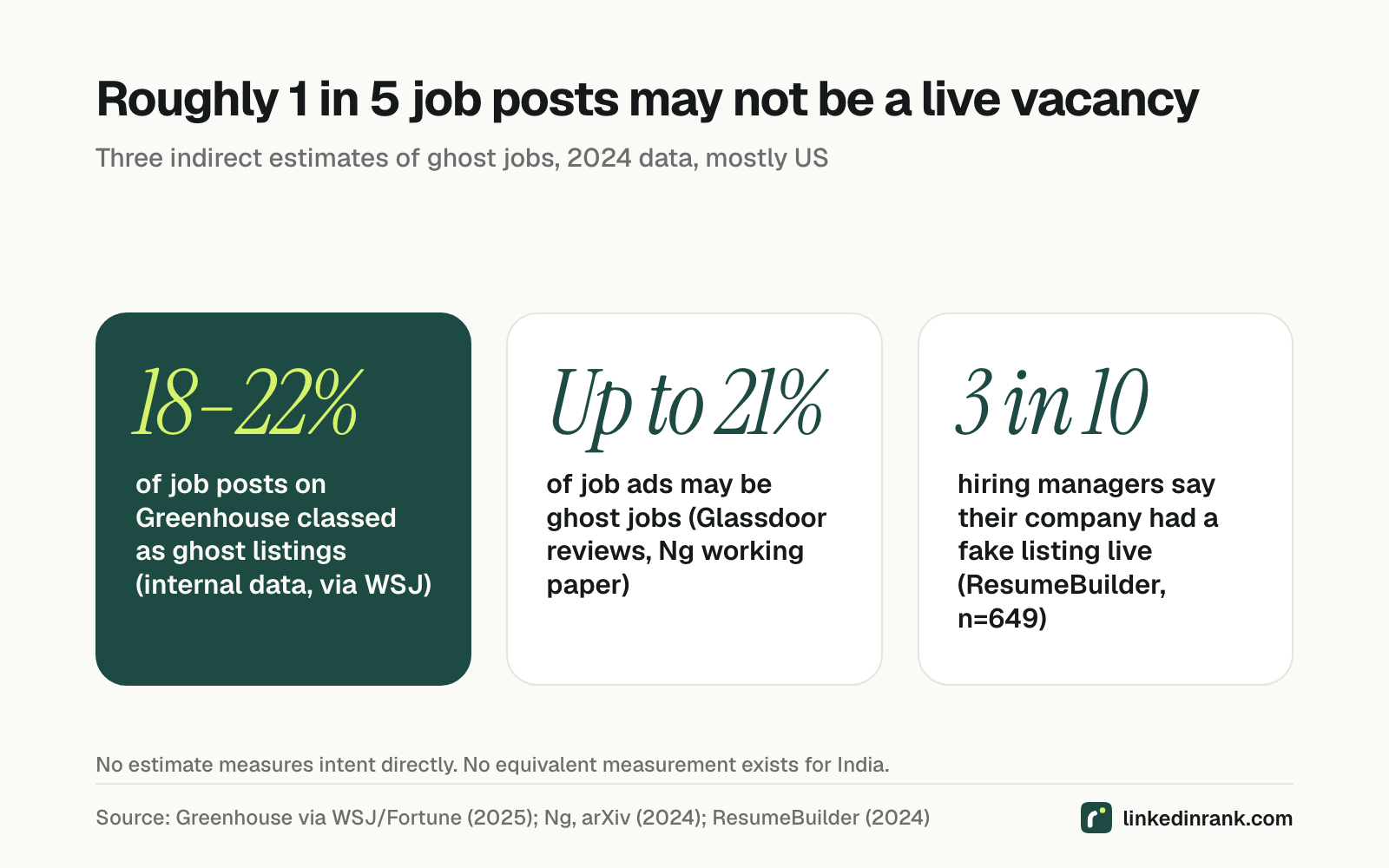
Those are the reasons hiring managers gave, in a May 2024 survey by ResumeBuilder, a résumé-template company, for posting jobs their companies did not intend to fill. Of the 649 who completed it, 40% said their company had done so in the past year, and three in ten said such a listing was live right now.
It is a vendor survey, and its numbers deserve caution. But it points at something that should change how you job-hunt. A meaningful share of the silence you get is not a verdict on you, because some of the jobs were never live. That changes how you judge yourself, and where you spend your next 20 hours of applying.
How common are ghost jobs?
Nobody can count ghost jobs directly, because the defining feature, intent, is invisible. Every estimate is indirect, and they cluster in the same range.
Greenhouse, an applicant-tracking platform used by employers to post and manage jobs, reviewed its own data and found that 18% to 22% of job posts were ghost listings, roles companies were not actually trying to fill, according to reporting by The Wall Street Journal in January 2025. Almost 70% of companies on the platform posted at least one in the second quarter of 2024. Greenhouse has not published how it classified them.
A 2024 working paper by Hunter Ng took a different route: it used Glassdoor interview reviews and a language model to estimate that up to 21% of job ads may be ghost jobs, with the practice most common at larger firms and in specialised industries. Its explanation is simple economics. Posting costs almost nothing, and an open listing keeps a pipeline of candidates warm.
You will also see people point to the US government's job openings data. In September 2026 the US had 7.5 million job openings and 5.4 million hires. That gap is not a ghost-job count. Openings are measured on one day; hires add up over a month; and plenty of hires never had a public posting at all. Use it as context, never as proof.
Try it on your profile
The free Cover Letter Generator applies this in a minute.
Not every ghost job is a lie
Some ghosts are deliberate. In the ResumeBuilder survey, the most common aims were to look open to outside talent (67%) and to look like a growing company (66%). Among companies that contacted applicants for these listings, 85% said candidates were even interviewed.
But before treating every silent employer as a fraud, it helps to see the ordinary ways a real job turns into a ghost.
A team opens a role, then the budget is frozen and nobody takes the post down. A recruiter keeps an "evergreen" listing open for a role the company fills a few times a year. An internal candidate is chosen, but policy requires an external posting anyway. A hiring manager goes on leave for six weeks. From inside the company, none of these feel like deception. From outside, they look exactly the same as a fake: you apply, and nothing happens.
That is the point. For your strategy, it does not matter whether a ghost was cynical or careless. What matters is that applying to it has close to zero expected return, and the only cost you can control is your own time.
An unanswered application to a job that was never live is not a rejection. It is noise.
Lawmakers are now asking: is this a real vacancy?
Since January 1, 2026, employers in Ontario, Canada, with 25 or more employees must state in public job postings whether the position is for an existing vacancy. They must also tell interviewed candidates within 45 days whether a decision has been made, and disclose if AI is used to screen applicants.
In June 2026, New York's legislature passed a bill, S8877, that would require employers with 100 or more staff to say whether a posting is a current vacancy and when they intend to fill it, and to remove the ad within two weeks of filling the job. At the time of writing we found no report that it had been signed into law.
We found no comparable rule in India. And for Indian freshers, the more pressing risk may be the fake job rather than the ghost one. In a 2026 Indeed survey of 1,161 Indian employees and job seekers, 93% said they had encountered suspicious or fraudulent job opportunities, and people with 0–2 years of experience were among the most targeted. A ghost job wastes your time. A scam can take your money and your documents.
How to spot a ghost job, and where to spend your effort instead
Do the arithmetic once, because it changes how silence feels. If roughly one in five postings is not a live vacancy, then out of 100 applications, around 20 could never have produced a reply, whatever you wrote. If you applied mostly to old, generic listings at large companies, where the working paper found ghosts more common, the share could be higher. Forty unanswered applications is a bad week. It is not proof that you are unemployable.
You cannot see intent. You can see signals that a job is alive. Shift your applications towards those.
- Prefer fresh postings. In the ResumeBuilder survey, more than a third of fake listings stayed up for three months or longer. A role posted this week is more likely to have a live budget behind it than one that has been reposted since summer. If a posting shows no date, treat it as old.
- Check the company's own careers page. If a role appears on a job board but not on the employer's own site, give it lower priority. If it is on the careers page with a recent date, give it more. Our guide to finding roles on company career pages shows how to search them.
- Look for a named human. Postings that name the team, the manager or the recruiter, or that someone at the company has shared in the last few weeks, are harder to fake. Send one short note to a person on that team asking whether the role is still open. A one-line answer, either way, saves you an hour of tailoring.
- Read the posting for specificity. A real vacancy usually describes a real problem: the team, the tools, what the first three months involve. A ghost is often generic. Our breakdown of job ad must-haves and match scores explains how to separate requirements from filler.
- Track replies by channel, not by count. Keep a simple sheet: where you applied, how old the posting was, whether you contacted a person. After 30 applications, you will see which channels produce replies. That number is a far better guide than your total.
- In India, verify before you share anything. Check that the recruiter's email domain matches the company. Never pay a fee for a job or an interview.
- Give each application an expiry date. Follow up once, politely, after about two weeks, ideally with a person rather than a portal. If nothing comes back after that, mark it closed in your sheet and stop checking. An application you keep hoping about costs attention you could spend on a fresh one.
What the data can't tell us
Every estimate here is indirect. Greenhouse's figure comes from one platform and an unpublished method. Ng's paper is a working paper built on interview reviews, which come from people who chose to post them. The ResumeBuilder figures are self-reported by hiring managers in a survey commissioned by a company that sells résumé tools, and the page does not say which countries respondents were in. We found no measurement of ghost jobs in India at all. What the sources agree on is the order of magnitude: not most jobs, but enough of them that silence is a poor measure of your worth.
You cannot make a ghost job reply. You can stop letting it set your self-worth, and start spending your effort where someone is actually listening.
Sources
- ResumeBuilder, "3 in 10 Companies Currently Have Fake Job Postings Listed", 2024. https://www.resumebuilder.com/3-in-10-companies-currently-have-fake…
- Entrepreneur (citing The Wall Street Journal and Greenhouse data), "Ghost Job Listings on the Rise, How to Spot, Avoid: Experts", 2025. https://www.entrepreneur.com/business-news/ghost-job-listings-on-th…
- Fortune, "Employees navigate an increasingly 'soul-crushing' job market, rife with fake listing and ghosting hiring managers", 2025. https://fortune.com/2025/01/16/job-market-rife-fake-listing-ghostin…
- Ng, Hunter, "Why is it so hard to find a job now? Enter Ghost Jobs", arXiv working paper, 2024. https://arxiv.org/abs/2410.21771
- US Bureau of Labor Statistics, "Job Openings and Labor Turnover Summary" (September 2026 data), 2026. https://www.bls.gov/news.release/jolts.nr0.htm
- Littler, "Canada: New Ontario Job Posting Requirements in Force January 1, 2026", 2025. https://www.littler.com/news-analysis/asap/canada-new-ontario-job-p…
- HR Dive, "New York passes a bill aimed at halting 'ghost jobs'", 2026. https://www.hrdive.com/news/new-york-passed-bill-aimed-at-halting-g…
- Business Today (Indeed survey), "More than 9 in 10 job seekers encounter fake job offers", 2026. https://www.businesstoday.in/jobs/story/more-than-9-in-10-job-seeke…
- Free Press Journal, "93% Of Indian Job Seekers Encounter Recruitment Scams, Finds Indeed Survey", 2026. https://freepressjournal.in/mumbai/93-of-indian-job-seekers-encount…
Questions people ask
How long should a cover letter be?
Three or four short paragraphs on one page is enough: why this role, two or three things you have done that the job asks for, and a short close. Recruiters skim, so every sentence should be specific.
Does the generator make things up?
No. It writes only from your LinkedIn PDF and what you type. If a number or name appears that we could not find in what you gave us, it is flagged so you can check it before you send.
Do I need a different cover letter for every job?
Yes, ideally. A letter that answers the specific job ad reads far better than a generic one. Paste each new ad and the letter changes to match what that job asks for.
What if I have no experience yet?
Use what you do have: projects, internships, coursework, volunteering or results from a part-time job. Type them in the experience box; the letter is built only from them.
Can I get a tailored resume for the same job?
Yes. The free resume maker turns your LinkedIn PDF into an ATS-friendly resume, and the Job Pack writes a resume and cover letter for each job ad you paste, with your match score and the gaps to fix.
Written by Bhavishya Singla
Founder of LinkedInRank. Writes about how recruiters search LinkedIn and what makes a profile show up.
Add LinkedInRank as a preferred source on Google
See our new LinkedIn guides first in Google results.