In short
AI helps beginners most: new support agents with AI matched peers with 6+ months on the job. Why that only lasts if you use AI to learn, not skip.
On this page
With AI, 2-month hires matched 6-month ones
Picture a support desk in the Philippines in late 2020. Thousands of agents answer chat messages from American small-business owners whose business software has stopped working. A session lasts about 40 minutes, most of it spent working out what is actually wrong. New agents struggle. The best ones have a feel for it that nobody has ever managed to write down.
Then the company starts rolling out an AI assistant. It reads each conversation and suggests what the agent might say next. The agent can use the suggestion, edit it or ignore it.
That rollout became the basis of "Generative AI at Work" by Erik Brynjolfsson, Danielle Li and Lindsey Raymond, published in the Quarterly Journal of Economics in 2025. Its central finding runs against almost every headline about AI and young workers. The people who gained the most were the beginners.
That makes AI a strange thing for a fresher. The same tool that is shrinking some entry-level hiring is also the fastest catch-up machine a beginner has ever had. Whether it helps you depends on one choice: whether you use it to learn the job or to skip learning it.
What "Generative AI at Work" found
The study followed more than 5,000 agents at a Fortune 500 software company, most of them working from offices in the Philippines. Because the tool reached different teams at different times, the researchers could compare agents with and without it doing the same work.
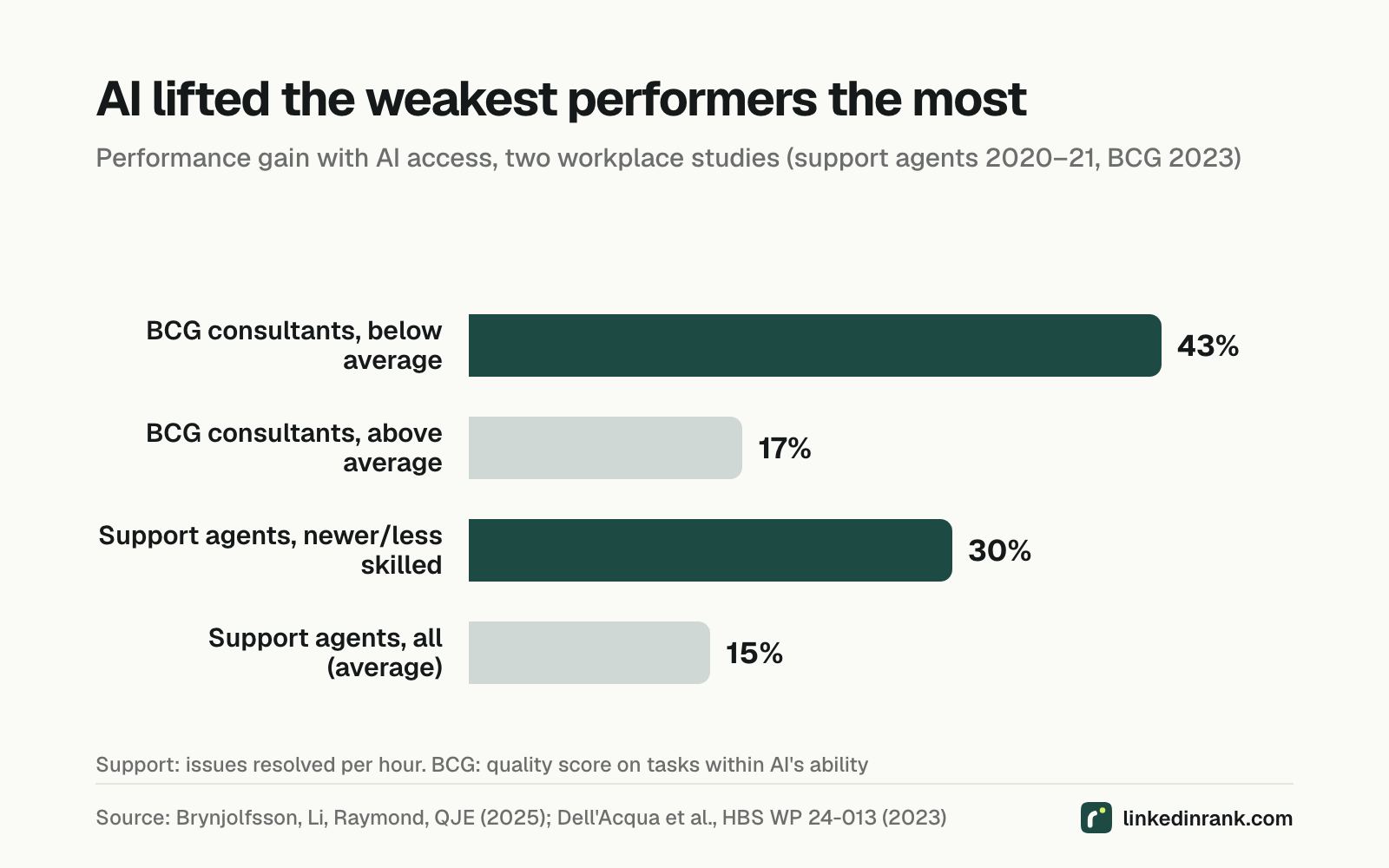
On average, access to the AI assistant raised productivity, measured as issues resolved per hour, by 15%. But the average hides the real story. Less experienced and lower-skilled agents improved by about 30%, in both speed and quality. The most experienced and highest-skilled agents saw "small gains in speed and small declines in quality."
The most striking line is about time. In the journal's press release, AI-assisted agents with two months on the job "performed just as well as regular agents with more than six months of tenure" (EurekAlert, 2025). Four months of the learning curve, compressed.
There were human effects too. Customers were more polite to agents using the tool and less likely to ask for a manager. Attrition fell, driven mostly by newer agents staying.
Try it on your profile
The free LinkedIn Keyword Finder applies this in a minute.
Why AI helps beginners most
The reason is in how the tool was built. The AI company trained it on past conversations and flagged which ones came from the firm's top performers. The paper explains that many of the best agents' skills are hard to write down: "asking clarifying questions, being attentive to customer concerns, deescalating tense situations". Training on their chats was a way of capturing that.
In effect, the tool bottled the habits of the best agents and offered them, line by line, to the newest ones. The researchers found evidence that low-skill agents "begin communicating more like high-skill agents." The veterans already had those habits, which is why they gained little.
The same pattern shows up far from call centres. In a 2023 experiment with 758 Boston Consulting Group consultants, Fabrizio Dell'Acqua and colleagues at Harvard Business School found that on tasks within AI's capabilities, consultants below the average performance threshold improved by 43%, while those above it improved by 17% (HBS working paper 24-013).
The catch: when AI stops you learning
Here is where most "AI will make you 10x" posts stop. They should not, because there is equally good evidence that AI can make beginners worse.
In a field experiment with nearly 1,000 high school maths students in Turkey, Hamsa Bastani and colleagues gave some students a standard GPT-4 chat interface and others a tutor version with prompts designed to safeguard learning (PNAS, 2025; Wharton summary). During practice, grades rose 48% with the plain chatbot and 127% with the tutor version. Then the AI was taken away for the exam. Students who had used the plain chatbot scored 17% lower than students who never had AI at all. The tutor version largely avoided that damage.
So AI lifted both groups during practice, and only one group kept the gain. The difference was not the technology. It was whether the student did the thinking.
The BCG study found a version of this at work. On a task deliberately chosen to be just outside what AI could do well, consultants without AI got the right answer about 84.5% of the time. Those with AI managed 60% to 70%. People trusted a confident wrong answer.
AI can hand a beginner the answer or the skill. Only the skill is still there when the tool goes down.
The call-centre study contains a quiet test of exactly this. Sometimes the AI software went down. During those outages, agents who had been using the tool still performed better than their own pre-AI baseline, and the gain was biggest for those who had engaged with its suggestions most closely. The tool had been teaching them. Note what that engagement looked like: agents followed well under half of the suggestions. They read, judged and edited. The authors are careful here: they cannot fully separate learning from following, but the outage evidence points towards learning.
What this means for India's BPM and entry-level jobs
India's business process management industry employs about 1.65 million people in call centres, payroll and data handling, according to a Reuters report from October 2025. In the same report, Pramod Bhasin, who founded India's first call centre, warned: "The biggest impact is going to be on young students coming out of college." A training-centre staffer added that "recruiters are asking for students with basic AI skills."
Both things are true. Firms may need fewer people for the same volume, and the authors of "Generative AI at Work" say so plainly: their study cannot show what happens to hiring overall, and firms could respond to productive beginners "by hiring more of them, or by seeking to develop more powerful AI systems that replace their use of labor altogether." But for the people who are hired, the evidence says the tool shortens the road from new joiner to competent. That makes the AI-fluent beginner who still learns the job a better hire than either the fresher who avoids AI or the one who leans on it blindly. Our guide on how AI is changing jobs covers which roles are shifting fastest.
How to use AI like the agents who improved
- Make the AI suggest, then decide yourself. Ask for options and reasons, not the final answer. Accept, edit or reject each one, and say why. That is the pattern the improving agents followed.
- Run your own outage test every week. Do one task you normally use AI for without it: a SQL query, an email to a client, a short analysis. If you cannot do it at all, you have been skipping, not learning.
- Ask the AI to teach the pattern, not just the output. "Why does this reply calm an angry customer?" is a better prompt than "write a reply." Write the answer in your own notes. If you are still choosing a first role, our list of AI jobs for beginners covers roles built around this kind of work.
- Keep a log of where the AI was wrong. The BCG result shows the danger is confident errors just outside AI's ability. Every caught mistake teaches you where that edge is, which is knowledge employers value.
- Show it in interviews. Describe a time AI gave you a wrong or weak answer and how you caught it. That one story signals both AI fluency and judgement.
What the data can't tell us
The call-centre study covers one company, one kind of job and an early generative AI tool, measured over months, not years. It cannot tell us how many agents the firm hired afterwards or what happened to wages. The BCG experiment ran for a single session with elite consultants. The Turkish study involved schoolchildren, not employees. Together they point the same way, but none of them shows what AI does to a whole career.
The old fear about AI was that it would replace beginners. The early evidence says it can do something stranger: give beginners a senior's habits in weeks. Whether you keep those habits is the one part the tool cannot do for you.
Sources
- Brynjolfsson, Li, Raymond, "Generative AI at Work", The Quarterly Journal of Economics 140(2), 2025 (abstract via EconPapers). https://econpapers.repec.org/RePEc:oup:qjecon:v:140:y:2025:i:2:p:88….
- Brynjolfsson, Li, Raymond, "Generative AI at Work", working paper full text (arXiv 2304.11771), 2023. https://arxiv.org/abs/2304.11771
- EurekAlert (Oxford University Press), press release on "Generative AI at Work", 2025. https://www.eurekalert.org/news-releases/1071936
- Dell'Acqua et al., "Navigating the Jagged Technological Frontier: Field Experimental Evidence of the Effects of AI on Knowledge Worker Productivity and Quality", Harvard Business School Working Paper 24-013, 2023. https://mitsloan.mit.edu/sites/default/files/2023-10/SSRN-id4573321…
- Bastani et al., "Generative AI without guardrails can harm learning: Evidence from high school mathematics", PNAS 122(26), 2025. https://ideas.repec.org/a/nas/journl/v122y2025pe2422633122.html
- Knowledge at Wharton, "Without guardrails, generative AI can harm education", 2024. https://knowledge.wharton.upenn.edu/article/without-guardrails-gene…
- Reuters via The Irish Times, "AI chatbots replacing India's call-centre workers", 2025. https://www.irishtimes.com/business/work/2025/10/20/artificial-inte…
Questions people ask
What are the best keywords for a LinkedIn profile?
The job title you want and the hard skills and tools from job posts for that title. Generic words like "hardworking" or "team player" are rarely searched.
Where should I put keywords on LinkedIn?
In order of weight: your headline, your current job title, the Skills section, your About section and your experience bullets. Use the job post's exact words, for example "Power BI", not "BI tools".
How many job posts should I paste?
3 to 5 posts for the same role give a reliable list. A keyword that appears in most of them is a must-have.
Should I add keywords I do not have?
No. Recruiters and interviewers check. Add only skills you can talk about, and learn the ones that keep coming up.
Is my data stored?
No. The analysis runs in your browser. If you drop your LinkedIn PDF it is read once to extract text and never stored.
Written by Bhavishya Singla
Founder of LinkedInRank. Writes about how recruiters search LinkedIn and what makes a profile show up.
Add LinkedInRank as a preferred source on Google
See our new LinkedIn guides first in Google results.