In short
Salary negotiation for freshers in India: why the band you land in matters more than haggling, how CTC really works, and what you can still ask for.
On this page
- For freshers, the band beats the bargain
- Does negotiating a job offer actually work?
- What the research says about women and negotiation
- CTC vs in-hand: how a fresher offer in India is built
- What freshers can actually negotiate
- Will asking cost you the offer?
- What the data can't tell us
- Sources
- Questions people ask
For freshers, the band beats the bargain
In an off-campus hiring drive for 2025 graduates, Infosys advertised four trainee roles open to the same set of degrees: BE, BTech, ME, MTech, MCA and integrated MSc. The pay, as reported by Storyboard18, ran from ₹7 lakh a year for a Digital Specialist Engineer trainee to ₹11, ₹16 and ₹21 lakh for three levels of Specialist Programmer.
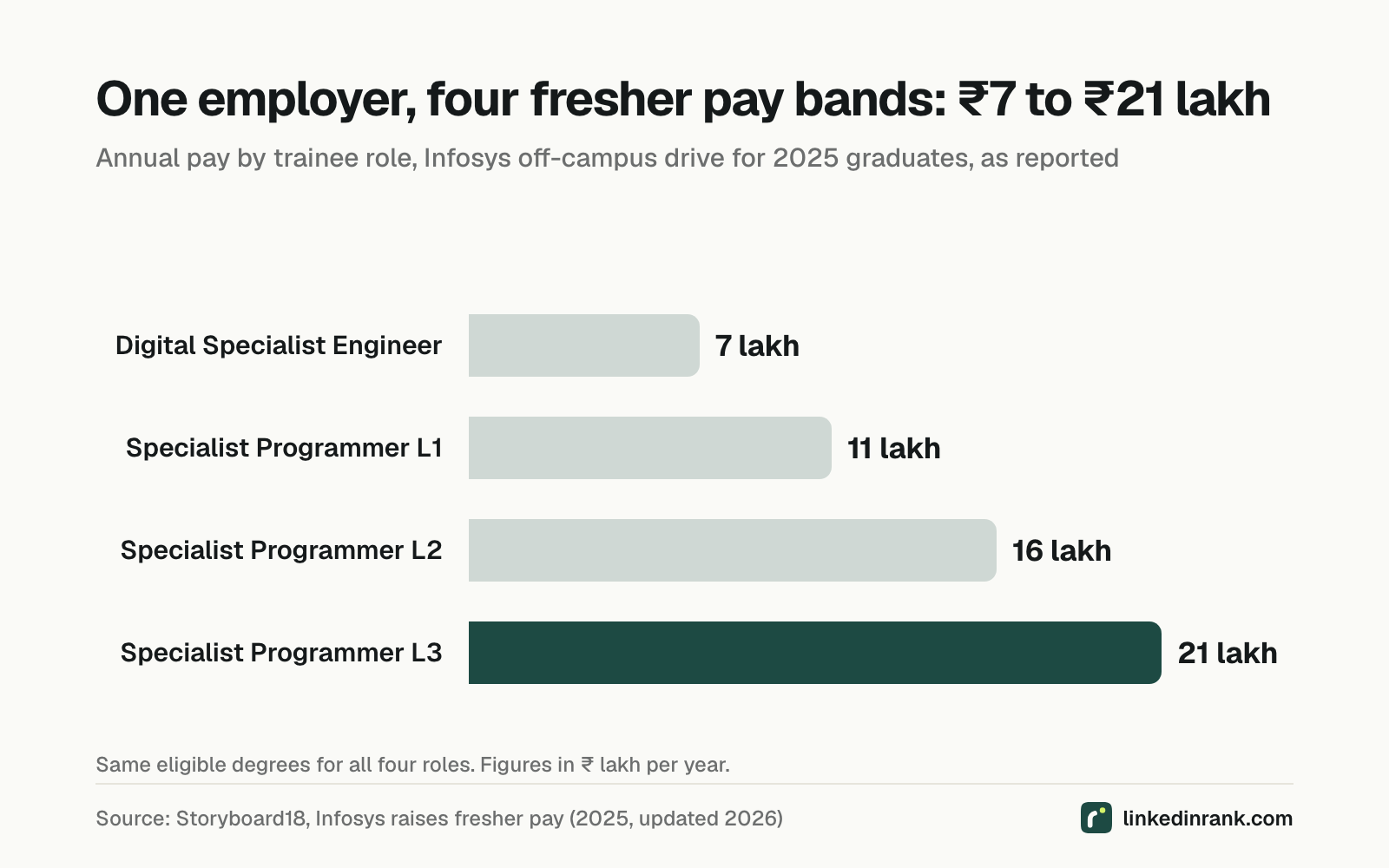
Same company, same batch, same eligibility. A ₹14 lakh difference between the bottom and top band. A polite email after the offer letter is unlikely to move anyone from one band to the next. The report does not say how candidates were sorted into roles, but whatever the method, it happened before the offer existed.
This is the part of salary negotiation for freshers that most advice skips. For a first job in India, the biggest pay decision usually happens before the offer. After it, the money in the base figure often has little room to move. Other terms often have more.
Does negotiating a job offer actually work?
Start with what the standard advice gets right: asking often works.
A Pew Research Center survey of 5,188 US workers, published in 2023, found most had not asked for more than they were first offered the last time they were hired. Among those who did ask, 28% said they got what they asked for and 38% got more than the first offer, though less than they asked for. That is about two in three. The other 35% said they were given only what was first offered.
Older academic work points the same way. Michelle Marks and Crystal Harold surveyed 149 new employees for a study in the Journal of Organizational Behavior in 2011. As summarised by strategy+business, those who negotiated raised their annual pay by about US$5,000 on average compared with those who accepted the first offer.
Why do so many people not ask? In the Pew survey, 38% of those who did not ask said they did not feel comfortable doing it. Among workers aged 18 to 29 who did not ask, 46% gave that reason, the highest of any age group.
Try it on your profile
The free Cover Letter Generator applies this in a minute.
What the research says about women and negotiation
A common line in negotiation advice is that women earn less because they do not ask. The newer evidence is more complicated, and it is worth getting right.
In Pew's data, 32% of men and 28% of women said they had asked for more pay, a small gap. But among those who asked, women were more likely than men to say they got only the original offer (38% against 31%).
Two other studies point the same way. Benjamin Artz, Amanda Goodall and Andrew Oswald, writing in Industrial Relations in 2018, used Australian matched employer-employee data and found women asked for raises and promotions as often as men, but were less likely to get them. And a 2024 study by Laura Kray and colleagues, reported by Harvard's Program on Negotiation, surveyed nearly 1,000 graduates of one top US business school and found 54% of women had negotiated their first post-MBA salary, compared with 44% of men.
The fair summary: in this research, women do ask. The gap appears more in what they receive. That is a problem for employers to fix, not a confidence problem for women to fix alone.
CTC vs in-hand: how a fresher offer in India is built
In India, offers are quoted as CTC, cost to company. It is the total the employer expects to spend on you, which is not the same as what reaches your bank account.
A typical CTC can include basic pay, house rent allowance and other allowances, the employer's provident fund contribution, gratuity, a variable or performance component, insurance, and sometimes a one-time joining bonus.
Three parts deserve attention:
- Provident fund. Under the EPF scheme, both employee and employer contribute 12% of basic wages plus dearness allowance. When the employer's share is counted inside CTC, it raises the headline without raising your monthly pay.
- Gratuity. It is paid when you leave, and only after a qualifying period. Permanent employees still need five years of continuous service. Under India's new labour codes, which took effect on 21 November 2025, fixed-term employees qualify after one year.
- Variable pay. It depends on performance or company results. A ₹6 lakh CTC with ₹60,000 variable is a ₹5.4 lakh offer in a year when none of the variable is paid.
The labour codes also brought a single definition of wages. Under the new rule, if allowances excluded from wages exceed 50% of total pay, the excess is counted as wages. Since PF and gratuity are calculated on wages, this can change how an employer splits the same CTC. Two offers with the same CTC can now produce different in-hand pay, so ask for the monthly breakdown in writing.
What freshers can actually negotiate
If base pay inside a fixed fresher band has little room, here is where room often exists. None of these comes with a guarantee; they are the terms that are more often flexible because they cost the employer less than a permanent raise.
- The band itself, before the offer. If a company hires into several tracks, ask early what decides which one you are considered for, and whether you can attempt the assessment for the higher track. This is the single biggest pay lever most freshers have.
- The split between fixed and variable. Asking for more of the same CTC to be fixed costs the employer little in a normal year and protects you in a bad one.
- Joining date. If you need to finish a semester, a course or a family commitment, ask. Check whether the date affects your batch or training cohort.
- Location and team. Rent in one city can be worth more than a raise in another. If several locations are open, say which you prefer and why.
- A joining bonus or relocation support. One-time payments are easier to approve than base pay. Read whether you must repay them if you leave within a set period.
- Learning. A certification budget, paid exam fees or a training programme. Ask in writing.
- An early review. If pay cannot move now, ask whether your performance can be reviewed after six months rather than at the standard cycle, with that commitment in the offer.
For wording, our guide on how to negotiate salary has phone and email scripts, including what to say if they say no.
Will asking cost you the offer?
This is the fear behind most silence, so it deserves an honest answer: we could not find reliable data on how often a polite request leads to a withdrawn offer, in India or elsewhere. Pew's survey did not even list it as an outcome; the three answers were got what I asked, got something more, or got the original offer.
What the research does show is that the style of asking matters. In the Marks and Harold study as summarised, the hardest-bargaining negotiators won the biggest raises, but those who worked collaboratively, trading some salary for other benefits, felt better about the result. For a fresher who will work with the same manager for years, the collaborative route is usually the sensible one: one request, one reason, no ultimatum, and a clear thank-you either way.
What the data can't tell us
Almost all negotiation research is from the US, and none of the studies here looks at Indian freshers specifically. Pay band figures come from a single employer as reported in the press, not from a company filing. And no study tells us how often fixed fresher packages in India actually move after a request. The advice above follows from how offers are built, not from a controlled test.
The quiet fresher does not lose money in the phone call after the offer. They lose it earlier, by not asking which band they are being considered for, and later, by not reading what the CTC contains.
Sources
- Storyboard18, "Infosys raises fresher pay, offers up to Rs 21 lakh for specialised roles", 2025 (updated 2026). https://www.storyboard18.com/brand-marketing/infosys-raises-fresher…
- Pew Research Center, "When negotiating starting salaries, most U.S. women and men don't ask for higher pay", 2023. https://www.pewresearch.org/short-reads/2023/04/05/when-negotiating…
- Marks, M., Harold, C., "Who asks and who receives in salary negotiation", Journal of Organizational Behavior 32(3), 2011, as summarised by strategy+business. https://strategy-business.com/article/11115
- Artz, B., Goodall, A., Oswald, A. J., "Do Women Ask?", Industrial Relations 57(4), 2018. https://econpapers.repec.org/RePEc:bla:indres:v:57:y:2018:i:4:p:611…
- Program on Negotiation, Harvard Law School, "In Salary Negotiations, Women Do Ask" (on Kray, Kennedy and Lee, 2024). https://www.pon.harvard.edu/daily/salary-negotiations/in-salary-neg…
- Employees' Provident Fund Organisation, "EPF Scheme". https://pmvbry.epfindia.gov.in/epf-scheme/
- KPMG India, "Implementation of labour codes: what changes and road ahead", 2025. https://kpmg.com/in/en/blogs/2025/12/implementation-of-labour-codes…
- Bar & Bench (Ahlawat & Associates), "Labour Codes: Key Highlights", 2025. https://www.barandbench.com/view-point/labour-codes-key-highlights
Questions people ask
How long should a cover letter be?
Three or four short paragraphs on one page is enough: why this role, two or three things you have done that the job asks for, and a short close. Recruiters skim, so every sentence should be specific.
Does the generator make things up?
No. It writes only from your LinkedIn PDF and what you type. If a number or name appears that we could not find in what you gave us, it is flagged so you can check it before you send.
Do I need a different cover letter for every job?
Yes, ideally. A letter that answers the specific job ad reads far better than a generic one. Paste each new ad and the letter changes to match what that job asks for.
What if I have no experience yet?
Use what you do have: projects, internships, coursework, volunteering or results from a part-time job. Type them in the experience box; the letter is built only from them.
Can I get a tailored resume for the same job?
Yes. The free resume maker turns your LinkedIn PDF into an ATS-friendly resume, and the Job Pack writes a resume and cover letter for each job ad you paste, with your match score and the gaps to fix.
Written by Bhavishya Singla
Founder of LinkedInRank. Writes about how recruiters search LinkedIn and what makes a profile show up.
Add LinkedInRank as a preferred source on Google
See our new LinkedIn guides first in Google results.