In short
Does LinkedIn Easy Apply work? What job-search data says about one-click applications, response rates by channel, and a better weekly plan for freshers.
On this page
- One-click applying feels productive. It mostly isn't.
- Does LinkedIn Easy Apply work? What the data says
- Why one-click applications sink
- More applications often signal a harder search, not a better one
- How many job applications does it take? Count interviews per hour instead
- A weekly plan that measures the right thing
- What the data can't tell us
- Sources
- Questions people ask
One-click applying feels productive. It mostly isn't.
760 out of 1,049.
That is how many people in Huntr's 2025 job-seeker survey said LinkedIn's Easy Apply had not produced a single interview for them that year. Huntr sells a job-tracking app, so this is vendor data from a mostly North American user base, and we'll come to its limits. But anyone who has spent an evening clicking "Easy Apply" forty times, then heard nothing for three weeks, will recognise the shape of it.
The trap is not that applying a lot is wrong. Some searches genuinely need volume. The trap is that Easy Apply makes the cheapest part of a job search, sending, feel like progress, while routing you into the channel where the odds of a person ever looking at you are lowest. The number to manage is not applications sent. It is interviews per hour, and that depends more on where you apply than on how often.
Does LinkedIn Easy Apply work? What the data says
Huntr's 2025 annual report draws on two kinds of data. The first is a web survey of 1,049 job seekers, fielded in December 2025. Only 27.5% said Easy Apply had led to at least one interview that year. One caution: that 72.5% "no interview" share is of all respondents, and the report doesn't say how many actually used Easy Apply, so the failure rate among users could be lower.
The second is activity logged in Huntr's tracker during 2025. Across 598,627 applications, Huntr counted a "response" when a user moved a job to the interview stage or beyond. Jobs saved from LinkedIn had a 3.1% response rate. Google Jobs had 11.3%, GovernmentJobs 8.7%, Wellfound 6.0%, Glassdoor 5.5% and Indeed 4.5%.
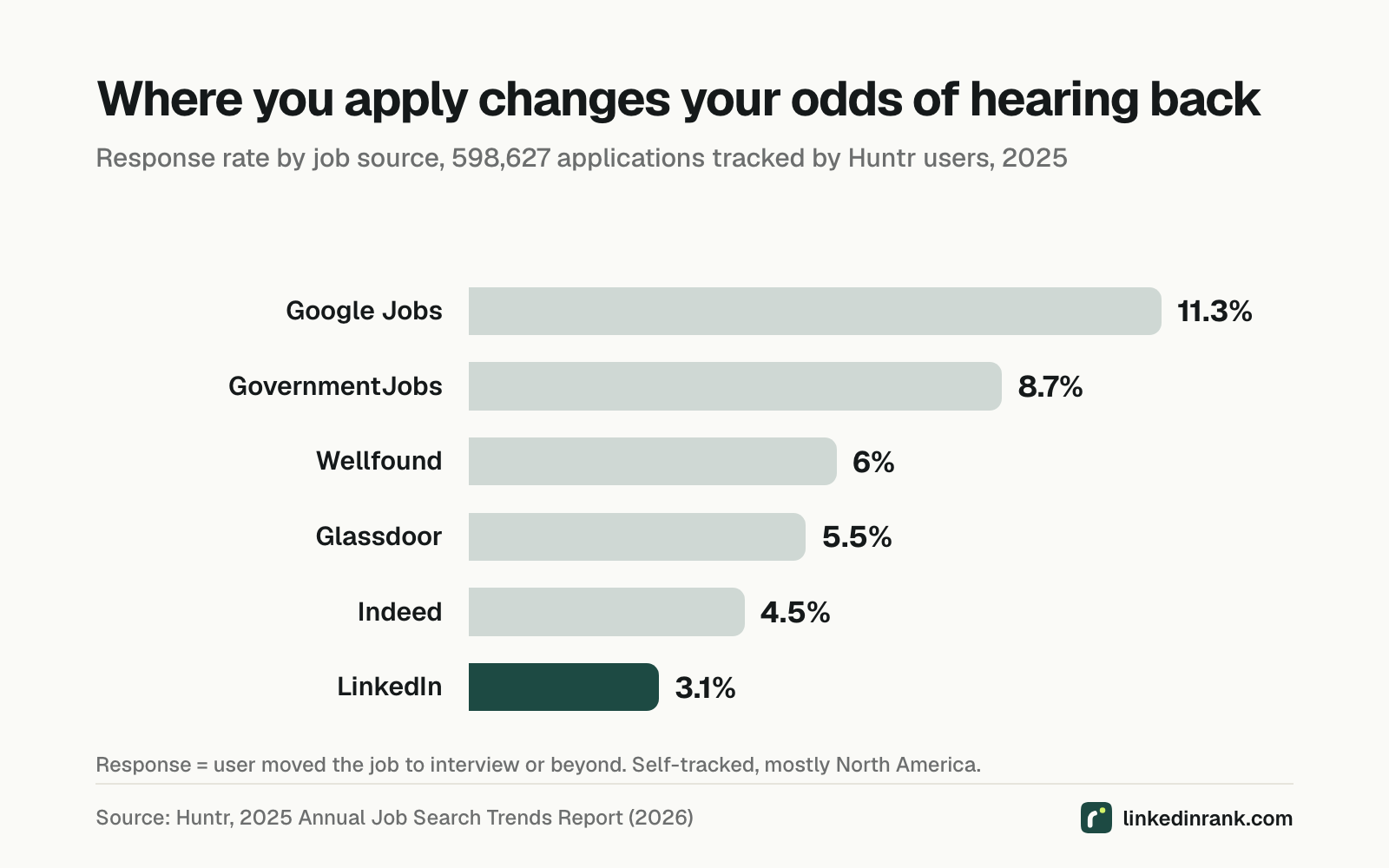
The LinkedIn figure covers every job saved from LinkedIn, not only Easy Apply roles, and the data is self-reported by people organised enough to use a tracker. Still, the pattern is plain: the biggest, easiest pile converts worst.
Try it on your profile
The free Cover Letter Generator applies this in a minute.
Why one-click applications sink
Think about what a one-click application tells an employer. A cover letter or a long form used to cost the applicant time, so it carried a faint signal: this person wanted this job. When applying costs a click, that signal disappears, for you and for everyone else in the pile.
And the pile is large. In June 2025, The New York Times reported that LinkedIn was receiving about 11,000 applications a minute, up 45% in a year, according to Semafor's summary of the story. The same story described an HR consultant who received 1,200 responses to a single post. When applying gets cheaper, everyone applies more, and each application is worth less.
Picture that pile from the other side of the desk. Few people can read 1,200 applications closely. A recruiter in that position is likely to filter, skim the top of the list, and stop once there are enough promising candidates to interview. If your application arrived on day four, matched the job only loosely, and came with no other sign of interest, there is a fair chance nobody opened it. Silence after Easy Apply is often what being application number 900 looks like, rather than a verdict on you.
The defence of volume deserves a fair hearing. Hiring has a lottery element, and you can't win a draw you don't enter. Huntr's tracker data shows how uneven searches are: the largest single group of users who got an offer, 16%, did so after 11 to 20 applications, but 18% needed more than 100. Some people, in some fields, need numbers.
More applications often signal a harder search, not a better one
There is a catch in reading that spread. Economists R. Jason Faberman and Marianna Kudlyak studied every application sent on the US job site SnagAJob between September 2010 and September 2011. They found that each person sent fewer applications per week as their search went on, but that people with longer searches sent more applications per week throughout. Their explanation: job seekers "with the lowest returns to search" put in the highest effort.
Put simply, high volume is often a symptom of a search going badly, not the cure for it. If 200 applications have produced nothing, application 201 is unlikely to be different. Something upstream needs to change: the roles, the channel or the resume.
How many job applications does it take? Count interviews per hour instead
Here is where honest arithmetic helps, and where it surprises people.
Huntr found that applications sent with a tailored resume reached interview or further 5.8% of the time, against 3.73% for untailored ones: about 1.6 times better. That sounds decisive until you add time. Suppose an Easy Apply takes 3 minutes and a tailored application takes 30. Tailoring is then ten times slower for 1.6 times the result, so per hour, untailored volume wins on these numbers. People who bother to tailor are also self-selected, so even the 1.6 may flatter it.
So "tailor everything" isn't the answer either. The bigger lever is the channel. The gap between job sources in Huntr's data, 3.1% for LinkedIn against 11.3% for Google Jobs, is wider than the tailoring gap. Applying on a smaller board or an employer's own careers page, then sending one short note to a recruiter or hiring manager, takes you out of the biggest pile. And a person vouching for you moves the odds most of all: hiring-software firm Ashby found that across 38 million applications, 40% of referred candidates reached interview, against about 3% of inbound applicants.
The bottleneck in a job search was never how fast you could send. It's whether anyone looks.
A weekly plan that measures the right thing
Here is a suggested routine for a fresher. It is a way to organise effort around the evidence above, not a tested formula.
- Pick 5 roles a week that fit well. You meet the must-haves, and you can name a reason for wanting that company. For these, tailor the resume, apply on the company's own site where you can, and message one person: a recruiter, the hiring manager, or an alumnus who works there.
- Use Easy Apply for 15 to 20 more, only where you meet the core requirements. No tailoring beyond the top summary line. Treat this as a fixed budget of lottery tickets, not your strategy.
- Track every application in one sheet. Role, date, channel, tailored or not, whether you messaged anyone, outcome. Our guide to building a job application tracker includes a template.
- Follow up on the 5, not the 20. A short, specific note about a week later. Our guide on how to follow up on a job application has wording that doesn't sound needy.
- After 30 applications, do the sum. Interviews per hour, by channel. Whichever channel wins in your own data gets more of your time next month.
A note on what "fits well" means for a fresher. It doesn't mean ticking every line of the post; employers' own wish-lists are often padded. It means you meet the few requirements that would be embarrassing to miss, such as the degree field, the main tool or language, and the location, and you can point to one piece of evidence for each.
That last step, doing the sum, is the real point. Every number in this article comes from someone else's job search, mostly in North America. Your tracker is the only dataset about your field, your city and your resume.
What the data can't tell us
Huntr's figures come from its own users and survey respondents: a self-selected, mostly North American group, with outcomes logged by the users themselves. Ashby's data comes only from companies that use its hiring software. The SnagAJob study covered mostly hourly-paid US jobs more than a decade ago. We found no comparable public data for Indian job portals or for LinkedIn in India, and LinkedIn doesn't publish Easy Apply conversion rates. None of this proves Easy Apply never works. It suggests that, on average, it is the lowest-yield way to spend an hour of job searching.
Easy Apply made sending effortless. Getting hired was never limited by how fast you could send.
Sources
- Huntr, "2025 Annual Job Search Trends Report", 2026. https://huntr.co/research/2025-annual-job-search-trends-report
- Semafor, summary of The New York Times report on AI-generated job applications, 2025 (original: The New York Times, 21 June 2025). https://www.semafor.com/article/06/24/2025/recruiters-swamped-with-…
- R. Jason Faberman and Marianna Kudlyak, Federal Reserve Bank of San Francisco, "The Intensity of Job Search and Search Duration", Working Paper 2016-13, 2016. https://www.frbsf.org/wp-content/uploads/wp2016-13.pdf
- Ashby, "Talent Trends Report: Referrals", 2025. https://www.ashbyhq.com/talent-trends-report/reports/referrals
Questions people ask
How long should a cover letter be?
Three or four short paragraphs on one page is enough: why this role, two or three things you have done that the job asks for, and a short close. Recruiters skim, so every sentence should be specific.
Does the generator make things up?
No. It writes only from your LinkedIn PDF and what you type. If a number or name appears that we could not find in what you gave us, it is flagged so you can check it before you send.
Do I need a different cover letter for every job?
Yes, ideally. A letter that answers the specific job ad reads far better than a generic one. Paste each new ad and the letter changes to match what that job asks for.
What if I have no experience yet?
Use what you do have: projects, internships, coursework, volunteering or results from a part-time job. Type them in the experience box; the letter is built only from them.
Can I get a tailored resume for the same job?
Yes. The free resume maker turns your LinkedIn PDF into an ATS-friendly resume, and the Job Pack writes a resume and cover letter for each job ad you paste, with your match score and the gaps to fix.
Written by Bhavishya Singla
Founder of LinkedInRank. Writes about how recruiters search LinkedIn and what makes a profile show up.
Add LinkedInRank as a preferred source on Google
See our new LinkedIn guides first in Google results.