In short
A career gap on your resume costs callbacks, and a one-line explanation didn't fix it in a 9,022-employer test. What the evidence says works instead.
On this page
Nobody hires a reason. They hire recent proof.
Between October 2019 and March 2020, a woman called Sarah Smith applied for jobs at 9,022 employers across the United Kingdom. Software engineering, HR, finance, call centres, warehouses, social care. She had nine years of experience in two previous roles. She was also not real.
Sarah was the fictitious applicant in a pre-registered field experiment by Ariella Kristal, Leonie Nicks, Jamie Gloor and Oliver Hauser, published in Nature Human Behaviour in 2023. Some employers received a resume with no gap. Some received one where her last job ended two and a half years earlier, with no explanation. Others got the same gap, plus the advice every career site gives: explain it. "Left to become a full-time mother and look after my children."
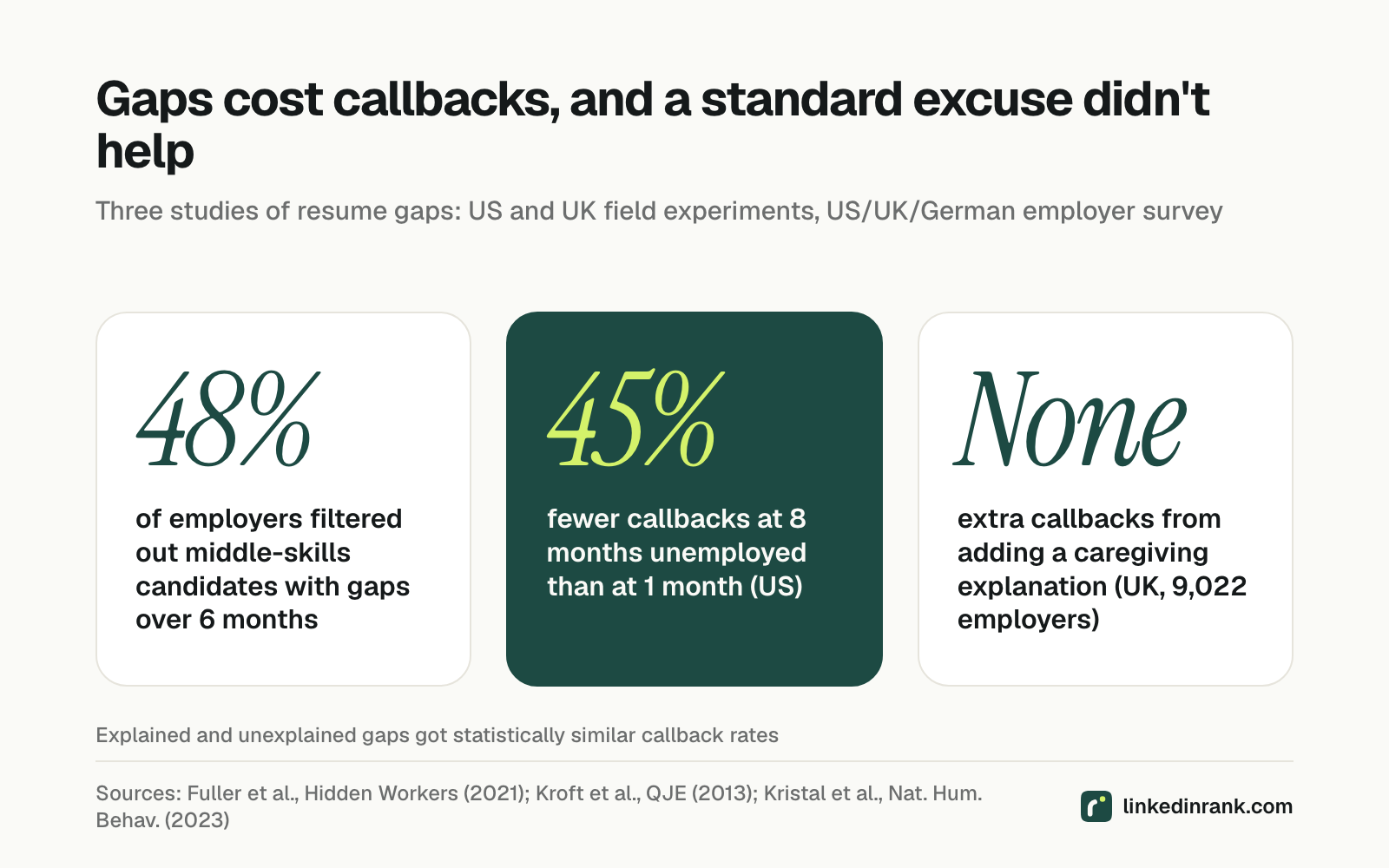
The explanation made no measurable difference. The researchers found "no empirical support" that it worked any better than saying nothing. A one-line reason does not fix a career gap. What changes an employer's mind is recent evidence that you can do the work.
What hiring managers say about career breaks
The standard advice is not made up. It comes from what hirers say when asked.
When LinkedIn launched its Career Break profile entry in March 2022, with 13 options including caregiving and health, it published survey results. According to LinkedIn, 51% of hirers said they were more likely to contact a candidate who provides context about their career break. And 52% of hiring managers believed candidates should bring the break up themselves in the interview. LinkedIn described it only as a global survey and did not publish the sample size.
So there is a real gap, but it is between two sets of evidence. Asked in a survey, hirers say context helps. Tested with real vacancies, a standard explanation got the same response as silence. This is common in hiring research: what people say they value and what they do when screening 200 applications are often different things.
The survey answers are still useful. They tell you what to do in a conversation, once you have one. They are a weak guide to what gets you the conversation.
Try it on your profile
The free LinkedIn About Section Generator applies this in a minute.
How much a resume gap actually costs
Gaps do cost something, and the cost is front-loaded.
In a US study published in the Quarterly Journal of Economics in 2013, Kory Kroft, Fabian Lange and Matthew Notowidigdo sent about 12,000 fictitious resumes to about 3,000 job postings in the 100 largest US metro areas, mostly sales, customer service and admin roles. They randomly varied how long each applicant had been unemployed, from one to 36 months.
Callbacks fell steeply at first. At eight months out of work, applicants got about 45% fewer callbacks than at one month, a drop from roughly 7% to 4%. After eight months, extra months made little further difference.
One detail from the study's design is worth knowing. Before building their fake applicants, the researchers read about 1,200 real resumes from job boards. Among people who were currently unemployed, roughly 95% gave no explanation at all for the gap: no course, no volunteering, no training. Most job seekers say nothing, so the experiment measured the gap as employers usually meet it, bare.
Some employers do not even look. The Hidden Workers report from Harvard Business School and Accenture surveyed 2,275 executives in the US, UK and Germany in 2021. It found 48% of employers filtered middle-skills candidates based on employment gaps of more than six months. In those systems, a recruiter never sees the resume at all.
Why an explanation alone doesn't work
To see why a sentence fails, think about what the employer is trying to infer.
Kroft and colleagues argue that employers use the length of unemployment as a signal of things they cannot see on paper, such as skill or motivation. A long gap invites the guess that others passed on this person. The researchers found the penalty was stronger when local job markets were tight, which fits that story. When jobs are plentiful, a long gap looks like a choice the market made about you.
A caregiving sentence does not answer that question. It explains why you left. It says nothing about whether you can do the job today.
A Swedish field experiment by Stefan Eriksson and Dan-Olof Rooth, in the American Economic Review in 2014, points to what does. Long spells of unemployment in the past did not affect whether applicants were invited to interview. A current spell of nine months or more did. The authors suggest later work experience erases the negative signal.
That is the useful finding. The gap that hurts is the one that is still open. The fix is to close it with something real and recent, not to describe it better.
The Kristal study found a second fix. When the resume listed each job with the number of years worked ("Software Engineer, 4 years") instead of start and end dates, callbacks rose by about 15% compared with the resumes showing a gap, with or without the explanation. They even beat the no-gap resume by about 8%. Making experience easy to see did more than any excuse.
The gap that hurts is the one that is still open. Close it with something recent, not with a better sentence.
How to explain a career gap on LinkedIn and your resume
Here is what the evidence suggests, in order of impact.
- Start something datable now. A freelance project, a part-time contract, a volunteer role with real responsibility, a course with a graded project you can show. Put it on your resume and LinkedIn with this month's date. It turns "out of work since 2025" into "working on X since November".
- Lead with experience, not dates. On your resume, consider a skills or experience summary at the top that states years of experience in plain numbers. Kristal's team found the years-based format raised callbacks. Many applicant tracking systems still expect dates, so keep dates in the job history and put the years summary above it.
- Use the LinkedIn Career Break entry, but fill it in. A blank break is a gap with a label. Add what you did: the certification you completed, the family business you helped run, the project you built. Our guide on how to add a career break on LinkedIn walks through the fields.
- Fix the headline if you are between jobs. "Seeking opportunities" tells a recruiter nothing they can search for. A headline that names your role and skills does. See what to put on LinkedIn when you're unemployed.
- In the interview, spend one sentence on why and three on now. Hiring managers in LinkedIn's survey said they want you to raise it. Say why briefly, then what you did, what you kept current, and why you are ready. LinkedIn also reported that 48% of hirers think the biggest mistake candidates make is undervaluing themselves on pay or seniority. Do not apologise your way into a lower offer.
- For freshers with a post-college gap. A year spent preparing for an entrance exam or a government job is common in India and easy to explain. What strengthens it is something you can show from that year: a project, an internship, tutoring work, a skill you can demonstrate in the interview.
What the data can't tell us
The Kristal study tested one explanation, caregiving, for one kind of applicant, a mother, in one country. A different reason, such as illness or a startup that failed, might be read differently, and that has not been tested at the same scale. The Kroft study covered US sales and admin roles more than a decade ago. None of these experiments ran in India, where campus hiring and exam-driven gaps change the picture. And LinkedIn's survey numbers come without a published method.
What the evidence does say clearly is this: the open gap costs more than the closed one, and recent proof does what a reason cannot.
Nobody hires a reason. They hire recent proof.
Sources
- Kristal, A. S., Nicks, L., Gloor, J. L., Hauser, O. P., "Reducing discrimination against job seekers with and without employment gaps", Nature Human Behaviour 7, 2023. https://pmc.ncbi.nlm.nih.gov/articles/PMC7614241/
- LinkedIn Corporate Communications, "A new way to represent career breaks on LinkedIn", 2022. https://news.linkedin.com/2022/march/new-way-to-represent-career-br…
- Kroft, K., Lange, F., Notowidigdo, M. J., "Duration Dependence and Labor Market Conditions: Evidence from a Field Experiment", Quarterly Journal of Economics 128(3), 2013 (NBER Working Paper 18387). https://www.nber.org/papers/w18387
- Fuller, J. B., Raman, M., Sage-Gavin, E., Hines, K., "Hidden Workers: Untapped Talent", Harvard Business School Project on Managing the Future of Work and Accenture, 2021. https://www.hbs.edu/managing-the-future-of-work/research/Pages/hidd…
- Eriksson, S., Rooth, D.-O., "Do Employers Use Unemployment as a Sorting Criterion When Hiring? Evidence from a Field Experiment", American Economic Review 104(3), 2014. https://ideas.repec.org/a/aea/aecrev/v104y2014i3p1014-39.html
Questions people ask
What should I write in my LinkedIn About section?
Open with a hook, follow with your professional background, key achievements with numbers, core skills, and a clear call-to-action. Write in first person and focus on the value you bring.
How long should a LinkedIn summary be?
Ideal is 150-300 words. LinkedIn truncates after ~300 characters with "see more", so your opening must be compelling enough to earn the click.
Should I write in first or third person?
Write in first person ("I"). It feels more personal, authentic, and approachable. Third person sounds overly formal on LinkedIn.
How do I start my LinkedIn About section?
Never start with "I am a [title]". Open with a hook: a surprising insight, bold statement, question, or specific achievement.
Written by Bhavishya Singla
Founder of LinkedInRank. Writes about how recruiters search LinkedIn and what makes a profile show up.
Add LinkedInRank as a preferred source on Google
See our new LinkedIn guides first in Google results.