In short
Should you use Open to Work on LinkedIn? What LinkedIn has measured, what recruiters only claim, and the one study that tracked outcomes in two markets.
On this page
- The green ring's meaning depends on the market
- What LinkedIn has measured about Open to Work
- Is Open to Work a red flag? What recruiters say
- The only outcome data: a tale of two job markets
- Open to Work settings: recruiters only vs the public frame
- What this means for you
- What the evidence can't tell us
- Sources
- Questions people ask
The green ring's meaning depends on the market
If you wanted to know whether LinkedIn's green Open to Work ring helps or hurts, you would want someone to check thousands of profiles twice: once when jobs are easy to find and once when they are not, and compare how the people wearing the ring actually performed. Someone did.
In early 2021, and again in early 2023, the interview platform interviewing.io looked up the LinkedIn profiles of more than ten thousand engineers who had interviewed through it. In 2021, a hiring boom, those showing Open to Work passed their interviews less often than average. In 2023, after a wave of tech layoffs, they passed more often than average.
That flip is the most useful fact in the whole debate. The ring is not a fixed signal of desperation, or of talent. It gets read against the market. Which means the loudest arguments about it, on both sides, are mostly opinion, and you can decide more calmly than the debate suggests.
What LinkedIn has measured about Open to Work
LinkedIn rolled out the #OpenToWork photo frame in June 2020. In October that year, it said more than three million members had tried it, and that they were "receiving, on average, 40% more InMails from recruiters" and were "20% more likely to receive messages from the broader LinkedIn community".
In 2024, LinkedIn gave Fortune newer figures. About 200 million professionals had switched Open to Work on behind the scenes, visible to recruiters but not to ordinary users, while about 40 million showed it publicly. Members using the frame, it said, were "on average, 40% more likely to receive InMails from recruiters".
The scale changed too. In 2020, LinkedIn counted 3 million members who had tried the frame; in 2024, about 40 million showed Open to Work publicly. The two numbers measure slightly different things, but the direction is clear. A ring worn by tens of millions of people can't single anyone out on its own, for better or worse.
Read the two 40% statements closely and you'll notice they are not the same claim. "40% more InMails" counts messages. "40% more likely to receive InMails" counts people. LinkedIn hasn't published the method behind either, and neither says anything about interviews or offers. What LinkedIn has measured is attention. That is worth something. It is not the same as being hired.
Try it on your profile
The free LinkedIn Profile Photo Ring Creator applies this in a minute.
Is Open to Work a red flag? What recruiters say
The case against the ring comes mostly from recruiters and career coaches, and it should be labelled as what it is: opinion. In the same Fortune piece, one career consultant said it "can look desperate, amateurish, and recruiters won't bite". Another recruiter quoted there argued the banner "can be what sets a candidate apart".
In 2023, ERE reported an informal LinkedIn poll by Hung Lee of the Recruiting Brainfood newsletter. Of nearly 3,000 responses, about 70% called the banner good and 7% bad. A poll of people who follow a recruiting newsletter is not science, as ERE itself noted.
The stigma argument does have respectable logic behind it. Economists call it negative selection: if the people openly looking are, on average, the ones employers chose not to keep, then "openly looking" becomes a weak signal of lower quality. Field experiments show employers do read time out of work this way: one US study found callbacks fell sharply as an applicant's unemployment spell grew. The real question is whether the ring triggers that reading, and when.
The only outcome data: a tale of two job markets
This is where the interviewing.io study by Aline Lerner and Maxim Massenkoff earns its place. First published in TechCrunch in April 2023, it compared engineers' interview pass rates on the platform with whether their LinkedIn profiles showed Open to Work.
Two things changed between the two checks. First, the ring became far more common: among the 10,000-plus people they had LinkedIn data for, 1.4% showed it in 2021 and 4.2% in the first quarter of 2023. Second, its meaning flipped.
On average, about 51% of candidates passed their interviews. In 2021, engineers showing Open to Work passed at 44%, 7 points below average. In 2023, they passed at 56%, 5 points above. The authors call the difference "highly statistically significant", and report the same result when they left out anyone who had worked at a FAANG company.
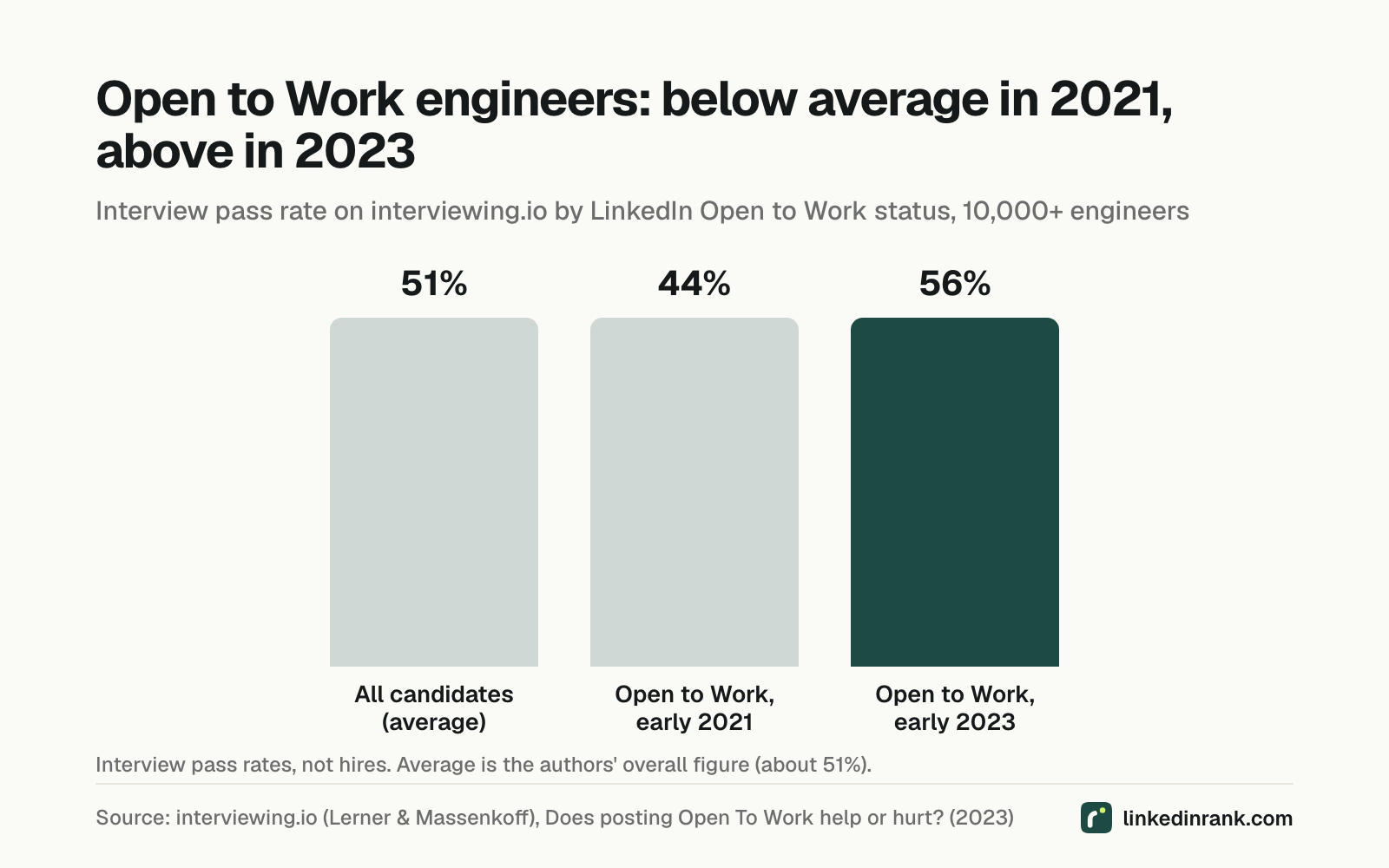
Their explanation is negative selection, applied to timing. In a boom, people still looking may be looking for a reason. In a downturn, layoffs hit strong people too, and openly looking becomes normal. Even so, the authors stopped short of recommending the ring, citing "the potential residual bias associated with that tag".
Keep the limits in view. This is engineers on one platform, and the outcome is interview pass rates there, not hires. The ring didn't make anyone better or worse at interviews. It showed who was looking, and that group changed with the market.
Open to Work settings: recruiters only vs the public frame
There are two settings, and the argument is almost entirely about one of them. LinkedIn's help page describes them:
- All LinkedIn members: visible to everyone, which "includes recruiters and people at your current company", and adds the #OpenToWork photo frame.
- Recruiters only: visible to "people using LinkedIn Recruiter only". LinkedIn says it takes steps to stop Recruiter users at your current company seeing it, "but we can't guarantee complete privacy".
LinkedIn's 40% figures are about the public frame. It hasn't published a comparable number for the recruiters-only setting. What recruiters-only does, by LinkedIn's own description, is tell the people who pay to search for candidates that you're available, without the public ring the stigma argument is about.
What this means for you
Given what is measured and what isn't, here is a reasonable way to decide.
- Turn on Open to Work in some form. Recruiters-only tells the people most likely to act on it. The public frame adds visibility to everyone, which is what LinkedIn's figures measure.
- If you're a student, fresher or recently laid off, the public ring carries little risk. Nobody expects a final-year student not to be looking, so the negative-selection worry barely applies. And in the one study with outcome data, engineers showing the ring in a weak market did better than average, not worse.
- If you're employed, use recruiters-only, and assume someone could still see it. LinkedIn says plainly that privacy isn't guaranteed.
- Fill in the preferences properly. Choose specific job titles and locations. Vague preferences tell a recruiter you exist, not what you're for.
- Consider a post as well as, or instead of, the ring. A short post saying what role you want, where, and what you have done gives your network something specific to pass on. LinkedIn told Fortune that 85% of job seekers who post about their search find support from their network. That is LinkedIn's own figure, with no method published, and "support" is not a job offer, but a specific ask is easier to help with than a green circle.
- Fix the profile before the frame. The ring sends attention to your profile. If your headline, experience and skills don't show what you can do, more attention only means more people leaving.
If you're still weighing the ring itself, our breakdown of the Open to Work ring's pros and cons goes further, and the free profile photo ring tool lets you preview a ring on your photo before you commit.
What the evidence can't tell us
Nobody outside LinkedIn has measured whether the ring changes who gets hired. LinkedIn's own numbers measure messages, not offers, and its methods are unpublished. The interviewing.io study is the best outcome data we found, and it covers engineers on one platform in two particular years. We found no data for India. The recruiter quotes are opinions, sometimes from people who sell job-search advice.
The ring doesn't say "I'm desperate" or "I'm talented". It says "I'm available". What a recruiter concludes from that depends on the rest of your profile, and on the market they are hiring in.
Sources
- LinkedIn Corporate Communications, "Helping jobseekers take their next step", 2020. https://news.linkedin.com/2020/october/helping-job-seekers-take-the…
- Orianna Rosa Royle, Fortune, "40 million people are using LinkedIn's #OpenToWork badge right now—but recruiters say it can look desperate", 2024. https://fortune.com/2024/09/05/linkedin-opentowork-badge-recruiters…
- Suzanne Lucas, ERE, "The debate over Open to Work", 2023. https://ere.net/articles/the-debate-over-open-to-work
- Kory Kroft, Fabian Lange, Matthew Notowidigdo, "Duration Dependence and Labor Market Conditions: Evidence from a Field Experiment", Quarterly Journal of Economics, 2013. Summary via J-PAL: https://www.povertyactionlab.org/evaluation/dependence-duration-and…
- Aline Lerner and Maxim Massenkoff, interviewing.io, "Does posting Open To Work on LinkedIn help or hurt? A tale of two labor markets", 2023 (first published in TechCrunch). https://interviewing.io/blog/whos-open-to-work-a-tale-of-two-labor-…
- LinkedIn Help, "Let recruiters know you're Open to Work", accessed 2026. https://www.linkedin.com/help/linkedin/answer/67405
Questions people ask
Does a ring on your LinkedIn photo increase views?
Yes. A colored ring makes your photo visually distinct. Profiles with distinctive photos get up to 14x more views.
What color ring should I use?
Choose a color that aligns with your brand. Blue and green convey trust, red and orange signal energy.
Are LinkedIn profile photo rings free?
Yes, our ring creator is completely free with no watermark or signup required.
Written by Bhavishya Singla
Founder of LinkedInRank. Writes about how recruiters search LinkedIn and what makes a profile show up.
Add LinkedInRank as a preferred source on Google
See our new LinkedIn guides first in Google results.