In short
People judge a face in 100 ms, but the photo matters more than the face. What research says about your LinkedIn profile photo, and who should pick it.
On this page
- It's not your face. It's which photo you chose.
- What the 100-millisecond study actually found
- Do snap judgements of faces predict anything?
- The twist: it's the photo, not the face
- Why you're the worst judge of your own LinkedIn profile photo
- What this means for your LinkedIn profile photo
- What the data can't tell us
- Sources
- Questions people ask
It's not your face. It's which photo you chose.
You are probably the worst person to choose your own LinkedIn photo.
That's a research finding, and a useful one. In 2017, psychologists David White, Clare Sutherland and Amy Burton collected 12 everyday photos each from 102 students' Facebook accounts. The students picked the ones they would use as profile pictures, including for a professional site like LinkedIn. Strangers then made their own picks from the same sets. When fresh viewers rated the chosen photos, the strangers' picks made better impressions.
Put that next to the most famous result in face research, that people judge a face within a tenth of a second, and the usual advice changes. The snap judgement is real. But it is largely a judgement of a photo, not of you, and photos of one person vary a lot. You can't change your face. You can change which version of it a recruiter sees, and you should get help choosing.
What the 100-millisecond study actually found
The tenth-of-a-second line comes from a 2006 paper in Psychological Science by Willis and Todorov of Princeton, "First impressions: making up your mind after a 100-ms exposure to a face". Across five experiments, each focused on one trait, people rated unfamiliar faces for attractiveness, likeability, trustworthiness, competence or aggressiveness, after seeing them for different lengths of time.
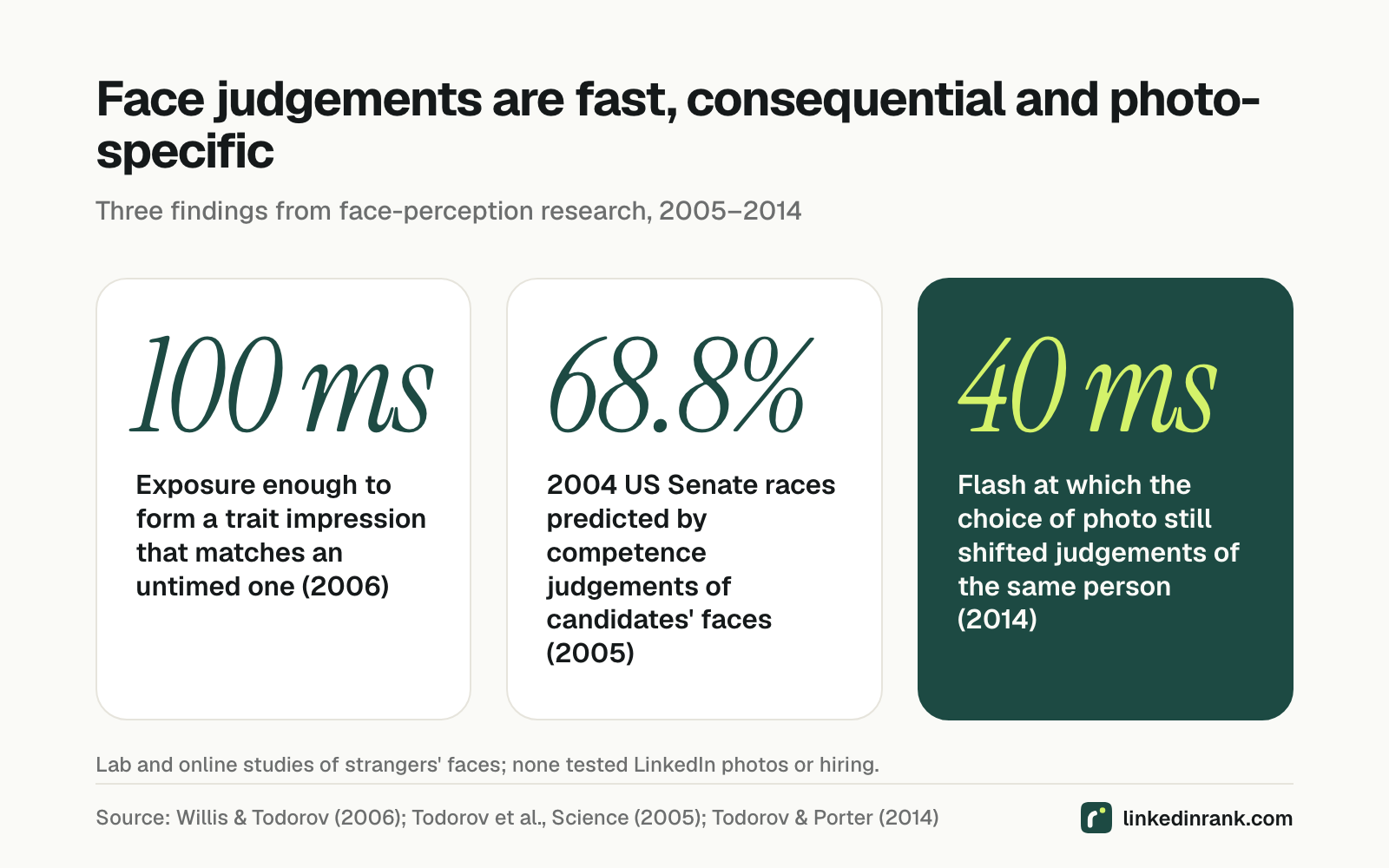
Judgements made after 100 milliseconds "correlated highly" with judgements made with no time limit, and more time did not significantly strengthen that link for any of the five traits. What extra time did was make people more confident. Between 100 and 500 ms, judgements also became more negative. And with more time, impressions became "more differentiated".
Think about what that means on LinkedIn. Your photo is rarely seen large. It appears as a small circle next to your name in search results, comments, messages and the "people you may know" list, usually for a moment, while the viewer's attention is on something else. That is close to the conditions in the lab: a brief look at an unfamiliar face. Whatever impression your photo gives, it gives it at thumbnail size and at speed, long before anyone opens your profile.
So the fast impression is real, stable and confidently held. None of that means it's accurate.
Try it on your profile
The free LinkedIn Profile Photo Ring Creator applies this in a minute.
Do snap judgements of faces predict anything?
The strongest evidence that face impressions matter comes from politics. In a 2005 paper in Science, Todorov and colleagues showed that judgements of competence based only on candidates' faces predicted the outcomes of US congressional elections better than chance, for example 68.8% of the 2004 Senate races. These judgements were linked to the margin of victory and could be made within a one-second look.
That is the steelman for "your photo really matters", and it's a serious one. Quick impressions of competence track real decisions.
But tracking decisions is not the same as being right. In 2010, Christopher Olivola and Todorov tested how well people infer real characteristics of others from photos, using more than a million judgements from a popular website and an online experiment with over a thousand participants. People were generally less accurate than they would have been if they had ignored the faces and relied on simple base rates. Their conclusion: "appearances are overweighed in judgments".
So people do judge you from a photo, quickly; those judgements can shape choices; and they are often wrong. That combination is exactly why your photo is worth getting right.
The twist: it's the photo, not the face
The most useful paper for anyone choosing a profile picture is a 2014 study in Psychological Science by Todorov and Jenny Porter, "Misleading first impressions: different for different facial images of the same person". Almost all earlier research, they noted, used one photo per person and treated differences in ratings as differences between people.
They used several ordinary photos of each person instead. For a range of traits, the variation between photos of the same individual was "comparable to or exceeding" the variation between different individuals. For almost any two people, which one looked more competent depended on which photos were compared.
In a second experiment, people picked one of five photos of each person for different purposes, including applying for a high-salary consulting job with a photo on the resume. Choices for the consulting job were best predicted by how competent, intelligent and trustworthy each photo had been rated; choices for online dating followed a different pattern. In later experiments, the effect of which photo was chosen showed up even when images were flashed for 40 milliseconds.
That is what the "tenth of a second" posts leave out. The judgement is fast, but it is a judgement of an image, and images of the same face can tell different stories.
Why you're the worst judge of your own LinkedIn profile photo
Back to White, Sutherland and Burton, published in Cognitive Research: Principles and Implications. Their participants chose photos for Facebook, dating sites and professional networking sites such as LinkedIn. The choices did fit the context: photos picked for professional sites raised competence ratings more than those picked for Facebook or dating. But across two large online studies, which recruited 610 viewers, photos chosen by strangers created more favourable impressions than the photos people chose for themselves.
The authors' practical advice is unusually direct. If people want to put their best face forward, "they should ask someone else to choose it".
There is also a recruiter-specific hint, from a weaker source. In TheLadders' 2012 eye-tracking study of 30 recruiters, recruiters looking at LinkedIn profiles spent 19% of their viewing time fixated on the profile picture. That was a vendor study, on LinkedIn's old layout, by a company promoting its own profile format. Still, it suggests the photo gets real attention.
You can't choose the face a recruiter sees. You can choose which tenth of a second of it they get.
What this means for your LinkedIn profile photo
- Take many photos, not one. One session, 15 to 20 shots: plain background, face filling most of the frame, camera at eye level, a range of expressions from neutral to a natural smile. A phone by a window in daylight is enough.
- Let near-strangers choose. Shortlist your best five. Show them to three to five people who don't know you well, and ask one specific question: "Which of these people would you trust to do a good job at work?" Use the photo most people pick.
- Judge at thumbnail size. Before you decide, shrink each shortlisted photo to the size of a coin on your phone screen. If your face isn't clear at that size, the impression people form will be of the background, the lighting or the crop.
- Choose for the context. Photo preferences shift with purpose. The picture your friends love on Instagram is answering a different question.
- Don't chase attractiveness. In a field experiment in Israel, Bradley Ruffle and Ze'ev Shtudiner (Management Science, 2015) sent 5,312 CVs to 2,656 job openings. Attractive men got significantly more callbacks than plain-looking men or men with no photo. But women with no photo got more callbacks than attractive or plain-looking women. Looks can cut both ways. Aim for competent and approachable, not striking.
- Then stop worrying about it. Willis and Todorov found impressions become more differentiated with more time and information. A clear headline and a specific experience section give a recruiter that information. The photo opens the door; it doesn't run the interview.
Our LinkedIn profile photo guide covers lighting, crop and background in detail, and our LinkedIn profile photo tips list quick fixes for the most common problems.
What the data can't tell us
None of these studies tested LinkedIn photos against hiring outcomes. The face studies used lab and online samples rating strangers, often students. The CV-photo experiment was run in Israel more than a decade ago, and attitudes to photos on CVs differ between countries. We couldn't trace the widely shared claim that profiles with photos get "21 times more views" to a current LinkedIn source, so we haven't used it. And the evidence that snap judgements are often wrong is a reason for recruiters to be careful, not a promise that they will be.
What the research does support is modest and practical: impressions form fast, they depend on the specific image, and you are not the best judge of which image works.
Pick the photo the way a stranger would, because a stranger is who will see it first.
Sources
- David White, Clare A. M. Sutherland, Amy L. Burton, "Choosing face: The curse of self in profile image selection", Cognitive Research: Principles and Implications, 2017. https://pmc.ncbi.nlm.nih.gov/articles/PMC5391387/
- J. Willis and Alexander Todorov, "First impressions: Making up your mind after a 100-ms exposure to a face", Psychological Science, 2006. https://pubmed.ncbi.nlm.nih.gov/16866745/
- Alexander Todorov, A. N. Mandisodza, A. Goren, C. C. Hall, "Inferences of competence from faces predict election outcomes", Science, 2005. https://pubmed.ncbi.nlm.nih.gov/15947187/
- Christopher Y. Olivola and Alexander Todorov, "Fooled by first impressions? Reexamining the diagnostic value of appearance-based inferences", Journal of Experimental Social Psychology, 2010. https://bpb-us-w2.wpmucdn.com/voices.uchicago.edu/dist/f/3051/files…
- Alexander Todorov and Jenny M. Porter, "Misleading first impressions: Different for different facial images of the same person", Psychological Science, 2014. https://bpb-us-w2.wpmucdn.com/voices.uchicago.edu/dist/f/3051/files…
- Will Evans / TheLadders, "Keeping an eye on recruiter behavior" (eye-tracking study summary), 2012. Archived copy: https://web.archive.org/web/20190121041657/https://cdn.theladders.n…
- Bradley J. Ruffle and Ze'ev Shtudiner, "Are Good-Looking People More Employable?", Management Science, 2015. https://econpapers.repec.org/RePEc:inm:ormnsc:v:61:y:2015:i:8:p:176…
- Ben-Gurion University of the Negev via EurekAlert, news release on the CV-photo study (location: Israel), 2010. https://www.eurekalert.org/news-releases/910019
Questions people ask
Does a ring on your LinkedIn photo increase views?
Yes. A colored ring makes your photo visually distinct. Profiles with distinctive photos get up to 14x more views.
What color ring should I use?
Choose a color that aligns with your brand. Blue and green convey trust, red and orange signal energy.
Are LinkedIn profile photo rings free?
Yes, our ring creator is completely free with no watermark or signup required.
Written by Bhavishya Singla
Founder of LinkedInRank. Writes about how recruiters search LinkedIn and what makes a profile show up.
Add LinkedInRank as a preferred source on Google
See our new LinkedIn guides first in Google results.