In short
Fake candidates and deepfake interviews are pushing employers to verify everyone. Why that helps honest freshers, and how to be easy to trust.
On this page
When anyone can fake a candidate, being real wins
In July 2024, KnowBe4, a company that trains other firms' employees to spot cyber attacks, published an unusual confession. It had hired a software engineer who turned out to be a North Korean operative.
The company had done everything a careful employer does. "Our HR team conducted four video conference based interviews on separate occasions," its CEO, Stu Sjouwerman, wrote. A background check and the standard pre-hiring checks came back clear. The applicant was using "a valid but stolen US-based identity", and the profile photo was "an AI fake that started out with stock photography." The moment the company's laptop arrived, it began loading malware. KnowBe4 caught it, and says no data was lost (KnowBe4).
If a security company can be fooled through four interviews, the old model of hiring is in trouble. For decades, hiring ran on trust by default: employers assumed the person on the call was the person on the resume, and checked only the claims. That assumption is ending. For honest candidates, especially freshers with thin records, this is not a threat. It is an opening. The candidates who are easiest to verify will be the easiest to hire.
How common are fake candidates?
The honest answer is that nobody measures it well yet. What exists is a set of warnings, court cases and forecasts that all point the same way.
The FBI was early. In June 2022 its Internet Crime Complaint Center warned of "an increase in complaints reporting the use of deepfakes and stolen Personally Identifiable Information" to apply for remote jobs, mostly in IT, programming and software (FBI IC3 PSA). Interviewers reported lip movements that did not match the audio, and coughs or sneezes that did not line up with the video.
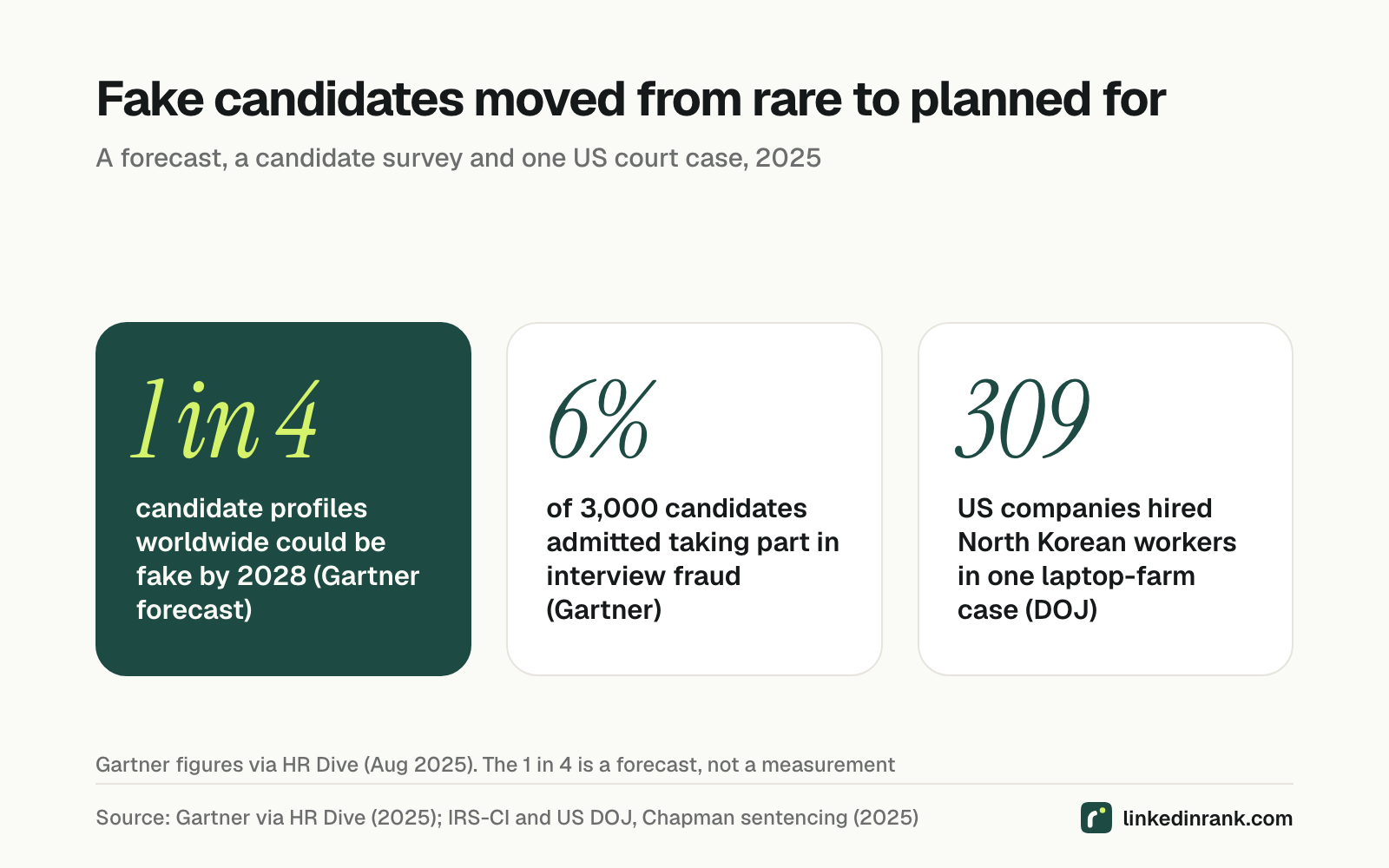
Then came the prosecutions. In July 2025, an Arizona woman, Christina Chapman, was sentenced to 102 months in prison for running a "laptop farm": she hosted company laptops at her home so North Korean IT workers could appear to be working from the US. According to the case release, she helped them get jobs at 309 US companies, using 68 identities stolen from Americans, and generated more than $17 million for herself and North Korea (IRS Criminal Investigation and DOJ).
A month earlier, the US Justice Department had announced searches of 29 suspected laptop farms across 16 states, in schemes where North Korean workers had obtained jobs at more than 100 US companies (DOJ, June 2025). In October 2026 it announced another round: more than 40 homes searched in Texas, about 187 devices seized, and more than 70 US employers affected (DOJ, October 2026).
And then the forecast that made headlines. Gartner, the research firm, predicts that by 2028, "1 in 4 candidate profiles worldwide could be fake", as reported by HR Dive in August 2025. In a Gartner survey of 3,000 job candidates, 6% admitted to taking part in interview fraud.
Try it on your profile
The free LinkedIn Profile Keyword Analyzer applies this in a minute.
Deepfake job interviews change who carries the burden
The striking thing about these cases is not the technology. It is what they did to the employer's default assumption.
Greenhouse, a hiring-software company, surveyed 665 US recruiters and hiring managers in 2025. 74% said they were more concerned than a year earlier about fake credentials, deepfakes or misrepresented experience, and 39% said they were running more in-person interviews to check that candidates are genuine (Greenhouse, vendor survey).
Put simply, the burden of proof is moving. Employers used to verify what you claimed. Increasingly they will verify who you are first. Camera-on rules, ID checks at the start of an interview, an in-person round, a call to a reference on a phone number they found themselves: these are becoming normal, not insulting.
Here is the part most coverage misses. Real candidates seem to want this. In a separate Gartner survey reported by HR Dive, 62% of candidates said they were more likely to apply to a position if it required in-person interviews. That makes sense. Fraud is a tax on everyone honest: it slows every process down and makes every unfamiliar name look suspicious.
In a market full of fakes, the scarcest thing a candidate can offer is being easy to check.
The other side: job scams targeting Indian job seekers
Trust is breaking in both directions, and in India the bigger daily risk is to job seekers, not employers.
In December 2023, the Ministry of Home Affairs said its Indian Cybercrime Coordination Centre had identified over 100 websites involved in "task based - part time job frauds", which were then blocked (PIB). The pattern it described is now familiar: ads for "Ghar baithe job", a WhatsApp or Telegram contact, small paid tasks like liking videos or rating places on maps, a little commission at first, then a request to invest more, and then frozen deposits. The release said the targets were mostly "retired employees, women and unemployed youth looking for part time jobs."
The stakes can be far higher than money. In March 2025, India repatriated 549 citizens from cybercrime centres along the Myanmar-Thailand border, people "who were lured with fake job offers", and the Ministry of External Affairs again advised Indians "to verify credentials of foreign employers" (The Week, PTI).
So verification is not just something done to you. It is something you owe yourself. Gartner found that only half of candidates believed the jobs they were applying for were legitimate. That suspicion is reasonable. Our guide on whether LinkedIn is a safe platform covers how to check a recruiter before you share anything.
What this means for you: make yourself easy to verify
- Make every record tell the same story. Same name spelling, same dates, same job titles across your resume, LinkedIn, GitHub and college records. Inconsistency used to look careless. Now it looks like fraud. Our list of red flags on LinkedIn shows what recruiters notice.
- Use a real, recent photo. The KnowBe4 applicant used an AI-altered stock image. A plain, current photo of you is now a trust signal, not just a formality.
- Verify your profile. In 2023, LinkedIn launched free ID verification in India for members with an Aadhaar number and an Indian phone number, run by a third party, HyperVerge (Business Today). Check the current options in the app before you start.
- Build a footprint with history. A GitHub account with commits spread over months, a project write-up from last year, a professor or internship manager who can take a phone call. Fakes are usually new. Time is hard to forge.
- Treat checks as a chance, not an insult. Keep your camera on, have your ID ready, say yes to an in-person round. Being relaxed about verification reads as confidence.
- Check them back. Never pay to get a job. TCS's own 2026 recruitment notice says it "does NOT ask candidates to deposit any money at any stage of recruitment." Confirm offers on the company's official careers site, and report fraud at cybercrime.gov.in or on the 1930 helpline.
What the data can't tell us
There is no reliable count of fake candidates. Gartner's "1 in 4" is a forecast, not a measurement, and its survey figures reached us through a trade publication. The North Korean cases are documented in court, but they are a specific, state-run operation in mostly US tech jobs, and say little about a typical campus drive in India. The Greenhouse survey is from a vendor. And there is no published India-wide count of job-scam complaints in the official releases we found. What is solid is the direction: both employers and job seekers are being taught, the hard way, to verify first.
For a long time, being a fresher meant asking employers to take a chance on you. In a hiring market learning to distrust, the better pitch is different: you do not have to take a chance on me, you can check.
Sources
- KnowBe4, Stu Sjouwerman, "How a North Korean Fake IT Worker Tried to Infiltrate Us", 2024. https://blog.knowbe4.com/how-a-north-korean-fake-it-worker-tried-to…
- FBI Internet Crime Complaint Center, "Deepfakes and Stolen PII Utilized to Apply for Remote Work Positions" (PSA I-062822-PSA), 2022. https://www.ic3.gov/PSA/2022/PSA220628
- IRS Criminal Investigation (with US Department of Justice), "Arizona woman sentenced for $17M information technology worker fraud scheme that generated revenue for North Korea", 2025. https://www.irs.gov/compliance/criminal-investigation/arizona-woman…
- US Department of Justice, "Justice Department Announces Coordinated, Nationwide Actions to Combat North Korean Remote Information Technology Workers' Illicit Revenue Generation Schemes", 2025. https://www.justice.gov/opa/pr/justice-department-announces-coordin…
- US Department of Justice, "Justice Department Announces Coordinated Actions to Combat North Korean Remote IT Worker Schemes", 2026. https://justice.gov/opa/pr/justice-department-announces-coordinated…
- HR Dive, Carolyn Crist, "Fake job candidates and AI" (reporting Gartner, 31 July 2025), 2025. https://www.hrdive.com/news/fake-job-candidates-ai/757126/
- Greenhouse, "An AI trust crisis: 70% of hiring managers trust AI to make faster and better hiring decisions, only 8% of job seekers call it fair" (vendor survey), 2025. https://www.greenhouse.com/newsroom/an-ai-trust-crisis-70-of-hiring…
- Press Information Bureau, Ministry of Home Affairs, release on blocking over 100 task-based part-time job fraud websites, 2023. https://www.pib.gov.in/PressReleasePage.aspx?PRID=1982936
- The Week (PTI), "Almost 550 Indian nationals rescued from scam centres near Myanmar-Thailand border", 2025. https://www.theweek.in/wire-updates/international/2025/03/12/fgn60-…
- RGUKT Training and Placement Office, "TCS All India NQT Hiring 2026" notice (reproducing tcs.com), 2026. https://hub.rgukt.ac.in/hub/notice/download/notice.upload_attach.b6…
- Business Today, "LinkedIn now allows Indian users to verify their identity on the platform", 2023. https://www.businesstoday.in/technology/story/linkedin-now-allows-i…
Questions people ask
How do I find the right keywords for my LinkedIn profile?
Start with the job title you want, then the skills and tools that appear in job posts for it. The LinkedIn Keyword Finder pulls them from real job posts; this analyzer checks how well your profile covers your field.
What is LinkedIn SEO?
LinkedIn SEO is optimizing your profile with keywords recruiters search for. The right keywords in the right sections make you appear higher in search results.
Where should I put keywords on LinkedIn?
Headline (highest weight), About section, experience descriptions, skills section, and job titles.
How many keywords should I have?
Aim for 15-25 relevant keywords spread across sections. Each section should have 3-5 naturally integrated.
Written by Bhavishya Singla
Founder of LinkedInRank. Writes about how recruiters search LinkedIn and what makes a profile show up.
Add LinkedInRank as a preferred source on Google
See our new LinkedIn guides first in Google results.