In short
Is an ATS rejecting qualified candidates like you? Employers in a Harvard study admit it. What the filters screen for, and how to stop being filtered out.
On this page
- Employers admit their filters reject qualified people
- What the Hidden Workers study found
- How ATS filters reject qualified candidates
- The job description is a wish-list, and employers know it
- Why an employment gap costs more than you think
- What this means for you: how to get past ATS filters
- What the data can't tell us
- Sources
- Questions people ask
Employers admit their filters reject qualified people
The most striking sentence in a 2021 Harvard Business School report is a confession, and the people confessing are employers.
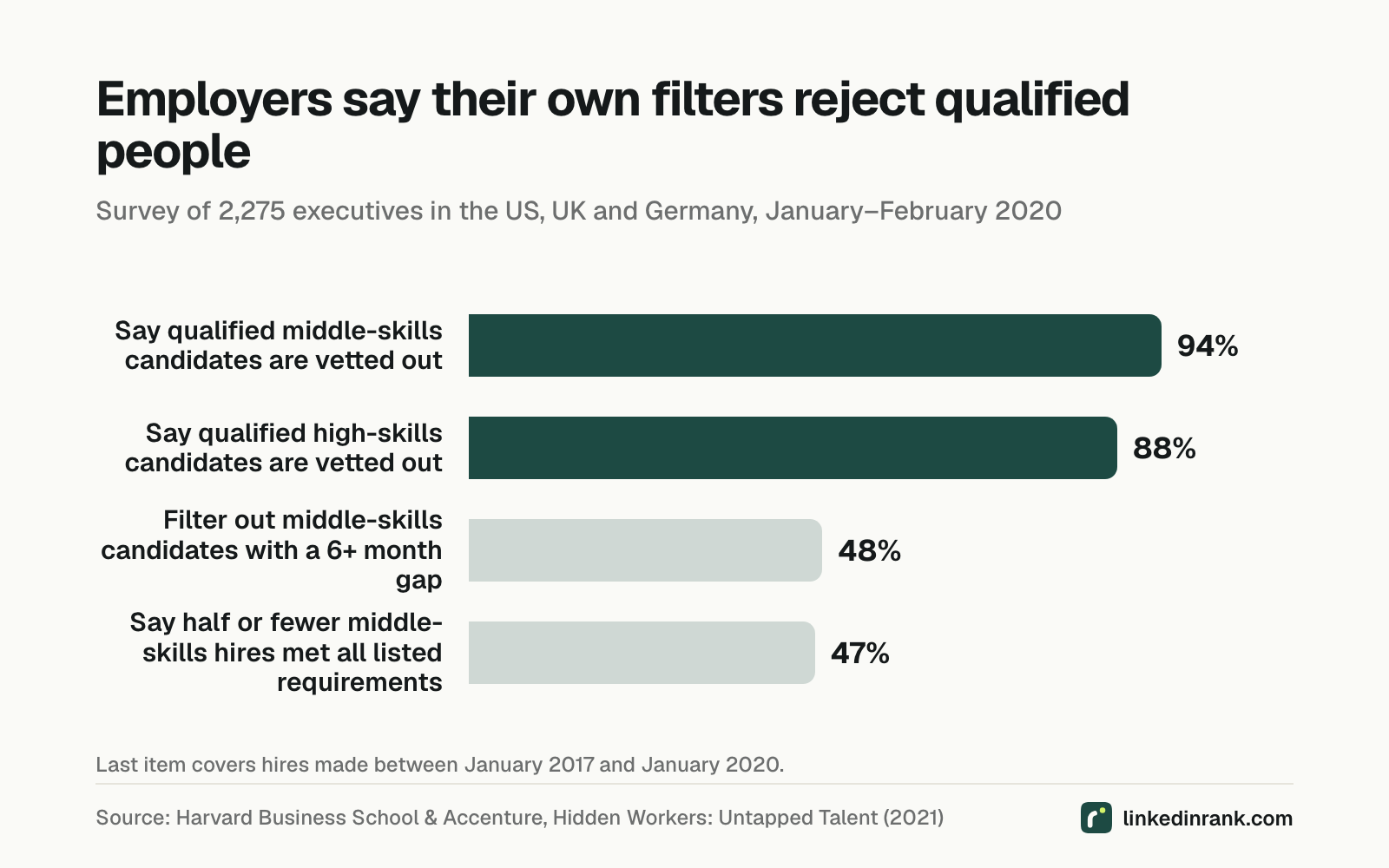
Researchers from Harvard Business School's Project on Managing the Future of Work and Accenture surveyed 2,275 executives in the US, the UK and Germany. A large majority, 88%, agreed that qualified high-skills candidates are "vetted out of the process because they do not match the exact criteria established by the job description". For middle-skills roles, the figure was 94%.
If you have sent 50 applications and heard nothing back, sit with that for a moment. Being rejected by a hiring system is weak evidence that you couldn't do the job. These systems filter for missing words, missing credentials and gaps in dates. The job descriptions they match against are wish-lists that, by employers' own account, many of the people they hire don't fully meet. The answer is not to stop applying for those jobs. It is to apply in a form a literal-minded filter can read.
What the Hidden Workers study found
The report, "Hidden Workers: Untapped Talent" by Joseph Fuller, Manjari Raman, Eva Sage-Gavin and Kristen Hines (September 2021), set out to explain a paradox: employers complaining that they cannot find talent while millions of people who want work can't get hired.
Alongside the executives, it surveyed 8,720 workers across the same three countries. It defines hidden workers as people who want a job, or more hours, but keep getting screened out: part-time workers who want full-time work, the long-term unemployed, and people outside the workforce who would work under the right circumstances. Its model, built on March 2020 data, estimates more than 27 million hidden workers in the US alone.
The authors list who they are: caregivers, veterans, immigrants and refugees, people with disabilities, people previously incarcerated, and "those without traditional qualifications". Many freshers will recognise themselves in that last group.
Try it on your profile
The free LinkedIn Profile Keyword Analyzer applies this in a minute.
How ATS filters reject qualified candidates
The report puts much of the blame on software. Applicant tracking systems (ATS) and recruiting management systems (RMS), it says, "are designed to maximize the efficiency of the process", not to widen the pool of people considered.
Use is widespread. In the survey, 63% of employers across the three countries used an RMS, rising to 75% in the US. More than 90% of employers used their system to initially filter or rank candidates: 94% for middle-skills roles and 92% for high-skills ones.
The filters work largely by exclusion. The report calls these "negative" criteria: a candidate is dropped for lacking something, such as a degree, or for having something, such as a gap. Its sharpest example is the gap. Almost half the companies surveyed screened out resumes showing more than six months without work, and 48% filtered middle-skills candidates this way. "A recruiter will never see that candidate's application, even though it might fill all of the employer's requirements," the report says.
The filter can't ask why. A gap for illness, for caring for a parent, for a start-up that didn't work out or for exam preparation looks exactly like a gap for no reason.
The job description is a wish-list, and employers know it
The second problem is what the software matches against. The report found that 72% of employers, when creating a new posting for a middle-skills job, reused an existing posting or modified it only slightly. Over time, the authors write, requirements "come to resemble the rings on a tree trunk": new ones are added on top of everything accumulated before.
Then comes the most useful finding for anyone who skips jobs because they don't tick every box. Looking back at hiring between January 2017 and January 2020, 47% of business leaders said only half or fewer of their middle-skills hires met all the requirements in their own job postings. For high-skills roles, only 21% of employers said all their hires met every listed requirement.
In plain terms, the posting often describes an imaginary candidate. Many of the people who actually get hired don't match it either. They got past the filter, or around it.
The workers' side of the survey shows what that feels like from outside. Only 20% of the hidden workers surveyed said they had ever made it from applicant to candidate, and their success rate in getting a full-time offer hovered around 7%. Asked what employers could change, they put clarity first: 71% said aligning the job title with the actual tasks would help, 64% said limiting the skills requirements to the essentials, 62% said cutting jargon, and 61% said limiting academic requirements to what the job really needs.
Notice that none of those requests is "lower the bar". They are requests to say what the bar actually is. Until employers do that, part of your job as an applicant is to work it out for them: read the posting for the few requirements that really matter, and make sure those are impossible to miss on your resume.
Why an employment gap costs more than you think
The six-month rule has independent support. In a field experiment published in the Quarterly Journal of Economics in 2013, Kory Kroft, Fabian Lange and Matthew Notowidigdo sent 12,054 fictitious resumes to 3,040 job openings in 100 US cities, randomly varying how long each applicant had been out of work. At eight months of unemployment, callbacks were about 45% lower than at one month, falling from roughly 7% to 4%. The penalty was stronger in tighter job markets, where employers seemed to read a gap as more telling about the person.
The case for employers is real. With 500 applicants for one role, a "no gaps" rule is cheap, and recent experience is a reasonable guess at current skill. The trouble is that a guess hardens into a gate, and nobody counts how many capable people it keeps out.
What this means for you: how to get past ATS filters
You can't change how an employer sets up its software. You can make sure it doesn't reject you for reasons that have nothing to do with ability.
- Use the job post's exact words. Filters read literally. If the post says "Microsoft Excel" and "stakeholder management" and your resume says "spreadsheets" and "working with teams", you may not match. Our guide to ATS resume keywords shows how to find and place them without stuffing.
- Write credentials in full and short form. "Bachelor of Technology (BTech), Computer Science" matches more searches than "BTech CSE". Do the same for certifications and tools.
- Leave no unexplained hole in your dates. If you have a gap of more than six months, give it an honest, dated entry: "Career break: caring for a family member", "Full-time preparation for [exam name]", "Independent project: built and published [what]". A labelled period reads better, to software and to people, than a missing one.
- Apply when you meet the core, not every line. Split the post into must-haves (often the degree field, one or two tools, location) and nice-to-haves. Employers' own answers above say many hires miss some listed requirements. Our guide to tailoring your resume to a job description walks through that sort.
- Open a second door that starts with a person. A referral, a short message to the hiring manager, or an alumni contact puts a human in front of your profile before the software decides. It doesn't replace a proper application. It means the filter is not your only route in.
What the data can't tell us
The surveys were run in 2020 in the US, UK and Germany. They don't cover India, where campus hiring, online tests and job portals work differently, and we found no comparable Indian study. The 88% and 94% figures are executives' beliefs about their own systems, not audits of rejected applications. The 27 million figure is a model estimate. The callback experiment used US resumes from more than a decade ago.
Still, when the people who run the filters tell researchers the filters reject qualified people, it is reasonable to take them at their word.
A filter can't see that you are capable. It can only see whether you match. Make sure you match, so that a person gets the chance to see the rest.
Sources
- Joseph B. Fuller, Manjari Raman, Eva Sage-Gavin, Kristen Hines, Harvard Business School Project on Managing the Future of Work and Accenture, "Hidden Workers: Untapped Talent", 2021 (updated 4 October 2021). Archived copy of the HBS PDF: https://web.archive.org/web/20260621110325/https://www.hbs.edu/mana…
- Kory Kroft, Fabian Lange, Matthew J. Notowidigdo, "Duration Dependence and Labor Market Conditions: Evidence from a Field Experiment", The Quarterly Journal of Economics, 2013. Summary via J-PAL: https://www.povertyactionlab.org/evaluation/dependence-duration-and…
Questions people ask
How do I find the right keywords for my LinkedIn profile?
Start with the job title you want, then the skills and tools that appear in job posts for it. The LinkedIn Keyword Finder pulls them from real job posts; this analyzer checks how well your profile covers your field.
What is LinkedIn SEO?
LinkedIn SEO is optimizing your profile with keywords recruiters search for. The right keywords in the right sections make you appear higher in search results.
Where should I put keywords on LinkedIn?
Headline (highest weight), About section, experience descriptions, skills section, and job titles.
How many keywords should I have?
Aim for 15-25 relevant keywords spread across sections. Each section should have 3-5 naturally integrated.
Written by Bhavishya Singla
Founder of LinkedInRank. Writes about how recruiters search LinkedIn and what makes a profile show up.
Add LinkedInRank as a preferred source on Google
See our new LinkedIn guides first in Google results.