In short
Job referrals work because they carry information, not just favours. What the research shows, and how to earn a referral worth something.
On this page
A referral is only worth what the referrer knows
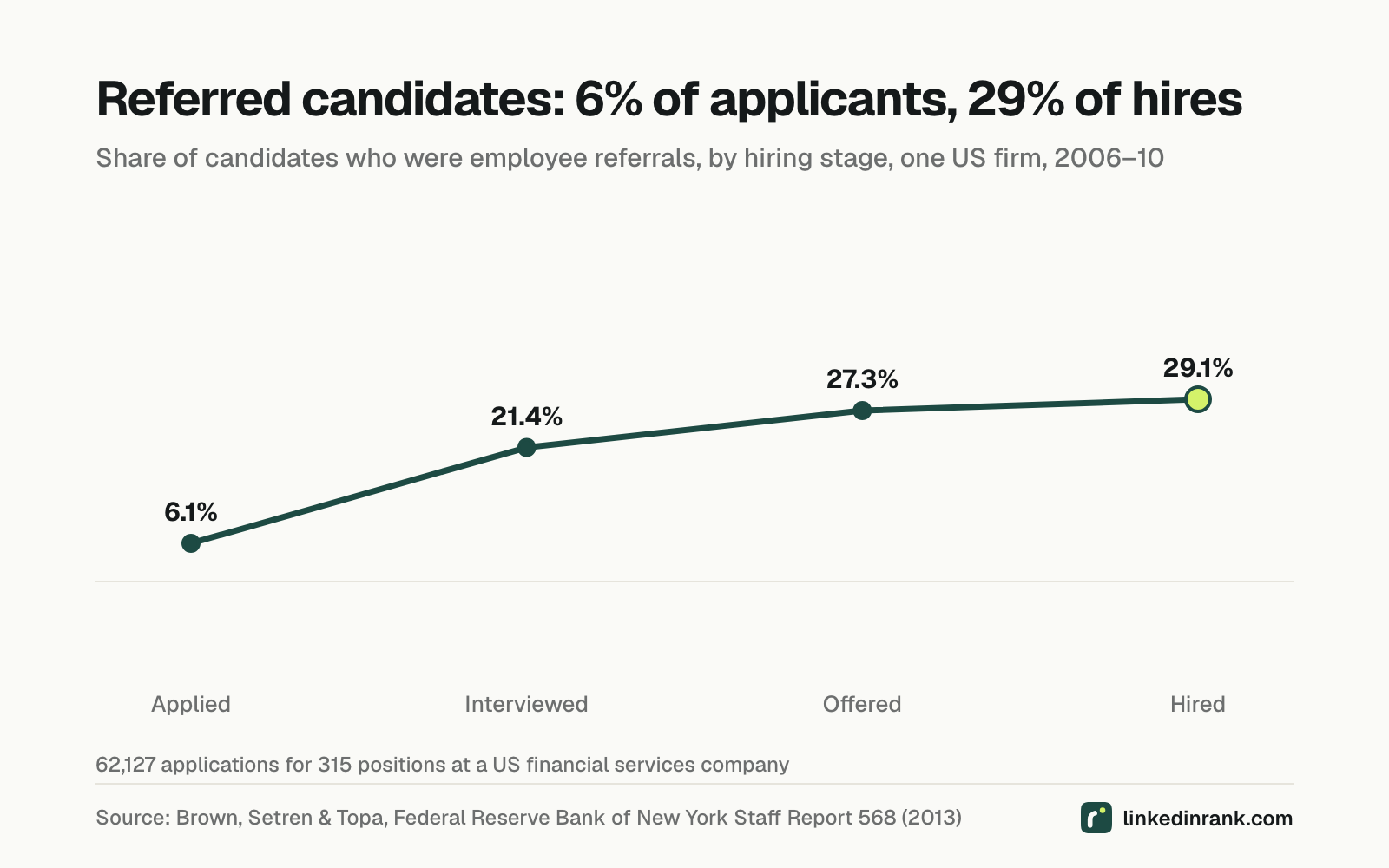
Between 2006 and 2010, a US financial services company with a few thousand employees kept unusually careful records. For 62,127 applications to 315 jobs, it logged how each candidate had found the opening: a job board, the company website, campus recruitment, or a referral from someone who already worked there. Then it tracked every candidate through interview, offer and hire.
Economists Meta Brown, Elizabeth Setren and Giorgio Topa of the Federal Reserve Bank of New York analysed the data. Referred candidates made up 6.1% of applicants. By the interview stage they were 21.4% of the pool. Among final hires, they were 29.1%.
The easy reading is "it's who you know". The more useful reading, and the one the evidence supports, is that a referral works because of what the referrer knows about you. Which means a referral from someone who has never seen your work is worth much less than you think.
Why referrals get hired more often
Start with what the common belief gets right. Referrals do help, a lot, and in data from many sources.
The New York Fed study found referred candidates were more likely to be hired. A larger study by Stephen Burks, Bo Cowgill, Mitchell Hoffman and Michael Housman, published in the Quarterly Journal of Economics in 2015, used personnel data from nine large firms in call centres, trucking and high-tech. Referred applicants were more likely to be hired and more likely to accept offers.
Vendor data points the same way. Ashby, a company that makes applicant tracking software, analysed more than 38 million applications to 93,000 jobs between 2021 and 2024 in its 2025 Talent Trends Report. It found that 40% of referred candidates moved from application to interview, against about 3% of inbound applicants. Older data from Lever, another applicant tracking vendor, reported by SHRM in 2016, put it as 1 in 16 referred candidates hired against 1 in 152 applicants.
One more number from Ashby is easy to miss. Internal candidates and candidates sent by recruitment agencies each moved to interview at 42%, about the same rate as referrals. These three channels have little in common on the surface. What they share is that someone who knows the candidate, the employer, or both has already done some checking before the resume arrives. The cold inbound application is the only route where nobody has.
So yes: if you can get a referral, your odds change. The question is why.
Try it on your profile
The free LinkedIn Connection Message Generator applies this in a minute.
Favouritism, or information?
There are two stories. In the first, referrals are a club. Employees push their friends, hiring managers do favours, and the people with the right relatives win. In the second, a referral is a piece of information that a resume cannot carry: someone who knows the job and knows you is saying "this person will fit".
The evidence leans hard toward the second. Burks and colleagues found referred and non-referred applicants had similar skill characteristics on paper. Yet the referred ones were hired more often and were substantially less likely to quit. On most productivity measures they performed about the same, but referred truckers had fewer accidents and referred high-tech workers produced more patents. In the two industries where profit per worker could be calculated, referrals were more profitable, mainly because they stayed longer and cost less to recruit.
If referrals were favours, you would expect referred workers to be weaker and to leave sooner. They were not. Something the referrer knew, and the resume did not show, predicted fit.
The New York Fed paper adds a revealing detail. Referred workers started on slightly higher pay, but the advantage faded over time, and they stayed longer at the firm. That is what you would expect if a referral is an early signal that the employer later confirms by watching you work.
None of this means referrals are fair. They reward people who already have networks: the student whose uncle works at the bank, the graduate whose college has a thick alumni list. That is a real cost, and it falls hardest on first-generation graduates and smaller colleges. But knowing why referrals work tells you how to get one that counts even without those advantages.
The cold referral problem
Here is the part most "how to get a referral" advice skips. If a referral works because it carries information, then a referral from someone who knows nothing about you carries almost none.
On LinkedIn, a common script goes like this: find an employee at the company, send a message saying "Please refer me for job ID 12345", attach a resume. Sometimes it works, because many companies pay a bonus for referred hires. The New York Fed study's employer paid between $500 and $4,000. So some employees refer almost anyone.
Recruiters learn this. A referral form submitted by a stranger is a resume with a name attached.
Ashby's data hints at the result, though it does not prove a cause. Referrals fell from about 2% of applications in early 2021 to under 1% by 2024, and the share of referred candidates who received an offer also fell, from 12.1% to 7.3% over the period it tracked. The company does not say why. One plausible reading is that referrals are being treated with more caution. Another is simply a tougher hiring market, since offer rates for inbound applicants fell too, from 0.7% to 0.2%. Either way, a referral today is mostly a ticket to an interview, not to an offer.
A referral is a reference given before the interview. It is only as strong as what the referrer can honestly say.
How to get a job referral that carries weight
The goal is not to collect referrals. It is to give a specific person enough real information that they can vouch for you, and then to make the referral easy.
- Start with people who have seen you work. Classmates from a project, an internship manager, a teaching assistant who graded your lab work, a senior from a college club. They can say something specific, which is exactly what a referral is for.
- With strangers, create the information first. Do not open with "please refer me". Ask a focused question about their team, or share a short project that is relevant to their work and ask what they would improve. A 10-minute call in which you are clearly prepared gives them something to say.
- Pick one real opening that fits. A referral for "any role" tells the recruiter nothing. If you meet most of the requirements of one job, the referrer's word lines up with your resume.
- Hand them the words. Send the job link or ID, your tailored resume, and three lines they can paste into the referral form: what you have done that matches the role. Our guide on how to ask for a referral has message templates for friends, alumni and people you have never met.
- Make sure your profile backs them up. The recruiter who receives a referral will open your LinkedIn profile. If it is empty or contradicts your resume, the referral loses its value. Check that your headline and experience say the same thing as the resume you sent.
- Keep applying directly too. Ashby found inbound applications were still the largest source of hires. Referrals improve your odds on a few roles. Direct applications keep the numbers up across many.
What the data can't tell us
The best academic evidence comes from a handful of firms, mostly in the US, and most of it predates LinkedIn's referral culture. Vendor data from Ashby and Lever covers their own customers, which are not a random sample of employers, and neither reports by country. We found no comparable public data for India, where campus placement and mass hiring work differently. And no study we found compares a referral from a stranger with one from a former colleague directly. The argument above follows from why referrals work, not from a test of that exact difference.
Treat a referral as a reference given early. Then make sure the person giving it has something true to say.
Sources
- Brown, M., Setren, E., Topa, G., "Do Informal Referrals Lead to Better Matches? Evidence from a Firm's Employee Referral System", Federal Reserve Bank of New York Staff Report 568, 2013 (published in Journal of Labor Economics, 2016). https://www.newyorkfed.org/medialibrary/media/research/staff_report…
- Burks, S., Cowgill, B., Hoffman, M., Housman, M., "The Value of Hiring through Employee Referrals", Quarterly Journal of Economics 130(2), 2015. https://econpapers.repec.org/RePEc:oup:qjecon:v:130:y:2015:i:2:p:80…
- Ashby, "Talent Trends Report: Referrals", 2025. https://www.ashbyhq.com/talent-trends-report/reports/referrals
- Maurer, R., "Lever Study Shows 1 in 100 Candidates Is Hired", SHRM, 2016. https://shrm.org/topics-tools/news/talent-acquisition/lever-study-s…
Questions people ask
Should I add a note to LinkedIn connection requests?
Yes. Personalized connection requests are 2-3x more likely to be accepted than blank requests.
What should I write in a LinkedIn connection message?
Mention why you want to connect specifically, reference something about their profile, and keep it under 300 characters.
Written by Bhavishya Singla
Founder of LinkedInRank. Writes about how recruiters search LinkedIn and what makes a profile show up.
Add LinkedInRank as a preferred source on Google
See our new LinkedIn guides first in Google results.