In short
What graduating in a recession does to your pay, how long it lasts, and the one move that research says heals it. For freshers facing a tough 2026.
On this page
- Your first job is a step, not a sentence
- What graduating in a recession does to your pay
- The pessimists are partly right
- How the scar heals: switching to better employers
- Youth unemployment in India in 2026: a squeeze, not a textbook recession
- What this means for you if you're graduating into a bad job market
- What the data can't tell us
- Sources
- Questions people ask
Your first job is a step, not a sentence
In the 2000s, three economists, Philip Oreopoulos, Till von Wachter and Andrew Heisz, got access to an unusual dataset. It linked university records for about 70% of Canadian graduates from 1976 to 1995 to their income tax records and to the payroll data of the companies that employed them, year after year.
That let them answer a question every graduating batch asks in a bad year: if I start my career when nobody is hiring, how much does it cost me, and for how long?
Their answer, published in 2012, is the thesis of this piece. The scar from graduating into a bad market is real and measurable. For most graduates it fades, and it fades through one specific mechanism: moving up to better employers. Your first job is a stepping stone, not a sentence. The real danger is standing still on it.
What graduating in a recession does to your pay
The study's male graduates who entered a typical recession, which in their data meant an unemployment rate about 5 percentage points higher, earned about 9% less in their first year than those who graduated in good times. That gap halved within five years and had faded to zero by ten. Added up, the bad timing cost about 5% of a decade's earnings.
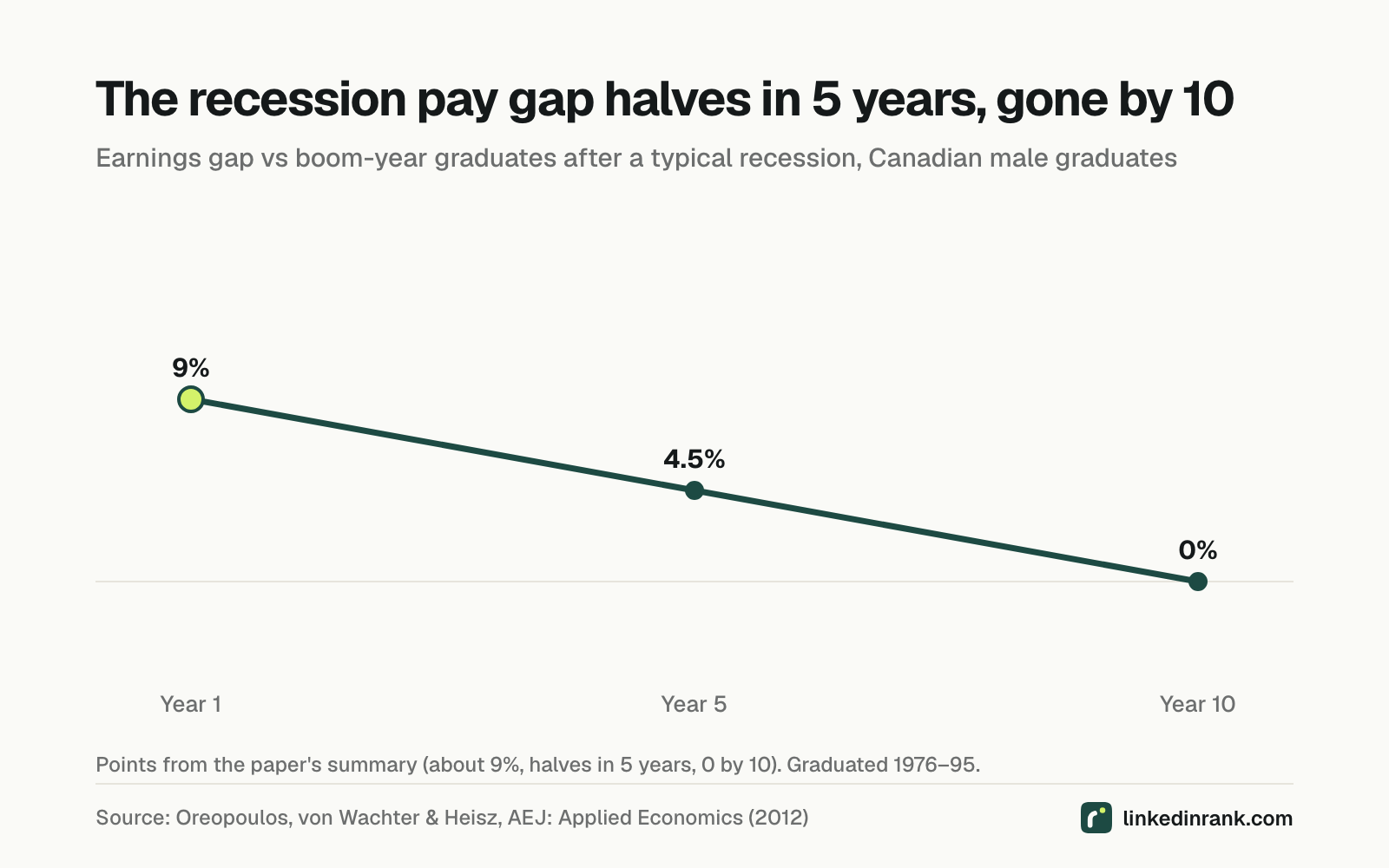
That is not trivial. But it is also not the permanent "lost generation" story that a bad placement season makes you feel. The authors also found that the damage is concentrated right at the start: the effect of bad conditions was much larger for people in the first year of their careers than for those with even a few years behind them.
Other studies point the same way, with less comfort. Lisa Kahn followed white American men who graduated between 1979 and 1989 and found that those who graduated into a large downturn still earned around 10% less 17 years later than those who graduated in the best times. Hannes Schwandt and Till von Wachter, summarising the research for the IMF, put the typical range at lower earnings for 10 to 15 years, with college graduates losing about 6% at the start in a moderate recession.
Try it on your profile
The free LinkedIn Keyword Finder applies this in a minute.
The pessimists are partly right
If you have heard that a bad first year follows you forever, the research does not simply dismiss that. It says it is true for some people, and it tells you which ones.
In the Canadian data, the graduates with the lowest expected earnings, based on their college and subject, took a first-year hit of about 15% and lost 8% of their cumulative earnings over ten years, almost double the median graduate. For some of them, the loss did not fully fade. The paper's phrase for it is "cyclical downgrading": you start lower, and you never quite get back to the ladder you would have been on.
It is also worth knowing what the scar was not. In the same data, bad entry conditions caused only a small, short rise in the share of graduates with no earnings at all, and it faded within about three years. The lasting cost showed up in pay and in the kind of employer people worked for, not in long spells without work. That matters for how you read your own situation: a slow start in 2026 is mostly a question of where you begin, and where you go next is still open.
So "it fades in ten years" is an average. Whether it fades for you depends on something the authors measured directly.
How the scar heals: switching to better employers
The most useful finding in this research is not the size of the loss. It is the mechanism of recovery.
Unlucky graduates did not mainly recover by getting raises where they started. They recovered by moving. In the study's words, they "start to work for lower paying employers, and then partly recover through a gradual process of mobility toward better firms." The more advantaged graduates suffered least because they switched to better firms quickly. For the least advantaged, that mobility was slow, and their losses lasted longest.
Kahn's later work with US employer-employee data, with Census Bureau economists, explains why bad years hurt so much: they freeze the ladder. In the Great Recession, movement away from the lowest-paying firms fell by 85%, and earnings growth fell with it. When competition for workers is weak, low-paying employers keep people they would normally lose. Young workers end up spending longer at the bottom rung.
The bad year decides your first employer. It does not have to decide your fifth.
Schwandt and von Wachter draw the practical conclusion themselves: telling young workers about these long-term effects can "motivate continued job search and movement to better jobs as the economy recovers." In other words, knowing this is part of the cure.
Youth unemployment in India in 2026: a squeeze, not a textbook recession
India's situation is different from the downturns in these studies, and it is worth being precise. The overall unemployment rate for people aged 15 and over was 5.0% in September 2026. But for urban youth aged 15 to 29, the government's PLFS data showed 19%, and for young urban women 26.6%. The State of Working India 2026 report found that only 4.6% of graduates had a permanent salaried job within a year of graduating. And TCS, long one of the largest fresher employers, made 25,000 fresher offers for FY27, down from about 44,000 freshers hired in FY26.
That is a narrow door at the entry level rather than a collapse across the economy. But the mechanism in the research is about exactly this: where you are able to start. If the 2026 market pushes you into a smaller firm, a contract role or a job below what you trained for, the evidence says the start is not what decides the outcome. The next move is. Our youth unemployment 2026 guide has the wider numbers.
What this means for you if you're graduating into a bad job market
The research gives you a plan that is less about finding the perfect first job and more about making the first job portable.
- Choose the first job for what it lets you prove. Between two similar offers, pick the one where you will own something you can describe with a number by month nine. A brand name you cannot explain is worth less on the next move than a small firm where you ran a process.
- Keep a monthly work log from day one. Three lines: what you shipped, what changed because of it, and the number. Mobility runs on evidence, and memory is a poor archive.
- Look at where your employer's people go. On LinkedIn, search the company and filter past employees. If people who joined two years ago now work at firms you would want, the company is a ladder. If they are all still there, or all left the field, that tells you something too.
- Set a review date before you join. Put a reminder for month 12 to 18: update your profile, test the market with five applications, and talk to two people at firms one rung up. The graduates who recovered fastest were the ones who moved, and moving is easier when it is a habit, not a crisis.
- Keep your profile searchable while you work. Recruiters at better firms can only poach you if they can find you. A current headline and skills list cost nothing.
For the current entry-level picture in India, see our fresher job market 2026 report.
What the data can't tell us
The strongest studies cover Canadian and American graduates, mostly men, who started work between the 1970s and the 1990s. India's labour market has far more informal and contract work, and its 2026 problem is an entry-level squeeze shaped partly by automation, not a classic recession. We do not have Indian studies that follow graduates' earnings for ten years by entry conditions. The averages also hide wide variation: the same research that says the scar fades says it fades least for the graduates with the fewest advantages. The direction of the advice still holds. The size of the effect for you is unknown.
What the data does show is clear enough to act on. A bad year to graduate lowers the first rung. The people who recovered were not the ones who waited for a better year. They were the ones who kept climbing.
Sources
- Oreopoulos, von Wachter & Heisz, "The Short- and Long-Term Career Effects of Graduating in a Recession", American Economic Journal: Applied Economics, 2012. https://oreopoulos.faculty.economics.utoronto.ca/wp-content/uploads…
- Kahn, Lisa B., "The long-term labor market consequences of graduating from college in a bad economy", Labour Economics, 2010. https://econpapers.repec.org/RePEc:eee:labeco:v:17:y:2010:i:2:p:303…
- Kahn, Lisa B., "Changes in the Character of the Labor Market over the Business Cycle", NBER Reporter, 2019. https://www.nber.org/reporter/2019number2/changes-character-labor-m…
- Schwandt & von Wachter, "The Long Shadow of an Unlucky Start", IMF Finance & Development, 2020. https://www.imf.org/en/publications/fandd/issues/2020/12/future-of-…
- NewKerala (ANI), "Urban youth unemployment rises to 19% in September 2026" (MoSPI PLFS Monthly Bulletin), 2026. https://www.newkerala.com/news/a/urban-youth-unemployment-rises-19-…
- Business Today, "Youth in labour market: Graduate unemployment remains high in India" (Azim Premji University, State of Working India 2026), 2026. https://www.businesstoday.in/jobs/story/youth-in-labour-market-grad…
- Outlook Business (PTI), "TCS Makes Only 25k Fresher Offers This Fiscal, More Hires Dependent on Demand Scenario: Official", 2026. https://www.outlookbusiness.com/corporate/tcs-makes-only-25k-freshe…
Questions people ask
What are the best keywords for a LinkedIn profile?
The job title you want and the hard skills and tools from job posts for that title. Generic words like "hardworking" or "team player" are rarely searched.
Where should I put keywords on LinkedIn?
In order of weight: your headline, your current job title, the Skills section, your About section and your experience bullets. Use the job post's exact words, for example "Power BI", not "BI tools".
How many job posts should I paste?
3 to 5 posts for the same role give a reliable list. A keyword that appears in most of them is a must-have.
Should I add keywords I do not have?
No. Recruiters and interviewers check. Add only skills you can talk about, and learn the ones that keep coming up.
Is my data stored?
No. The analysis runs in your browser. If you drop your LinkedIn PDF it is read once to extract text and never stored.
Written by Bhavishya Singla
Founder of LinkedInRank. Writes about how recruiters search LinkedIn and what makes a profile show up.
Add LinkedInRank as a preferred source on Google
See our new LinkedIn guides first in Google results.