In short
Are online certificates worth it for a job? A certificate beats nothing, but proof you used the skill is a far stronger signal. What the research shows.
On this page
Certificates say you finished. Projects say you can.
Harvard and MIT did something unusual with their online courses on edX: they shared the data. By May 2018 it covered 12.67 million registrations from 5.63 million learners. In 2019, Justin Reich and José Ruipérez-Valiente of MIT published what it showed in Science. Of those who registered for a course, 52% never opened the course material. In the 2017-18 academic year, just 3.13% of course participants completed. Among learners who had paid for a verified certificate, the completion rate was 46%.
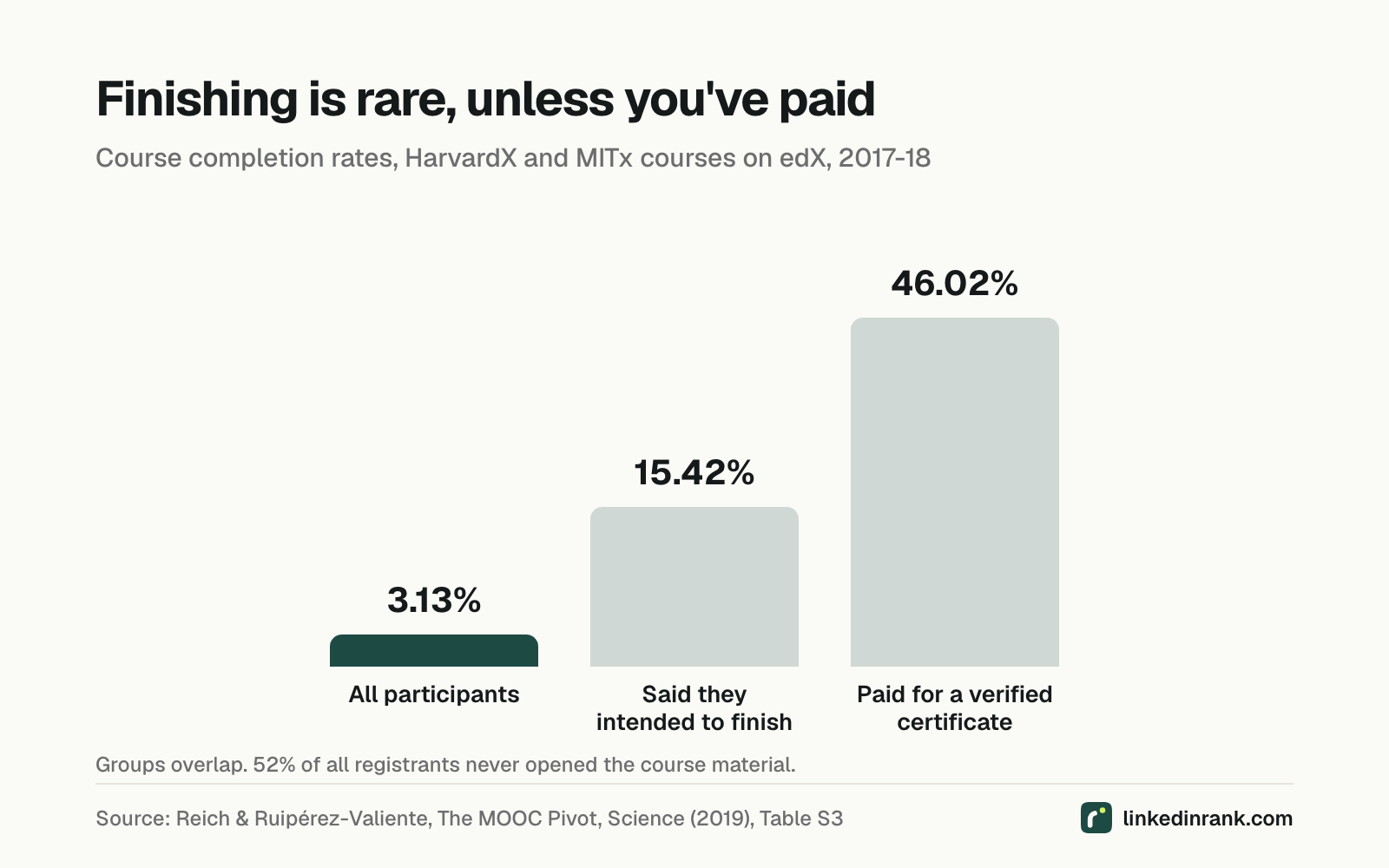
Finishing an online course is rarer than most people assume. And yet a certificate, on its own, is a weak signal to an employer. Not because it is worthless, but because it records that you finished something, not that you can do anything with it. Proof that you used the skill is a much stronger signal, and it is the part most LinkedIn profiles leave out.
Are online certificates worth it at all?
Start with the case for certificates, because it is better than the cynics admit.
In a 2020 study in AERA Open, Michael Rivas, Rachel Baker and Brent Evans ran two randomised experiments. US respondents recruited online were asked to choose between profiles of hypothetical freelance web developers. When one profile listed an online course certificate and the other listed no credential, respondents preferred the certificate by 61 percentage points. The preference held whatever the level of professional experience.
Vendor data points the same way. In a 2025 Coursera survey of more than 1,000 employers worldwide, 85% said they were more likely to hire a candidate with a micro-credential than one without. Coursera sells these credentials, so treat that as a stated preference from an interested party, but it is not nothing.
And in some jobs, a certificate is a gate. The Hidden Workers report from Harvard Business School and Accenture found that many employers filter applicants on very specific credentials. If a job ad names a certification, not having it can mean nobody reads the rest of your application.
So a certificate is better than nothing. The trouble is that "nothing" is rarely the comparison.
Try it on your profile
The free LinkedIn Experience Description Generator applies this in a minute.
Why a certificate is a weak signal
The same Rivas experiment had a second half. When a profile with an online certificate was compared with profiles holding traditional qualifications, respondents preferred every traditional degree. The authors' conclusion was blunt: these courses "do not serve as substitutes for traditional postsecondary credentials".
Economists have a name for what is going on. In 1973, Michael Spence described job market signalling: when employers cannot observe ability directly, they rely on things that are easier for able people to acquire than for others. A signal is only informative if it separates people.
Here is the problem with a certificate as a signal. It tells the employer you completed a course, and the edX data says completion takes real persistence. But it says much less about the thing the employer is paying for: whether you can use the skill on their problem. Two candidates with the same "Google Data Analytics" badge may be very different analysts, and the badge cannot show the difference. When a hundred applicants list the same course, it stops separating anyone.
That is why a long list of certificates can work against you. To a recruiter skimming a profile, eight certificates and no project can read as eight courses watched and nothing built.
A certificate says you finished. A project says you can.
What a stronger signal looks like
If certificates are weak because they hide ability, the strong signal is anything that shows it.
Amanda Pallais tested this directly in a field experiment published in the American Economic Review in 2014. On an online freelancing marketplace, she hired 952 randomly selected workers for a short job. Some received detailed public evaluations of their work, others only coarse ones. Both getting hired and getting a more detailed evaluation substantially improved the workers' later employment. Her explanation: hiring an inexperienced worker produces information about their ability, and once that information is public, other employers use it.
That is the mechanism to copy. A certificate is information about your effort. A piece of real work, especially one somebody else has used or judged, is information about your ability.
For a fresher, the equivalents are:
- a project that uses the course skill on a real dataset or problem, with the result written up in plain language
- a short case study: the problem, what you tried, what failed, what you would do next
- code, a dashboard, a design file or a document that a recruiter can open in one click
- a review or recommendation from someone who used your work, such as an internship manager, a professor or a small business you helped
Picture two freshers in Pune applying for the same junior analyst role. (This is an illustration, not a case study.) The first lists nine certificates: Excel, SQL, Python, Power BI, two in "data science", three in soft skills. The second lists two certificates, SQL and Power BI, and under them a link to a dashboard built on a year of public bus ridership data, with a 200-word note on what the data showed and one mistake she fixed along the way.
A recruiter cannot tell from the first profile whether the candidate can write a join. From the second, they can open the dashboard and see it in a minute. The second fresher has fewer credentials and a much stronger signal, because she has handed over the information the certificate could not carry.
How to show certifications on LinkedIn so they count
- Pair every certificate with one piece of proof. For each course you list, add something you made with it. If you cannot, ask whether the course belongs on your profile.
- Cut the list to what the target role needs. Five relevant certificates read better than fifteen scattered ones. Our guide on how to add certifications to LinkedIn covers which fields to fill so they are searchable.
- Put the proof where recruiters look. Projects, the Featured section and the experience entries sit higher on your profile and say more than a licences list at the bottom. Here is how to share a project on LinkedIn so it shows up properly.
- Write three lines, not a badge. "Completed SQL for Data Analysis" says little. "Used SQL to analyse 2 years of a local shop's sales data and found the three products driving 40% of returns" says what you can do. (That is an illustrative example; use your own numbers.)
- Get the certificate when the job ad names it. If the role lists a specific certification as required, treat it as a gate and get it. Then add proof anyway.
- Seek an evaluation. A small freelance job, a volunteer project for a local organisation or a college department, anything where someone judges the result and can say so in writing. That is the closest thing to Pallais's detailed evaluation.
What the data can't tell us
The edX numbers come from Harvard and MIT courses only and stop in 2018; newer platforms and paid programmes may look different. The Rivas experiment used hypothetical hiring choices by online survey respondents, not real recruiters. Coursera's survey is vendor data with a stated preference, not observed hiring. Pallais studied short freelance jobs, not graduate roles. We found no Indian study of how recruiters treat certificates, and no experiment that pits a certificate against a project for the same candidate.
So the honest summary is this: a certificate helps more than nothing and less than a degree, and the evidence on information suggests proof of work helps most. Finishing the course is the start of the signal. What you do with it next week is the part employers can actually see.
Sources
- Reich, J., Ruipérez-Valiente, J. A., "The MOOC Pivot", Science 363(6423), 2019 (postprint; data tables at github.com/jruiperezv/MOOC_Pivot). https://webs.um.es/jruiperez/papers/journals/2019_Science_MOOCPivot…
- Rivas, M. J., Baker, R. B., Evans, B. J., "Do MOOCs Make You More Marketable? An Experimental Analysis of the Value of MOOCs Relative to Traditional Credentials and Experience", AERA Open 6, 2020. https://doi.org/10.1177/2332858420973577
- Coursera, "New Coursera report shows strong employer and student ROI for industry micro-credentials", 2025. https://blog.coursera.org/new-coursera-report-shows-strong-employer…
- Fuller, J. B., Raman, M., Sage-Gavin, E., Hines, K., "Hidden Workers: Untapped Talent", Harvard Business School and Accenture, 2021. https://www.hbs.edu/managing-the-future-of-work/research/Pages/hidd…
- Spence, M., "Job Market Signaling", Quarterly Journal of Economics 87(3), 1973. https://doi.org/10.2307/1882010
- Pallais, A., "Inefficient Hiring in Entry-Level Labor Markets", American Economic Review 104(11), 2014. https://doi.org/10.1257/aer.104.11.3565
Questions people ask
How long should a LinkedIn experience description be?
3 to 5 bullets per role, each one line. LinkedIn allows about 2,000 characters per role, but recruiters skim.
How do I format a LinkedIn experience description?
Start each line with a bullet (•) and an action verb, keep one achievement per line, and put the most relevant one first.
How do I write LinkedIn experience descriptions?
Use the XYZ formula: "Accomplished [X] as measured by [Y], by doing [Z]". Lead with a strong action verb, include a quantified result, and explain the method.
Should I use bullet points on LinkedIn?
Yes. Bullet points make your experience scannable. Use 3-5 per role, each starting with an action verb and focusing on a different achievement.
What action verbs should I use?
Use verbs that signal impact: Led, Built, Increased, Reduced, Launched, Designed, Negotiated, Streamlined, Generated, Transformed.
Written by Bhavishya Singla
Founder of LinkedInRank. Writes about how recruiters search LinkedIn and what makes a profile show up.
Add LinkedInRank as a preferred source on Google
See our new LinkedIn guides first in Google results.