In short
How often internships turn into full-time offers, what the data says decides it, and a week-by-week plan to make your work impossible to overlook.
On this page
Nobody hires an intern. They hire what you built.
Of the 16,060 young people who had joined internships under India's PM Internship Scheme in its two pilot rounds, 95 had received full-time job offers from their host companies. That was the government's figure in a written reply to Parliament in December 2025. About 41% of those who joined had left before finishing.
The number needs context, and we will get to it: the scheme counts internships, not hires, and many interns had not finished when the figure was reported. But it shows the point of this piece in its starkest form. An internship does not turn into a job by itself. The gap between "did an internship" and "got an offer" is closed by one thing more than any other: whether the team can name specific work you did, and wants more of it.
Internship to full-time offer rate: what the best data says
The most detailed numbers come from the US, where the National Association of Colleges and Employers surveys employers every year. Its 2026 report, covering 284 organisations, found that employers offered full-time jobs to 71.8% of their 2024–25 interns. Of those offers, 88.3% were accepted. Overall, 63.1% of eligible interns converted to full-time hires, the highest rate in five years.
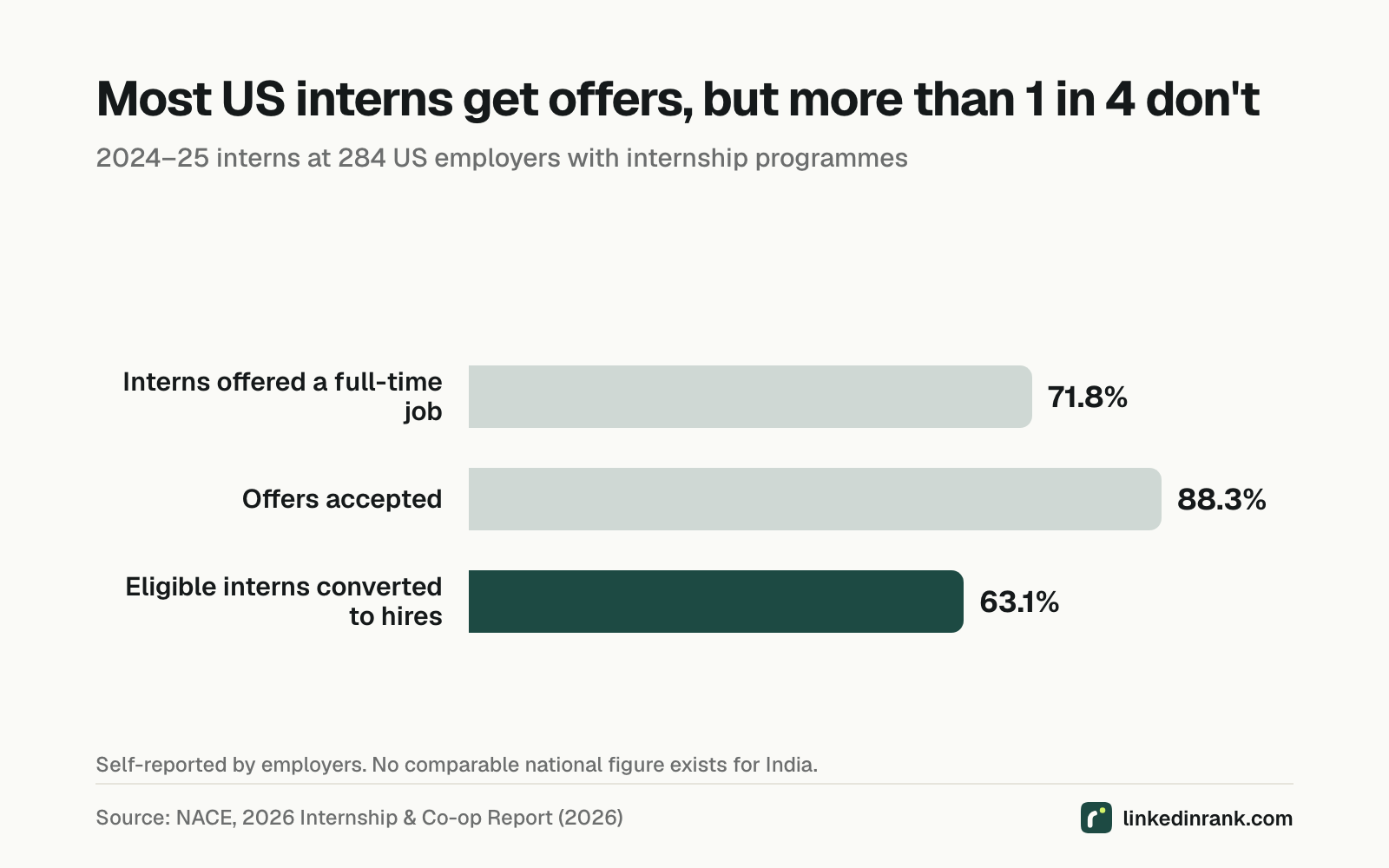
Two things stand out. First, even at employers with formal, recruiting-focused programmes, more than one in four interns did not get an offer. Second, the rate moves with the market. For the 2024 intern class, the offer rate was 62%, down from two-thirds a year earlier.
Employers have a clear reason to want conversions. In NACE's 2026 report, 76.1% of hires who had interned with their employer were still there after one year, and 51.6% after five. An intern who converts is a known quantity, which is exactly what makes the decision about you so personal.
India has no official national figure for conversion, and our guide to internship-to-full-time offer rates explains why any precise Indian number you see should be treated with suspicion. What we do have is the PM scheme's figure, and a plain fact of campus hiring: some companies use internships to make pre-placement offers, and others have no hiring plan behind them at all.
Try it on your profile
The free LinkedIn Experience Description Generator applies this in a minute.
The offer is not only about you
The common belief is that if you work hard, the offer follows. The data says that is only half true, and the other half is outside your control.
Offers depend on headcount. A team with no budget for a graduate hire cannot make one, however good you are. The swing from two-thirds to 62% to 71.8% across three US intern classes is not a story about interns getting better and worse. It is a story about hiring plans. In India, even signed offers are not certain: in 2026, the IITs imposed a two-year ban on 22 companies that failed to honour more than 150 offers made to graduating students. And the PM scheme's numbers reflect a year-long programme with very high drop-out: by January 2026, only 3,417 first-round interns had completed the full 12 months.
So the first honest step is to find out, early, whether your team can hire at all. The second is to make sure that if it can, you are the obvious choice.
Why visibility decides who converts
Inside programmes that do hire, the decision is usually made by people summarising your work to someone else: your manager to their manager, or to a hiring committee. They can only argue for what they can name.
NACE's data offers a hint of how much that matters. Among US employers, the average offer rate was 72% for in-person internships and about 56% for hybrid ones. That is a comparison across different employers, not a controlled experiment, so it cannot prove that being seen causes offers. But it is consistent with a simple idea: work that happens where people can see it is easier to remember and easier to defend.
Picture two interns in the same analytics team at a Bengaluru fintech (an illustration, not real people). Both are bright and both work long hours. The first helps with whatever lands on their desk: a chart here, a data pull there, a slide for someone's meeting. The second, in week two, takes ownership of one weekly report that took a senior analyst half a day, automates it, and sends a short note each Friday on what it showed. In the hiring discussion, the manager can describe the second intern in one sentence. The first intern did as many hours. Nobody in that room can say what they did.
Nobody hires an intern. They hire the person who built the thing they still use.
There is a second reason to document your work, and it pays off even if no offer comes. When US employers choose between equally qualified graduates, they rank an internship with their organisation or in their industry as the most influential factor. In India, foundit found that nearly six in ten fresher job postings now prefer or require prior internship experience. An internship you can describe with outcomes is worth far more on your next application than one you can only list.
How to convert an internship into a full-time offer
This is a plan for a two-to-six-month internship. Adjust the weeks for longer ones.
- Week 1: ask the two questions nobody asks. "Does the team plan to hire graduates this year?" and "What would a strong intern have done by the end?" The first tells you whether an offer is possible. The second gives you the rubric your manager will use, in their own words.
- Week 2: pick one thing to finish. Agree on a single deliverable that someone will use after you leave: a dashboard, a tested feature, a cleaned dataset, a process document. Finished and used beats ambitious and half-done.
- Every Friday: send a five-line update. What you finished, what changed because of it (with a number if possible), what is blocked, what is next, one question. It takes ten minutes, and it builds the record your manager will need when they argue for you. Something like: "Done: cleaned the March to June returns data, 4% of rows were duplicates. Changed: the weekly returns figure is now about 3 points lower and correct. Blocked: need access to the courier table. Next: dashboard draft by Wednesday. Question: should refunds count as returns?"
- Midpoint: say it out loud. Tell your manager directly that you want a full-time role and ask what would make it possible. Do not assume they already know.
- Final two weeks: demo and hand over. Show the work to the team, not only your manager. Write a one-page handover so the work survives you. People remember the intern whose work kept running.
- On the way out: get it in writing. Ask your manager for a LinkedIn recommendation that names the deliverable. Add the internship to your profile and resume with the outcome, not just the dates.
If you are still looking for the internship itself, our guide on how to get an internship covers where to find them and how to apply.
What the data can't tell us
The NACE figures are self-reported by US employers, mostly large organisations that run internships as a recruiting channel, so they overstate what a typical Indian intern at a small firm should expect. The in-person versus hybrid gap may partly reflect differences between the employers that choose each model. The PM scheme's 95 offers were reported in December 2025, before many interns had finished, and later reports mention more offers without giving a number. There is no reliable national data on Indian internship conversion. What the evidence does support is the direction: offers depend on whether a team is hiring, and, when it is, on whether the people deciding can point to something you did.
An internship is a long interview in which you choose what the evidence will be. Choose something they will still be using in March.
Sources
- Scroll, "Only 30% of candidates accepted PM internship scheme offers, 41% quit halfway", 2025. https://scroll.in/latest/1088939/only-30-of-candidates-accepted-pm-…
- NACE, "2026 Internship & Co-op Report" (report summary page), 2026. https://naceweb.org/research/reports/2026/2026-internship-co-op-rep…
- NACE (Kevin Gray), "Intern Conversion Rate Hits Highest Mark in Five Years", 2026. https://naceweb.org/talent-acquisition/internships/intern-conversio…
- NACE (Mimi Collins), "Intern Offer and Conversion Rates Fall, Acceptances Rise", 2025. https://naceweb.org/talent-acquisition/internships/intern-offer-and…
- NACE, "Internship Experience Often the Deciding Factor Between Equal Candidates", 2026. https://naceweb.org/talent-acquisition/candidate-selection/internsh…
- Business Today (foundit Insights Tracker), "AI, GCCs and a changing job market: India's fresher hiring is no longer just an IT story. Who's driving the shift?", 2026. https://www.businesstoday.in/jobs/story/ai-gccs-and-a-changing-job-…
- Business Today (citing The Economic Times), "Oracle among 22 firms facing 2 year ban from IIT campus placements over revoked offers: Report", 2026. https://www.businesstoday.in/jobs/story/oracle-among-22-firms-facin…
- ThePrint, "Budget deals drastic blow to floundering PM Internship scheme", 2026. https://theprint.in/economy/floundering-pm-internship-scheme-has-se…
Questions people ask
How long should a LinkedIn experience description be?
3 to 5 bullets per role, each one line. LinkedIn allows about 2,000 characters per role, but recruiters skim.
How do I format a LinkedIn experience description?
Start each line with a bullet (•) and an action verb, keep one achievement per line, and put the most relevant one first.
How do I write LinkedIn experience descriptions?
Use the XYZ formula: "Accomplished [X] as measured by [Y], by doing [Z]". Lead with a strong action verb, include a quantified result, and explain the method.
Should I use bullet points on LinkedIn?
Yes. Bullet points make your experience scannable. Use 3-5 per role, each starting with an action verb and focusing on a different achievement.
What action verbs should I use?
Use verbs that signal impact: Led, Built, Increased, Reduced, Launched, Designed, Negotiated, Streamlined, Generated, Transformed.
Written by Bhavishya Singla
Founder of LinkedInRank. Writes about how recruiters search LinkedIn and what makes a profile show up.
Add LinkedInRank as a preferred source on Google
See our new LinkedIn guides first in Google results.