In short
Personal branding on LinkedIn doesn't need daily posts. The 1% rule shows why a few useful posts and good comments make a job seeker visible.
On this page
Most people never post. That's your opening.
In 2006, the usability researcher Jakob Nielsen pointed out something odd about Amazon. A book that had sold thousands of copies had only 12 customer reviews. Fewer than 1% of buyers had written anything. On Wikipedia, he noted, the most active 1,000 people had made about two-thirds of the edits.
He called it participation inequality and summed it up as a rule of thumb: in most online communities, 90% of users only read, 9% contribute now and then, and 1% create most of what everyone else sees.
That rule is the most useful fact in personal branding, and almost nobody draws the right conclusion from it. If most people never post, you do not need to post every day to stand out. A few genuinely useful posts a week, and thoughtful comments on the right people's posts, already put you in a small, visible minority. Consistency matters far more than volume.
Is the 1% rule real?
Nielsen's numbers were a rule of thumb, not a measurement. Researchers have since tested it.
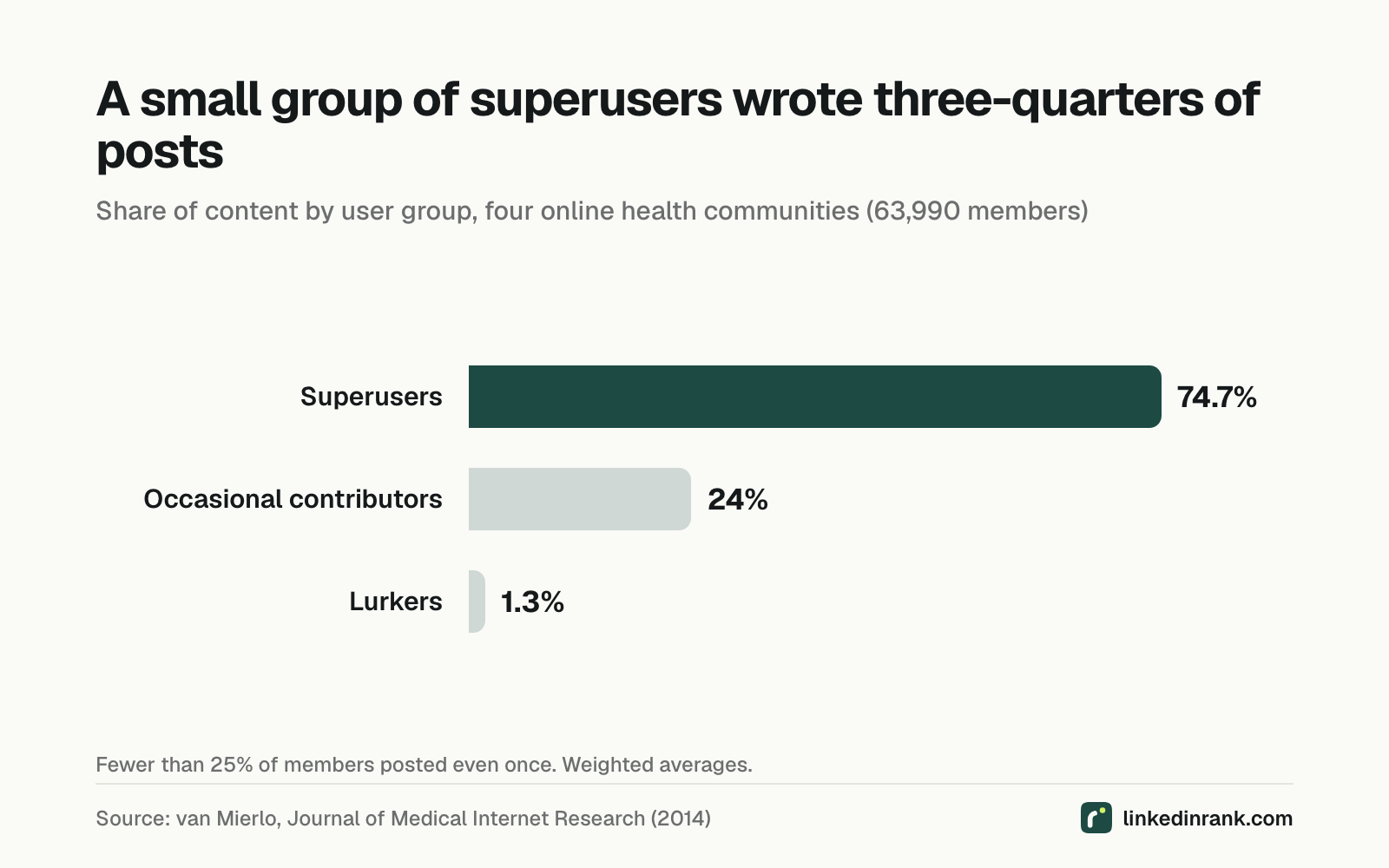
In 2014, Trevor van Mierlo analysed four long-running online health communities for people dealing with alcohol use, depression, panic and smoking, in the Journal of Medical Internet Research. Of 63,990 members, fewer than 25% posted even once. The heaviest contributors, the "superusers", produced 74.7% of all content, occasional contributors 24.0%, and everyone else 1.3%.
Twitter showed the same shape. A 2019 Pew Research Center study of 2,791 US adult users found the most active 10% produced 80% of tweets, and the median user tweeted twice a month. When Pew looked again in 2021, the most active quarter of US adult users produced 97% of tweets.
What about LinkedIn? It reports more than 1.4 billion members, but it does not publish what share of them post. A statistic you will see everywhere, that only about 3 million members share content weekly, appears on dozens of marketing pages with different totals underneath it, and we could not trace it to anything LinkedIn published. So we will not use it. The safest assumption, based on every platform that has been measured, is that the posting minority on LinkedIn is small too.
Try it on your profile
The free LinkedIn Post Idea Generator applies this in a minute.
The case for posting every day
The "post daily" advice is not foolish, and it is worth hearing out.
In 2025, Buffer, which sells social media scheduling software, analysed more than 2 million LinkedIn posts from over 94,000 accounts. Crucially, it compared each account with itself, in weeks when it posted more against weeks when it posted less. Compared with posting once a week, accounts posting 2 to 5 times got about 1,182 more impressions per post. At 11 or more posts a week, the gain was about 17,000 more impressions per post.
So if your goal is reach, more posting buys more of it. Buffer's own analyst added a caveat worth repeating: "Low-quality content posted frequently won't yield great results."
There is also a cost the impressions data cannot show. Someone posting daily to hit a target usually runs out of things worth saying within a few weeks, and the posts drift towards filler. Every hour spent producing a post is also an hour not spent on the project, internship task or skill that the posts are meant to be about. Volume can grow reach while hollowing out the thing being branded.
The question is whether reach is the goal.
Why reach is the wrong goal for a job seeker
A creator selling a course needs thousands of strangers. A fresher looking for a first job needs something different: a few dozen specific people to recognise their name when it lands in front of them. A hiring manager at a target company. Two seniors from college who now work in the team you want. A recruiter who hires for your role in your city.
Ten thousand impressions from random scrollers do less for that than 30 people who have seen you say something useful three or four times.
This is where participation inequality helps. Because so few people contribute at all, the bar to being noticed by any one person is low. The author of a post is usually notified of each comment, and a comment that adds a fact, an example or a sharp question stands out among "Great insights!" and "Congrats!". And it is seen first by exactly the person you wanted to reach, and then by their audience, which is often your target industry.
In Nielsen's terms, comments are the 9%: lighter contributions that still count. For most job seekers, they are the best-value activity on the platform.
You do not need a large audience. You need the right 30 people to remember your name.
What personal branding on LinkedIn looks like for a fresher
Here is a plan that fits around studies or a job, built on the idea that consistency beats volume.
- Name your 30. Write down about 30 people whose recognition would matter: people in roles you want, at companies you want, plus a few respected voices in your field. Follow them and turn on notifications for some.
- Comment with substance, four times a week. Pick posts from your list and add something: a data point, a short example from your own project, a counterpoint, a precise question. Two or three sentences is enough. Our guide to LinkedIn engagement through comments has examples of comments that start conversations.
- Post once or twice a week, on a fixed day. Formats that work for freshers: something you built and what went wrong; a concept from your field explained in plain words; a short takeaway from an event, a paper or an internship task. If you are stuck for topics, the free LinkedIn post idea generator gives you a starting list.
- Fix the profile before you post. A good comment can send people to your profile. If your headline says "Student" and your About section is empty, the visit is wasted. Our personal branding guide covers the basics.
- Measure the right thing. Track replies from people on your list, profile views from target companies, connection requests you did not ask for and messages that start with "I saw your comment". Ignore impressions.
- Commit to 12 weeks. At two posts and four comments a week, that is about 70 small contributions. Most people in your batch will make none.
Picture a final-year electronics student in Coimbatore who wants a role in embedded systems. (This is an illustration, not a real case.) Her list of 30 includes engineers at two firms she likes, three alumni, a professor who posts about chip design and a few recruiters. Each week she leaves four comments that add something: a datasheet detail, a question about a design choice, a result from a test she ran. On Thursdays she posts about her final-year project: what she measured, what broke, what she changed. None of this produces big numbers. But if, after a few months, a handful of those engineers recognise her name when her application arrives, she has built the only kind of brand a first job needs.
What the data can't tell us
The participation studies come from health forums and Twitter, not LinkedIn, because LinkedIn does not publish comparable figures. Buffer's numbers come from its own customers' accounts and show association, not proof that posting more causes the extra reach. And no study we found compares commenting with posting as a route to a job. The plan above follows from how participation is distributed, not from an experiment on job outcomes.
What is consistent across every platform anyone has measured is the shape: a small minority writes, a slightly larger group responds, and almost everyone else reads. You do not have to shout to join the first two groups. You only have to show up, regularly, with something worth reading.
Sources
- Nielsen, J., "Participation Inequality: Encouraging More Users to Contribute", Nielsen Norman Group, 2006. https://www.nngroup.com/articles/participation-inequality/
- van Mierlo, T., "The 1% Rule in Four Digital Health Social Networks: An Observational Study", Journal of Medical Internet Research 16(2), 2014. https://doi.org/10.2196/jmir.2966
- Pew Research Center, "Sizing Up Twitter Users", 2019. https://www.pewresearch.org/internet/2019/04/24/sizing-up-twitter-u…
- Pew Research Center, "The Behaviors and Attitudes of U.S. Adults on Twitter", 2021. https://www.pewresearch.org/internet/2021/11/15/the-behaviors-and-a…
- LinkedIn, "About LinkedIn". https://news.linkedin.com/about-us
- Buffer, "How Often Should You Post on LinkedIn? Data From 2 Million+ Posts", 2025. https://buffer.com/resources/how-often-to-post-on-linkedin/
Questions people ask
What should I post on LinkedIn?
Post content that demonstrates expertise, shares lessons, or provides value. Combine personal stories with professional insights.
How often should I post on LinkedIn?
Post 3-5 times per week. Quality matters more than quantity. One great post beats five mediocre ones.
What type of posts get the most engagement?
Personal stories with lessons, contrarian opinions, behind-the-scenes content, and data-backed insights.
Written by Bhavishya Singla
Founder of LinkedInRank. Writes about how recruiters search LinkedIn and what makes a profile show up.
Add LinkedInRank as a preferred source on Google
See our new LinkedIn guides first in Google results.