In short
The half-life of skills is said to be 5 years. We traced that number to a blog post. What the real data says lasts, and what to learn in 2027.
On this page
- Learn the layers that last, refresh one that doesn't
- Where the half-life of skills number really comes from
- How fast skills are changing: the forecasts keep changing too
- What actually decays fast: tool and technology skills
- What lasts: the durable layers
- What to learn in 2027: two layers
- What this means for you this week
- What the data can't tell us
- Sources
- Questions people ask
Learn the layers that last, refresh one that doesn't
You have probably seen the line. "The half-life of a skill is five years." Some versions say two and a half. It appears in learning-platform ads, HR decks and New Year posts like this one would usually be.
So we traced it. One widely cited source is a 2019 report from the IBM Institute for Business Value, which says "the half-life of a learned skill is estimated to be five years and even shorter for technical skills" (IBM IBV, 2019). The footnote for that sentence does not point to a study. It points to a 2017 opinion post on the World Economic Forum's website by Stephane Kasriel, then CEO of the freelancing platform Upwork. Others credit a 2011 book, "A New Culture of Learning", by Douglas Thomas and John Seely Brown. We could not find a dataset behind any of them, and we could not trace the "two and a half years" version at all.
That does not make the idea wrong. It makes it a metaphor wearing a lab coat. The better question for 2027 is not "how fast do skills expire?" but "which ones?" The evidence is clearer on that than the slogans are, and it points to a simple plan: invest most in durable layers, and treat tools as a subscription you renew every year.
Where the half-life of skills number really comes from
Physicists measure half-lives with clocks and counters. Nobody has done that for "a skill", partly because a skill is not one thing. Knowing a specific version of a software library and knowing how to explain a problem to a client do not decay at the same rate, and averaging them into one number hides the only thing worth knowing.
IBM's same report says the half-life of professional skills "was once estimated at 10 to 15 years." Once estimated by whom, it does not say. So the famous shrinking-half-life story is a chain of estimates citing estimates. Treat any precise number in it, five years or 2.5, as decoration.
Try it on your profile
The free LinkedIn Keyword Finder applies this in a minute.
How fast skills are changing: the forecasts keep changing too
There are better attempts to measure change, and they are instructive mainly for how much they move.
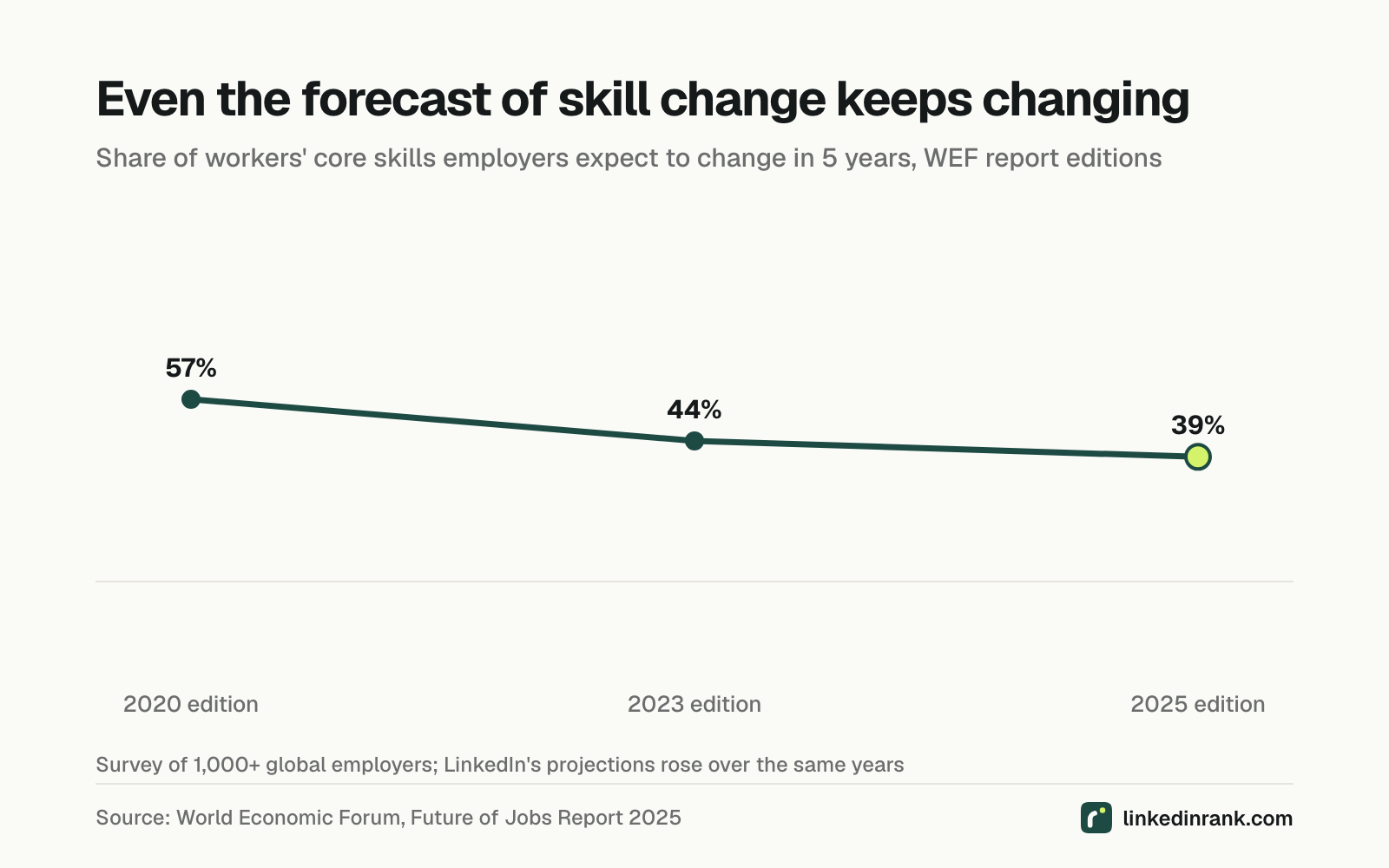
The World Economic Forum surveys more than 1,000 large employers for its Future of Jobs Report. In the 2025 edition, employers expect 39% of workers' core skills to change by 2030. The report itself notes that this "skill instability" figure was 44% in the 2023 edition and 57% in 2020, right after the pandemic (WEF Future of Jobs Report 2025). It suggests one reason for the fall: more workers have completed training, 50% now against 41% in 2023.
LinkedIn's numbers have moved the other way. In March 2022 it reported that the skills for jobs had changed by about 25% since 2015 and that this was "expected to double" by 2027 (LinkedIn Economic Graph, 2022). In November 2023 the projection became "up to 65% by 2030" (LinkedIn, AI at Work). In January 2025, "70% of the skills used in most jobs will change" by 2030 (LinkedIn Work Change Report).
One forecaster sees change slowing; another sees it speeding up. Both are serious organisations with large datasets, and they measure different things. The honest conclusion is the one in the title of this piece: nobody knows exactly what will last. Even predictions about skill change have a short half-life.
What actually decays fast: tool and technology skills
There is real research on decay, and it agrees with the slogan in one place: specific technical skills.
Economists David Deming and Kadeem Noray studied US graduates alongside detailed job-ad data. They found that "the initially high economic return to applied STEM degrees declines by more than 50 percent in the first decade of working life" (NBER working paper 25065, later published in the Quarterly Journal of Economics, 2020). The reason: STEM jobs "change especially quickly over time", so the specific skills of older graduates become obsolete while new graduates arrive with the current ones.
Notice what that finding does and does not say. It is not that engineers become worthless. It is that the part of their value tied to specific technologies fades fast, and they need to keep renewing it. That is the closest thing to a measured "half-life" we found, and it applies to tools, not to thinking.
What lasts: the durable layers
Now the other side of the ledger.
In the same WEF survey, employers named "reading, writing and mathematics", "dependability and attention to detail" and "quality control" among the most stable skills, those whose importance is expected to change least. Analytical thinking remains the top core skill, essential for seven in 10 companies. WEF does expect a small net decline in reading, writing and maths. Stable is not the same as rising, but it is the opposite of expiring.
Over a longer span, Deming's earlier research found that between 1980 and 2012, US jobs requiring high levels of social interaction grew by nearly 12 percentage points as a share of the labour force, while maths-intensive jobs with little social interaction shrank (NBER working paper 21473, Quarterly Journal of Economics, 2017). Working with people compounded across three decades of computerisation.
And the newest evidence on AI points the same way. The Stanford "canaries" paper suggests AI substitutes most easily for codified knowledge, the textbook kind, while complementing tacit knowledge gained "through practice, mentorship, and repeated exposure to real situations" (Stanford Digital Economy Lab, 2026). Domain knowledge built by doing is the layer AI makes more valuable, not less.
Tools are a subscription you renew every year. Thinking is an asset that compounds.
What to learn in 2027: two layers
Put together, the evidence suggests a learning plan with two layers.
The durable layer, most of your time. Four things that hold up in the evidence above:
- Problem framing. Turning a vague request into a clear question. This is what "analytical thinking" looks like in practice.
- Writing. Explaining something so the reader can act on it. Every AI tool you use is driven by how clearly you can write.
- Numeracy. Estimating, checking whether a number is plausible, reading a chart honestly.
- Domain knowledge. How one industry actually works: its customers, its money, its rules. This is the tacit layer, and it only comes from exposure.
The tool layer, refreshed yearly. One tool family that the jobs you want are asking for right now: an AI assistant inside your field, SQL and a dashboard tool, a design suite, a CRM. Learn it well enough to build something real, then review it next December. Our guide to the most in-demand skills of 2026 is a starting list.
What this means for you this week
- Split your skills list into two columns. Durable on the left, tools on the right. If the right column is long and the left is empty, that is your 2027 plan.
- Pick exactly one tool for 2027. Read 20 job posts for the role you want and count which tool names repeat. Choose the most frequent one you do not know yet.
- Practise one durable skill weekly, with output. One 300-word explanation of something you learned, one back-of-the-envelope estimate, or one conversation with someone who works in the industry you want. Keep them; they become portfolio material.
- Show both layers on your profile. Name your tools in the exact words recruiters search for, using our LinkedIn skills keywords guide. Prove durable skills inside project descriptions, where a recruiter can see you framed a problem and wrote it up.
- Put a review in your calendar for December 2027. Swap the tool if the job ads have moved. Keep the durable layer growing.
What the data can't tell us
The WEF and LinkedIn figures are forecasts built on employer surveys and platform data, with methods that are summarised more than published. The Deming studies are American and end before generative AI. Nobody has measured how fast "writing" or "problem framing" decays, because they are hard to measure at all. What we can say is narrower: specific technical skills demonstrably lose value within a decade, while the broad skills around them have held up in the data we have.
You do not need to know what lasts to plan well. You need to know what kind of thing has lasted. Learn those, and rent the rest one year at a time.
Sources
- IBM Institute for Business Value, "The enterprise guide to closing the skills gap", 2019. https://www.ibm.com/downloads/cas/EPYMNBJA
- World Economic Forum, "Future of Jobs Report 2025", 2025. https://reports.weforum.org/docs/WEF_Future_of_Jobs_Report_2025.pdf
- LinkedIn Economic Graph, "A Skills-First Blueprint for Better Job Outcomes", 2022. https://economicgraph.linkedin.com/content/dam/me/economicgraph/en-…
- LinkedIn, "Future of Work Report: AI at Work", 2023. https://economicgraph.linkedin.com/content/dam/me/economicgraph/en-…
- LinkedIn News, "Work Change Report", 2025. https://news.linkedin.com/2025/work-change-report-2025
- Deming and Noray, "STEM Careers and the Changing Skill Requirements of Work", NBER Working Paper 25065, 2019 (published as "Earnings Dynamics, Changing Job Skills, and STEM Careers", Quarterly Journal of Economics, 2020). https://www.nber.org/papers/w25065
- Deming, "The Growing Importance of Social Skills in the Labor Market", NBER Working Paper 21473 (Quarterly Journal of Economics, 2017). https://www.nber.org/papers/w21473
- Brynjolfsson, Chandar, Chen, Stanford Digital Economy Lab, "Canaries in the Coal Mine? Six Facts about the Recent Employment Effects of Artificial Intelligence", 2026. https://digitaleconomy.stanford.edu/publication/canaries-in-the-coa…
Questions people ask
What are the best keywords for a LinkedIn profile?
The job title you want and the hard skills and tools from job posts for that title. Generic words like "hardworking" or "team player" are rarely searched.
Where should I put keywords on LinkedIn?
In order of weight: your headline, your current job title, the Skills section, your About section and your experience bullets. Use the job post's exact words, for example "Power BI", not "BI tools".
How many job posts should I paste?
3 to 5 posts for the same role give a reliable list. A keyword that appears in most of them is a must-have.
Should I add keywords I do not have?
No. Recruiters and interviewers check. Add only skills you can talk about, and learn the ones that keep coming up.
Is my data stored?
No. The analysis runs in your browser. If you drop your LinkedIn PDF it is read once to extract text and never stored.
Written by Bhavishya Singla
Founder of LinkedInRank. Writes about how recruiters search LinkedIn and what makes a profile show up.
Add LinkedInRank as a preferred source on Google
See our new LinkedIn guides first in Google results.