In short
Skills-based hiring changed job ads far more than actual hires. What a Harvard and Burning Glass study found, and the proof that does get people hired.
On this page
- Dropping the degree line didn't change who got hired
- What skills-based hiring promised
- What the hiring data actually shows
- Why removing degree requirements doesn't change who gets hired
- Skills-first hiring in India: the filter is often written down
- What actually moves a hiring manager: proof
- What the data can't tell us
- Sources
- Questions people ask
Dropping the degree line didn't change who got hired
Bank of America, Amazon, Oracle and Lockheed Martin all removed degree requirements from some of their job ads. When researchers later checked who was actually hired into those roles, they found little change. In many firms like these, the share of new hires with degrees went up, not down.
That finding comes from "Skills-Based Hiring: The Long Road from Pronouncements to Practice", a February 2024 study by the Burning Glass Institute and Harvard Business School's Project on Managing the Future of Work. Its headline number is blunt: for all the announcements, skills-based hiring changed the outcome for "not even 1 in 700 hires" in the US in 2023.
The lesson for a fresher is not "degrees still rule". It is narrower and more useful. Removing a line from a job ad does not change how a tired hiring manager decides. Proof does.
What skills-based hiring promised
First, the part the believers get right. Between 2014 and 2023 the study found an almost fourfold increase in the number of roles each year from which employers dropped degree requirements. That is a real change in what companies say. And where firms followed through, it worked for everyone.
The researchers followed 11,300 roles at large US firms, using career histories of 65 million workers to see who was hired before and after each degree requirement was dropped. At the firms that genuinely changed, which they call Skills-Based Hiring Leaders, people without degrees hired into these roles saw an average salary increase of about 25%. They also stayed longer: a two-year retention rate of 58%, against 48% for colleagues with degrees.
So skills-based hiring is not a myth. Higher pay for workers, lower attrition for employers. When it is practised, it pays. The problem is how rarely it is practised.
Try it on your profile
The free LinkedIn Keyword Finder applies this in a minute.
What the hiring data actually shows
Across all 11,300 roles, removing the degree requirement raised the share of non-graduates hired by about 3.5 percentage points. In the report's own words, for every 100 jobs where the requirement was dropped, roughly 4 more people without degrees got hired. Because only a small share of all roles dropped the requirement, the national effect was about 97,000 extra hires out of 77 million a year. That is where "1 in 700" comes from.
Then the firms split into three groups.
- Leaders (37%) changed their hiring, taking on about 18% more non-graduates in those roles. The list includes Walmart, Apple, General Motors and Yelp.
- In Name Only (45%) removed the requirement from the ad and kept hiring the same people. The report places Bank of America, Amazon, Oracle and Lockheed Martin here, and notes that tech firms were over-represented in this group.
- Backsliders (18%) made early progress and then slid back to their old pattern. The report's examples include Nike, Uber and HSBC.
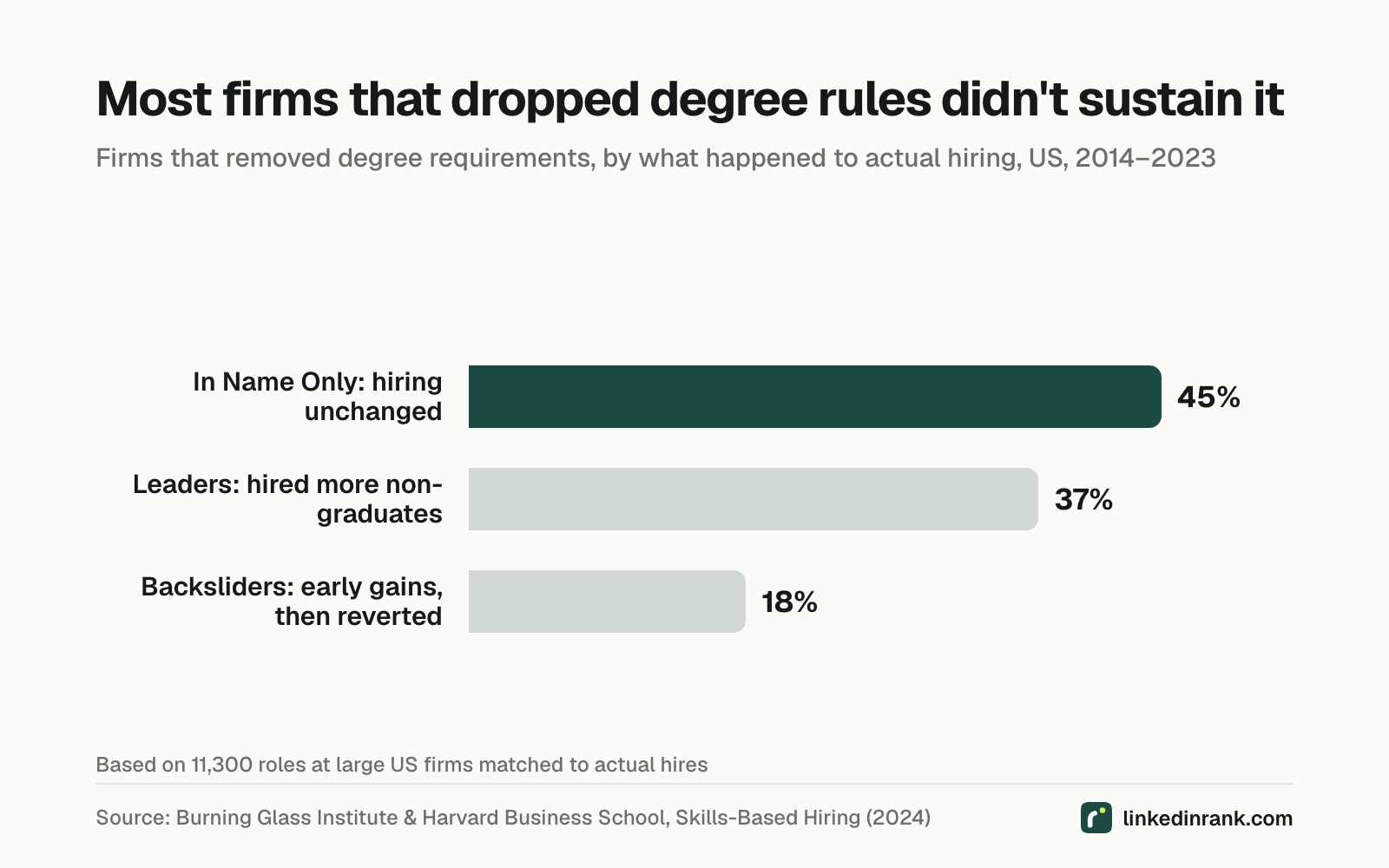
In other words, nearly two out of three firms that announced the change did not sustain it. The report's guess at why is telling: "initial executive enthusiasm did not translate to necessary change in underlying systems and practices."
Why removing degree requirements doesn't change who gets hired
The most useful paragraph in the study is not a statistic. It is about the person who makes the decision.
"Even when a degree is no longer required, it is still a heuristic hiring managers are likely to use to weigh a candidate's strengths." (Burning Glass Institute and HBS, 2024)
The report goes on: managers use the degree to assess "the risk inherent in choosing one candidate over another". Hiring is relative. A manager is not comparing you to the job description. They are comparing you to everyone else in the pile, under pressure to fill an expensive vacancy quickly. That, the authors write, creates "a subtle, but real incentive to revert to relying on proxies".
This is the key shift in thinking. A degree requirement is not mainly a rule. It is risk insurance for the person signing off on the hire. You can delete the rule from the job ad in an afternoon. You cannot delete the manager's need for insurance. If a candidate gives them nothing else to hold on to, they reach for the old proxy: the degree, the college name, the marks.
Skills-first hiring in India: the filter is often written down
In India the proxy is frequently not hidden at all. TCS's 2026 National Qualifier Test drive, as reproduced in a university placement notice citing the TCS careers page, asks for a minimum 60% or equivalent CGPA in Class 10, Class 12, diploma if any, and graduation. The test itself measures numerical, verbal and reasoning ability, plus a 90-minute coding section. So a skills test exists, but your board exam marks at 15 decide whether you may sit it at 22.
Meanwhile the language is changing. In February 2026, LinkedIn's Ruchee Anand told PTI: "We're seeing a structural shift in hiring from pedigree and past titles to demonstrated skills and capability" (Outlook Money). Both things can be true at once. The statement describes a direction. The cut-off describes this year's application form.
The US has moved further on one measure. In NACE's Job Outlook 2026 survey of 183 US employers, only 42% screen graduates by GPA, down from 73% in 2019, and 70% say they use skills-based hiring for entry-level roles (NACE, 2026). Note the gap the Burning Glass study warns about, though: saying you use skills-based hiring and hiring differently are separate things.
What actually moves a hiring manager: proof
If the degree is risk insurance, your job is to offer better insurance. The NACE release says employers want students to share "examples and situations when they honed and used their skills to resolve issues or solve problems." Not a list of skills. Evidence that a skill was used, on something real, with a result someone else can check.
Here is what that looks like this week.
- Sort your targets into "hard filter" and "soft filter". If a drive states a marks cut-off you miss, no amount of proof gets you past the form. Spend that energy on companies and roles that state skills or tests instead, where proof can actually be read.
- Name the risk, then answer it. For each role, write one sentence: what would worry a manager about hiring a fresher here? "Can she write SQL against messy data?" Then put the answer at the top of your resume and profile: a project, the dataset, the result, a link.
- Use the job's own skill words. Hiring managers and recruiter search both match on the words in the posting. Our guide to LinkedIn skills keywords for 2026 shows how to pick them, and the most in-demand skills of 2026 shows which ones employers are asking for.
- Get one skill witnessed by someone else. An internship supervisor's recommendation, a merged open-source pull request, a hackathon result, a freelance client's review. Third-party proof does the same job as a college name: someone else has already vouched.
- Ask how they assess skills. In an interview, ask: "How do you usually check whether someone can do X?" A firm with a work sample or case exercise is more likely a leader. A firm that only asks about your college is telling you something too.
What the data can't tell us
The Burning Glass study covers large US employers and degree requirements, not Indian campus hiring or marks cut-offs. Its 1-in-700 figure is an estimate extrapolated across the US economy, and its firm groupings are sensitive to which roles could be observed. NACE's survey is small, at 183 employers. There is no comparable public study of what happens in India when a company drops a cut-off, because few have. The principle still travels: a policy on paper is not a decision in a room.
Skills-based hiring is real wherever someone does the harder work of checking skills. Most companies have not done that work yet. Until they do, the candidate who brings their own evidence is doing the employer's job for them, and that is exactly why it works.
Sources
- Sigelman, Fuller, Martin, Burning Glass Institute and Harvard Business School Project on Managing the Future of Work, "Skills-Based Hiring: The Long Road from Pronouncements to Practice", 2024. https://static1.squarespace.com/static/6197797102be715f55c0e0a1/t/6…
- Harvard Kennedy School Public Works, "Skills-Based Hiring: The Long Road from Pronouncements to Practice" (summary), 2024. https://pw.hks.harvard.edu/post/skills-based-hiring-the-long-road-f…
- RGUKT Training and Placement Office, "TCS All India NQT Hiring 2026" notice (reproducing tcs.com eligibility), 2026. https://hub.rgukt.ac.in/hub/notice/download/notice.upload_attach.b6…
- Outlook Money (PTI), "71 per cent of recruiters turning to AI to find hidden talent, says report" (LinkedIn research, Censuswide survey), 2026. https://www.outlookmoney.com/news/71-per-cent-of-recruiters-turning…
- NACE, "Skills-based hiring grows, but college students don't fully understand it", 2026. https://naceweb.org/about-us/press/2026/skills-based-hiring-grows-b…
Questions people ask
What are the best keywords for a LinkedIn profile?
The job title you want and the hard skills and tools from job posts for that title. Generic words like "hardworking" or "team player" are rarely searched.
Where should I put keywords on LinkedIn?
In order of weight: your headline, your current job title, the Skills section, your About section and your experience bullets. Use the job post's exact words, for example "Power BI", not "BI tools".
How many job posts should I paste?
3 to 5 posts for the same role give a reliable list. A keyword that appears in most of them is a must-have.
Should I add keywords I do not have?
No. Recruiters and interviewers check. Add only skills you can talk about, and learn the ones that keep coming up.
Is my data stored?
No. The analysis runs in your browser. If you drop your LinkedIn PDF it is read once to extract text and never stored.
Written by Bhavishya Singla
Founder of LinkedInRank. Writes about how recruiters search LinkedIn and what makes a profile show up.
Add LinkedInRank as a preferred source on Google
See our new LinkedIn guides first in Google results.