In short
Why entry-level jobs ask for 3 years of experience, what the research says years actually predict, and how a fresher can answer the real question.
On this page
"3 years' experience" is a question, not a rule
"Entry-level. 3+ years of experience required." If you are a fresher, you have probably read some version of that line this week.
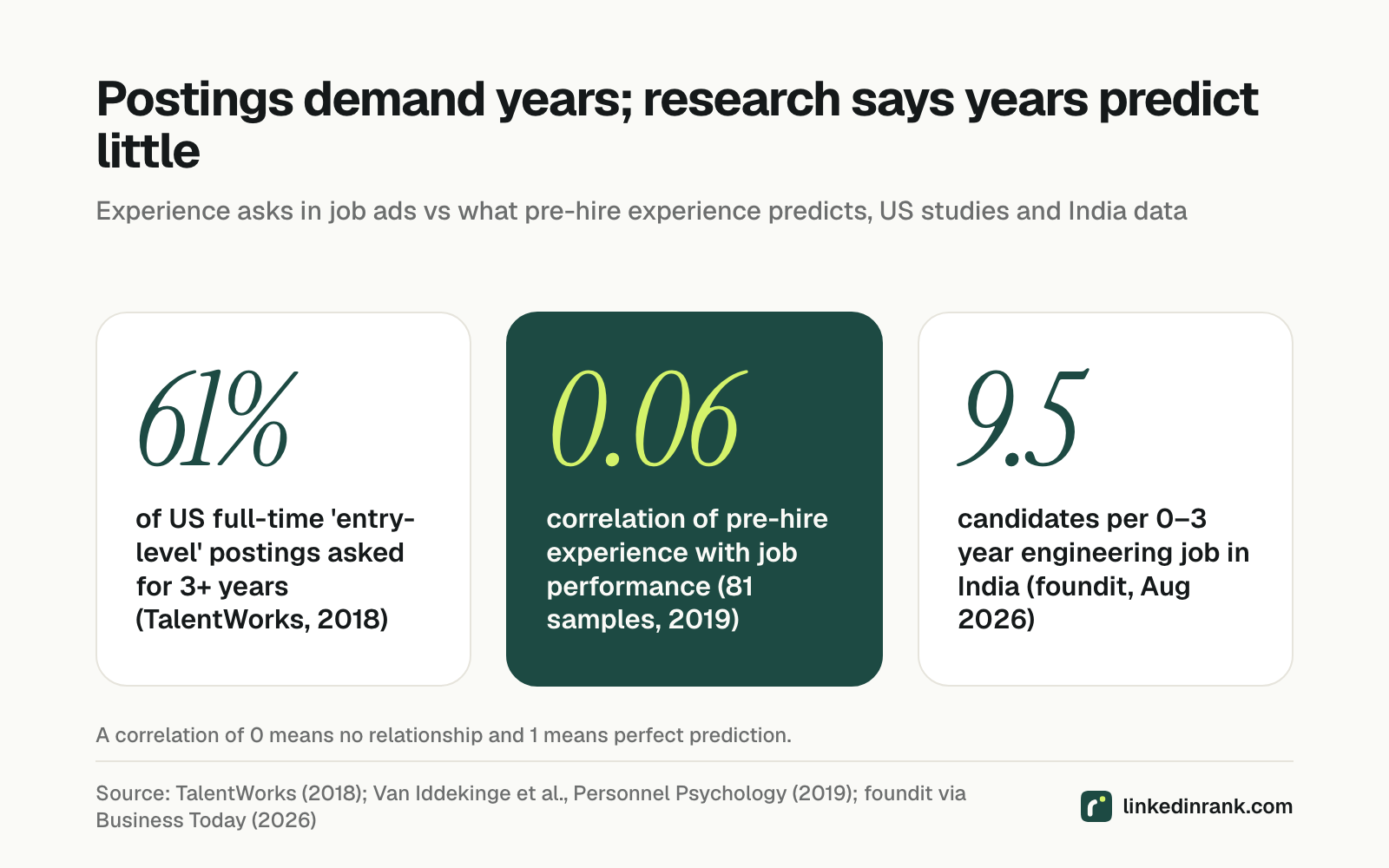
It is not your imagination. In 2018, a small US job-search company called TalentWorks pulled a random sample of 95,363 job postings and found that 61% of full-time "entry-level" jobs asked for three or more years of experience.
Here is the argument of this piece: "three years of experience" in a posting is rarely a measured requirement. It is shorthand for a different question, "will this person need hand-holding?", and the research on what experience actually predicts says the shorthand is weak. You can answer the real question directly.
The post's author then tried to find genuine entry-level marketing jobs in Los Angeles by hand. He reviewed 1,286 supposedly suitable postings and threw out 94% of them. The job is labelled for beginners and written for someone who already has the job. So why do employers keep writing it that way?
Why entry-level jobs ask for experience in the first place
Start with the employer's side, because it is not irrational.
Training a new hire costs a manager's time, and time is the thing teams are shortest of. Indeed's Hiring Lab found that in the US, the share of postings that mention training programmes has grown, but that training opportunities decline the more exposed a role is to AI. Many of the office roles freshers aim for sit on the exposed side.
Then there is the pile. When there are many applicants per seat, a years filter is the cheapest way to cut it. In India, foundit's analysis of engineering hiring in August 2026 found that 45% of active engineering candidates are entry-level, but only 28% of engineering jobs target 0–3 years. That is 9.5 candidates for every entry-level engineering job, against roughly four to five per job above three years. Meanwhile TCS, long one of India's largest fresher employers, made 25,000 fresher offers for FY27, after hiring about 44,000 freshers in FY26.
So the common belief is right about one thing: experience requirements are a response to risk and volume. Where it goes wrong is in assuming the filter measures anything useful.
Try it on your profile
The free LinkedIn PDF to Professional Resume Maker applies this in a minute.
What years of experience actually predict
In 2019, Chad Van Iddekinge and three colleagues published a thorough test of this question in Personnel Psychology. They pooled 81 independent samples that linked people's experience before they were hired to how they later performed.
The corrected correlation between pre-hire experience and job performance was .06. With staying in the job, it was .00. On a scale where 0 means no relationship and 1 means perfect prediction, .06 is close to nothing. "There's almost no relationship in most cases," Van Iddekinge told reporters when the paper came out.
A separate 2022 re-analysis of selection research in the Journal of Applied Psychology, by Paul Sackett and colleagues, lands in the same place: years of job experience come out at .07, while a work sample, where the candidate actually does a slice of the job, comes out at .33. Even Indeed's economists, describing why US employers have been dropping year counts, note that with a years requirement "the quality of that experience is not clear" (Hiring Lab, 2024).
The detail that matters most is the exception Van Iddekinge's team found. Experience predicted performance somewhat better at the very start of a new job. That is the whole story in one line. What employers are buying with "three years" is a faster first few months: someone who knows how work flows, how to ask a good question, how to finish without being chased.
This also explains why the filter survives even though it predicts so little. A manager sees the cost of a slow first quarter directly: their own evenings spent fixing work. They never see the cost of the capable fresher who was filtered out before anyone read the application. A rule that protects against the visible risk and ignores the invisible one will always look sensible from the inside.
"Three years' experience" usually means "I don't have time to teach you how to work."
Reading the requirement as a question
Once you see the number as a proxy, a posting reads differently. "3+ years in digital marketing" is not asking whether you were alive and employed in 2023. It is asking three narrower things:
- Have you used the tools this team uses, on something real?
- Have you finished work that someone else depended on?
- Can you be trusted with a task on day 10 without a minder?
None of those requires a payslip. A fresher who has run the Instagram account for a college fest, with a reach number, a budget and a mistake they fixed, has more evidence on all three than a candidate with two years in an unrelated back-office role.
Picture two applications for a junior data analyst role in Pune that asks for "2+ years with SQL and dashboards" (an illustration, not a real case). The first says "Proficient in SQL, Power BI, Excel" and lists a degree. The second says "Built a sales dashboard for my uncle's distribution business from 14 months of invoices; found that 3 customers made up 40% of late payments; he changed his credit terms." The second applicant has zero years of formal experience. They are also the only one who has shown the manager what Monday would look like.
Employers already know the number is soft. In the US, the share of postings with any year-specific requirement fell from about 40% in April 2022 to 30% in April 2024. It is not falling everywhere: in US tech, only 18% of postings that mention experience were open to people with 0–1 years in mid-2025. Tech is where the filter is hardening, which is exactly why proof matters more there, not less.
TalentWorks, for what a vendor's claim is worth, concluded from its own data that people within about two years of the stated requirement are often treated as "close enough". Treat that as a reason to apply, not as a guarantee.
How to get a job with no experience: replace years with proof
Most advice for freshers stops at "build projects". The useful version is narrower: build the proof that answers the specific question the years were standing in for. Here is how to do it this week.
- Translate one posting. Pick a role you want. For every line that says "X years of Y", write the task behind it. "2 years of SQL" becomes "can pull and clean data without help and explain what it shows".
- Make one work sample for that task. For the SQL line: take a public dataset, answer three business questions with queries, and write a one-page note on what you found and what you would check next. For a marketing role: a teardown of a real brand's last 10 posts and a 30-day plan with numbers. Keep it small enough to finish in a week.
- Put the proof where screeners look. The first lines of your resume and LinkedIn About section, with a link. A work sample buried on page two is invisible.
- Answer the hand-holding question in writing. In your application note, describe one time you finished something without being told how, in three sentences: the task, what you did, the result.
- Count what you have, honestly. Internships, paid freelance work, a semester-long college project with a real user, a sustained open-source contribution: list them as experience with dates and outcomes, labelled for what they are. "Intern" is a job title. "Self-employed" is one too, if someone paid you.
- Apply across the line. If a posting says 2–3 years and you have a strong internship and a sample, apply. The worst outcome is the silence you were going to get anyway.
There is a fuller playbook in our guide on how to get a job with no experience, and the latest Indian numbers are in our fresher job market 2026 report.
What the data can't tell us
The 61% figure is from 2018, from US postings, and from a company that was selling a job-search service in the same post; its methods were never published in full. Treat it as an illustration of the pattern, not a measure of today's Indian market. The meta-analyses are mostly built on studies of US and European workplaces, and a correlation across many jobs can hide roles where experience genuinely matters, such as licensed or safety-critical work. And none of this means a recruiter will read your work sample. It means that when someone does, it tells them more than a year count would.
The posting asks how long you have been doing the work. The hiring manager wants to know whether you can do it on Monday. Answer the second question.
Sources
- TalentWorks, "The Science of The Job Search, Part III: 61% of 'Entry-Level' Jobs Require 3+ Years of Experience", 2018 (archived copy). http://web.archive.org/web/2018/https://talent.works/2018/03/28/the…
- Van Iddekinge, Arnold, Frieder & Roth, "A meta-analysis of the criterion-related validity of prehire work experience", Personnel Psychology, 2019. https://digitalcommons.unf.edu/unf_faculty_publications/785/
- Phys.org (Florida State University), "Work experience poor predictor of future job performance", 2019. https://phys.org/news/2019-05-poor-predictor-future-job.html
- Sackett, Zhang, Berry & Lievens, "Revisiting meta-analytic estimates of validity in personnel selection", Journal of Applied Psychology, 2022. https://www.gwern.net/doc/statistics/meta-analysis/2021-sackett.pdf
- Indeed Hiring Lab (Cory Stahle), "Experience the Difference: Why Employers Are Relaxing Some Tenure Requirements", 2024. https://hiringlab.indeed.com/2024/05/23/tenure-requirements/
- Indeed Hiring Lab (Brendon Bernard), "Experience Requirements Have Tightened Amid the Tech Hiring Freeze", 2025. https://hiringlab.indeed.com/2025/07/30/experience-requirements-hav…
- Indeed Hiring Lab (Gallacher & Aoki), "Which jobs offer training and why it matters in the AI era", 2025. https://hiringlab.indeed.com/2025/10/09/which-jobs-offer-training-a…
- Business Today (foundit data), "Engineering hiring skips freshers as jobs shift beyond IT", 2026. https://www.businesstoday.in/jobs/story/engineering-hiring-skips-fr…
- Outlook Business (PTI), "TCS Makes Only 25k Fresher Offers This Fiscal, More Hires Dependent on Demand Scenario: Official", 2026. https://www.outlookbusiness.com/corporate/tcs-makes-only-25k-freshe…
Questions people ask
How do I convert my LinkedIn profile into a resume?
On LinkedIn open your profile, click More (or Resources), then Save to PDF. Drop that PDF here, review the sections, and click Download PDF.
Is this resume ATS-friendly?
Yes. It uses one column, standard headings like Experience and Education, real text and no tables, icons or images, which is what applicant tracking systems read best.
Will the AI make things up?
No. It may only reword what is already on your resume. Lines that add a new tool, employer or number are dropped, and missing numbers are left as [brackets] for you to fill in.
Is it free?
Yes. No signup and no watermark. Your PDF is read once and never stored.
Written by Bhavishya Singla
Founder of LinkedInRank. Writes about how recruiters search LinkedIn and what makes a profile show up.
Add LinkedInRank as a preferred source on Google
See our new LinkedIn guides first in Google results.