In short
AI job applications help one person and hurt everyone once all use them. What the research shows, and where your effort still counts with recruiters.
On this page
- When everyone applies with AI, nobody stands out
- How many AI job applications is LinkedIn actually getting?
- The case for using AI to apply (it is real)
- What happens when everyone applies with AI
- The employer side of the AI hiring arms race
- Where the scarce signal moved
- What this means for you this week
- What the data can't tell us
- Sources
- Questions people ask
When everyone applies with AI, nobody stands out
In June 2025, The New York Times reported that LinkedIn was receiving about 11,000 job applications a minute, up 45% in a year (Semafor's summary). One HR consultant in that story got 1,200 responses to a single post within days.
The usual reading is a tip: use AI too, or fall behind. The research points somewhere less comfortable. AI writing is a private advantage and a collective loss. When a few people use it, they win. When everyone uses it, the written application stops telling employers anything, and hiring falls back on the signals a chatbot cannot mass-produce: who vouches for you, what you have visibly done, and how you think when a human is in the room.
That is the arms race nobody wins. You can still win inside it, but not by applying faster.
How many AI job applications is LinkedIn actually getting?
Start with honesty about the number. The per-minute figure moves depending on who reports it and when. In September 2024, LinkedIn told Semafor it saw about 9,000 applications a minute. The Times put it at 11,000 in June 2025. A CNBC report in October 2025, reposted by Recruiting News Network, quoted a company representative saying "nearly 9,500".
So treat "11,000" as a headline, not a constant. The direction is not in doubt, though. In September 2026, LinkedIn CEO Dan Shapero said job seekers are sending 30% more applications than before the pandemic, and told the Wall Street Journal: "It's gotten harder and harder for employers to know who can actually do the job anymore" (Fortune).
India is not spared. LinkedIn research reported by People Matters in January 2026 says applicants per open role in India have more than doubled since early 2022, and 94% of Indian professionals plan to use AI in their job search. Nearly 74% of Indian recruiters said finding qualified talent had become harder over the past year. More applicants, more AI, and recruiters saying they can find fewer good people: that is the shape of the problem.
Try it on your profile
The free Cover Letter Generator applies this in a minute.
The case for using AI to apply (it is real)
Here is what the "use AI or fall behind" camp gets right.
In a field experiment with nearly half a million job seekers on an online labour market, economists Emma Wiles, Zanele Munyikwa and John Horton gave some applicants algorithmic help writing their resumes. Those applicants were hired 8% more often, and the researchers found no evidence that employers were less satisfied with them (NBER working paper 30886, later published in Management Science). Cleaner writing helped people whose resumes were holding them back.
So for one person, inside a market where most others are not doing it, writing help works. That finding is solid. The trouble starts when the experiment is no longer an experiment.
What happens when everyone applies with AI
In 1973 the economist Michael Spence published "Job Market Signaling", the paper behind part of his Nobel prize. Its core idea is simple. Employers cannot see ability directly, so they rely on signals, and a signal only works if it is costly for the wrong people to fake. A careful, tailored cover letter used to be one of those signals. Writing it took time and some skill.
Generative AI made that cost close to zero. Two economists, Anaïs Galdin (Dartmouth) and Jesse Silbert (Princeton), measured what followed on Freelancer.com, a large freelance marketplace that added an AI tool for writing bid proposals in 2023. Their paper, "Making Talk Cheap" (2025), found that before the AI tool, employers were much more willing to pay for workers who sent customised proposals. Afterwards, that willingness "falls sharply", and employers leaned more on price and past ratings instead (Tuck School of Business summary).
Then they modelled a market where written applications carry no signal at all. In that simulation, the most able fifth of workers were hired 19% less often, and the least able fifth 14% more often. The polish that once separated strong candidates had become the same polish everyone had.
AI writing is a private advantage and a collective loss.
Put the two studies side by side and the arms race is plain. The 8% gain came from having something others did not. Once everyone has it, nobody gains from it, and the people with real ability lose the channel that used to show it.
The employer side of the AI hiring arms race
Employers did what anyone would do with a flooded inbox: they automated the other end. Greenhouse, a hiring-software company, surveyed 4,136 people across the US, UK, Ireland and Germany in 2025, including 1,200 US job seekers and 665 US recruiters and hiring managers. Its CEO, Daniel Chait, described the result bluntly: "Jobseekers use AI to apply to more and more jobs, while employers use it to filter candidates back out again" (Greenhouse, November 2025).
The same vendor survey shows the race escalating on both sides. 41% of the US job seekers admitted using prompt injections, hidden text meant to slip past AI filters. 91% of recruiters said they had spotted candidate deception. And 39% of US hiring managers said they were running more in-person interviews to check that candidates are genuine.
That last number matters most. The response to cheap text is not better text detection. It is moving the decision to places text cannot reach. Google now requires at least one in-person interview round, and McKinsey asks hiring managers to schedule at least one in-person meeting, according to Entrepreneur's report on WSJ reporting from August 2025.
Greenhouse's October 2026 candidate report, again a vendor survey with 1,200 US respondents, found that 81% of US candidates had been rejected from a job in the past year without speaking to anyone (Greenhouse, 2026). Its head of voice AI, Ophir Samson, put the limit well: AI can fire off hundreds of applications, "but it can't show an employer how someone thinks or learns."
Where the scarce signal moved
If writing stopped being scarce, what is scarce now? Hiring data from Ashby, an applicant tracking system, gives one answer. Across more than 38 million applications to 93,000 jobs at its customers between 2021 and 2024, 40% of referred candidates reached an interview, against about 3% of inbound applicants (Ashby Talent Trends Report, 2025).
Offer rates tell the same story over time. Inbound applications that became offers fell from about 7 in 1,000 in late 2021 to 2 in 1,000 by late 2024, a drop of roughly 70%. Referrals fell too, from 12.1% to 7.3%, but they still convert at dozens of times the cold rate.
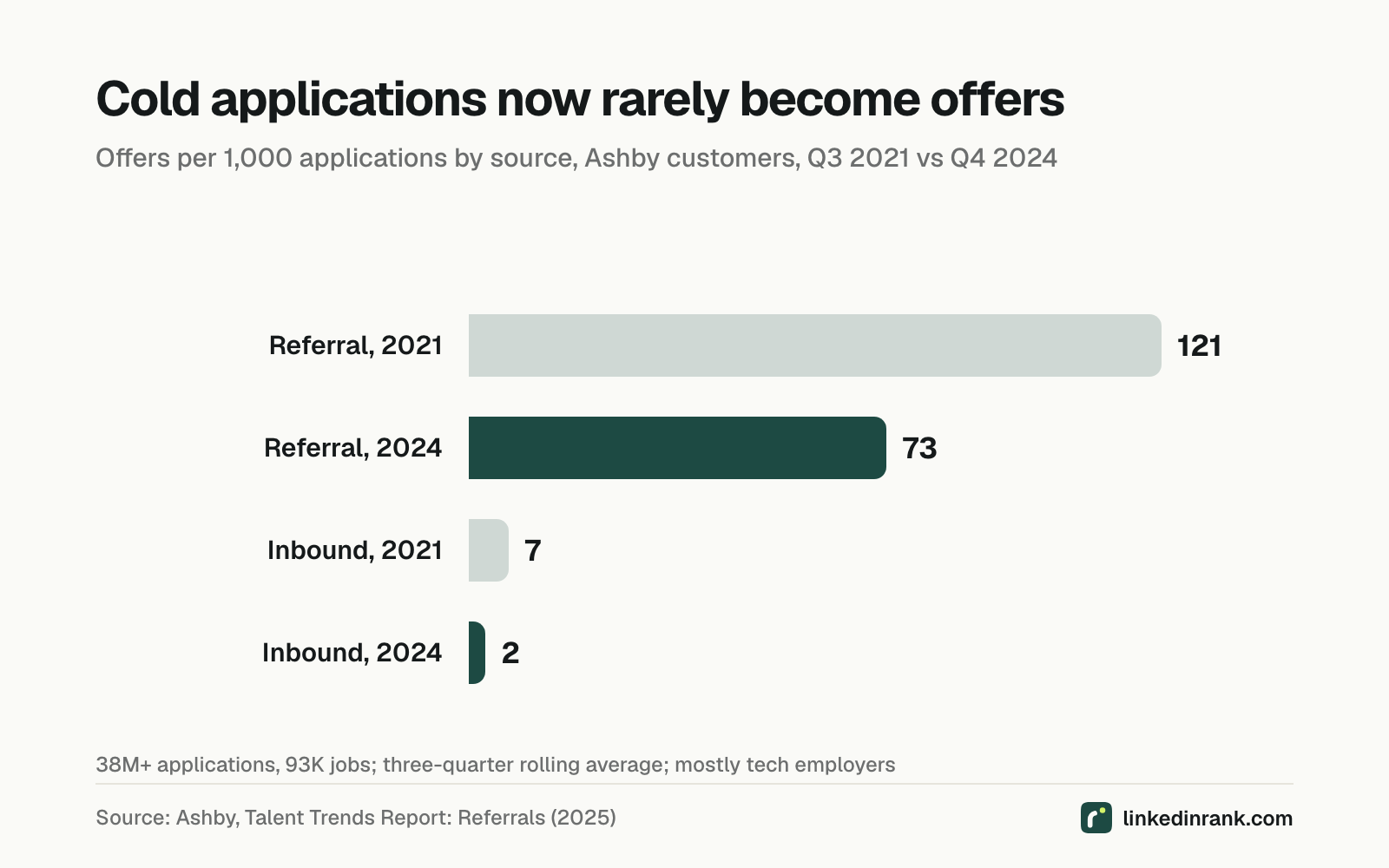
One fair caveat from the same report: inbound applications are about 94% of all applications, so they "remain the dominant source of all hires made." Cold applying still produces most hires in absolute terms. It is just becoming a lottery with worse odds each year, because the number of tickets keeps climbing.
What this means for you this week
The goal is not to stop using AI. It is to spend your effort where effort is still visible.
- Use AI for the parts that carry no signal. Formatting, grammar, a first draft of a summary. Then rewrite every claim in your own words with one specific fact: a number, a named tool, a link. If two candidates could paste the same sentence, it is not helping you. Our guide on tailoring your resume to a job description shows how to match a posting without sounding generated.
- Cut your list to 10 companies and find one human at each. An alumnus, a former intern, someone who posted about the team. Ask for 10 minutes about the work, not a referral. Referrals tend to follow conversations.
- Build one piece of proof that is costly to fake. A small project made for the kind of company you want, with a public write-up. A repository with real commit history. A short case analysis of their product. Things with a visible trail of time.
- Rehearse explaining your own work out loud, without notes. If the decision is moving to live and in-person rounds, the question is whether you can explain why you made the choices on your resume.
- Never use hidden prompt text or tricks. When most recruiters say they have seen deception, getting caught once ends the conversation, and trust is now the thing in shortest supply.
If you want the wider picture of which tasks AI is changing, our guide on how AI is changing jobs covers it.
What the data can't tell us
Most of these numbers are from the US and from vendors. Greenhouse and Ashby sell hiring software, and Ashby's customers lean towards tech companies. The Freelancer.com study covers short freelance gigs, not campus placements in Bengaluru, and its 19% figure comes from a model, not an observed market. LinkedIn's per-minute figure has never been published with a method. What holds across all of them is the direction: more applications, less information per application, and a shift towards human checks.
The arms race rewards whoever stops racing first. When a thousand applications look the same, the one that comes with a name, a conversation or a piece of real work does not need to be louder. It just needs to be true.
Sources
- Semafor, "Recruiters swamped with AI-generated job applications" (summarising The New York Times, 21 June 2025), 2025. https://www.semafor.com/article/06/24/2025/recruiters-swamped-with-…
- Semafor, Mizy Clifton, "LinkedIn's have nots and have bots", 2024. https://www.semafor.com/article/09/12/2024/linkedins-have-nots-and-…
- Recruiting News Network (repost of CNBC, 29 Oct 2025), "Recruiters are drinking through a fire hose of job applications", 2025. https://www.recruitingnewsnetwork.com/posts/recruiters-are-drinking…
- Fortune, Emma Burleigh, "LinkedIn CEO Dan Shapero says job seekers are sending out 30% more applications than pre-pandemic", 2026. https://fortune.com/2026/09/30/linkedin-ceo-dan-shapero-says-job-se…
- People Matters (LinkedIn research), "Applicants per job double in India", 2026. https://www.peoplematters.in/news/recruiting-and-onboarding/applica…
- Wiles, Munyikwa, Horton, "Algorithmic Writing Assistance on Jobseekers' Resumes Increases Hires", NBER Working Paper 30886, 2023. https://www.nber.org/papers/w30886
- Spence, "Job Market Signaling", Quarterly Journal of Economics 87(3), 1973. https://econpapers.repec.org/RePEc:oup:qjecon:v:87:y:1973:i:3:p:355….
- Galdin and Silbert, "Making Talk Cheap: Generative AI and Labor Market Signaling", arXiv 2511.08785, 2025. https://arxiv.org/abs/2511.08785
- Tuck School of Business at Dartmouth, Kirk Kardashian, "What Happens to Hiring When AI Writes Job Applications?", 2026. https://tuck.dartmouth.edu/news/articles/what-happens-to-hiring-whe…
- Greenhouse, "An AI trust crisis: 70% of hiring managers trust AI to make faster and better hiring decisions, only 8% of job seekers call it fair" (vendor survey), 2025. https://www.greenhouse.com/newsroom/an-ai-trust-crisis-70-of-hiring…
- Entrepreneur, Sherin Shibu, "Google, McKinsey reintroduce in-person interviews due to AI", 2025. https://www.entrepreneur.com/business-news/google-mckinsey-reintrod…
- Greenhouse, "6 in 10 job seekers are rethinking how they write to avoid sounding like AI" (2026 Future of Hiring Candidate Report, vendor survey), 2026. https://www.greenhouse.com/newsroom/6-in-10-job-seekers-are-rethink…
- Ashby, Joel Westmark, "Talent Trends Report: Referrals", 2025. https://www.ashbyhq.com/talent-trends-report/reports/referrals
Questions people ask
How long should a cover letter be?
Three or four short paragraphs on one page is enough: why this role, two or three things you have done that the job asks for, and a short close. Recruiters skim, so every sentence should be specific.
Does the generator make things up?
No. It writes only from your LinkedIn PDF and what you type. If a number or name appears that we could not find in what you gave us, it is flagged so you can check it before you send.
Do I need a different cover letter for every job?
Yes, ideally. A letter that answers the specific job ad reads far better than a generic one. Paste each new ad and the letter changes to match what that job asks for.
What if I have no experience yet?
Use what you do have: projects, internships, coursework, volunteering or results from a part-time job. Type them in the experience box; the letter is built only from them.
Can I get a tailored resume for the same job?
Yes. The free resume maker turns your LinkedIn PDF into an ATS-friendly resume, and the Job Pack writes a resume and cover letter for each job ad you paste, with your match score and the gaps to fix.
Written by Bhavishya Singla
Founder of LinkedInRank. Writes about how recruiters search LinkedIn and what makes a profile show up.
Add LinkedInRank as a preferred source on Google
See our new LinkedIn guides first in Google results.