In short
The 6-second resume scan is real, but it measured a pattern-match, not a read. What the eye-tracking studies found, and how to design your resume for it.
On this page
- Recruiters don't read in 6 seconds. They match.
- Where the 6-second resume number comes from
- What the study measured, and what it didn't
- The scan is a pattern-match, not a read
- The brevity myth: why "keep it short" misses the point
- What recruiters see in the first 6 seconds of your resume, and how to design for it
- What the data can't tell us
- Sources
- Questions people ask
Recruiters don't read in 6 seconds. They match.
The most quoted number in career advice comes from a five-page brochure that ends with a sales link.
In 2012, the US job site TheLadders published an eye-tracking study of recruiters. Its headline finding, that recruiters spend about 6 seconds on a resume, has since been repeated in thousands of posts, nearly always with the same moral: keep it short, nobody reads it anyway. The brochure's last line invites you to learn more about TheLadders' resume rewriting services.
The 6 seconds is real enough. The moral is wrong. What the study measured was a pattern-match on six pieces of information, not a reading. The real lesson is to put those six things exactly where a tired eye expects them, because the job of the first 6 seconds is to earn you the next two minutes. Brevity has little to do with it.
Where the 6-second resume number comes from
The 2012 report is credited to Will Evans, then TheLadders' head of user experience design. Thirty professional recruiters took part over a 10-week period, while eye-tracking equipment recorded where they looked, and for how long, as they reviewed resumes and online candidate profiles.
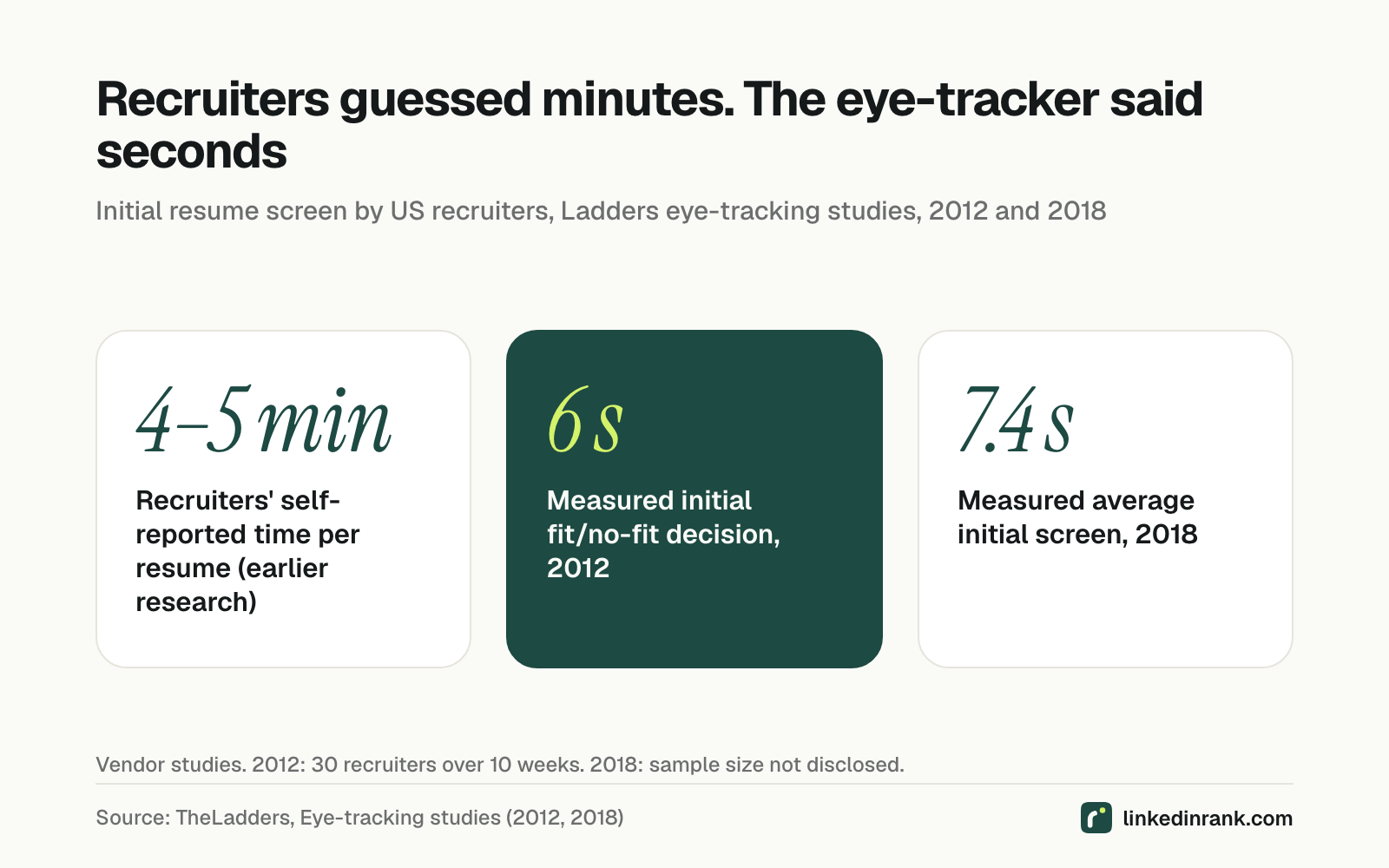
The surprise was the gap between what recruiters said and what they did. Earlier research, based on recruiters' own reports, suggested they spent as much as 4 to 5 minutes per resume. The eye-tracker put the initial "fit/no fit" decision at about 6 seconds.
In 2018, Ladders ran the study again with a two-stage design. In the first stage, recruiters who did not know they were being timed worked through a stack of resumes. In the second, eye-tracking followed recruiters as they read a selection of resumes under lab conditions. The average initial screen came out at 7.4 seconds. Ladders put the extra second down to the job market: the 2012 study ran "during the depths of the recession", when recruiters were overwhelmed with applicants.
Try it on your profile
The free LinkedIn PDF to Professional Resume Maker applies this in a minute.
What the study measured, and what it didn't
Before you build a job search around a number, it helps to know what kind of number it is.
This is vendor research. Ladders sold resume rewriting, and the 2012 report closes by recommending professional rewrites and its own profile format over LinkedIn's. The 2018 report gives no sample size at all. A 2020 column on ERE by Susan Gygax pointed out that it does not say how many recruiters took part, how experienced they were, or what kinds of roles and resume lengths they were screening. Both studies are American.
Most importantly, both measured the initial screen only. Neither followed candidates to interview or offer. So "6 seconds" tells you how long the first decision takes. It says nothing about how long a recruiter spends on a resume that passes it.
The scan is a pattern-match, not a read
Here is the part that rarely gets quoted. According to the 2012 report, recruiters spent almost 80% of their review time on six data points:
- your name
- current title and company
- current position start and end dates
- previous title and company
- previous position start and end dates
- education
Beyond these, the report says, recruiters "did little more than scan for keywords", which it called "a very cursory 'pattern matching' activity". The detailed copy, the paragraphs you sweated over, "became filler and had little to no impact on the initial decision making".
Read that with a fresher's eyes. In the first pass, nobody is reading your bullets. The recruiter is checking whether the shape of your resume matches the shape of the job: the right kind of title, at a plausible kind of organisation, for a believable length of time, with the expected education. A 6-second scan does not punish long resumes. It punishes resumes where those six things are hard to find.
In the first 6 seconds, nobody reads your resume. They check whether its shape matches the job.
The brevity myth: why "keep it short" misses the point
The "keep it short" advice gets one thing right: clutter costs you. In the 2018 study, the worst-performing resumes had a cluttered look, "characterized by long sentences, multiple columns, and very little white space", layouts that did not draw the eye down the page, and signs of keyword stuffing. On those resumes, recruiters' attention bunched on a few areas, which Ladders read as a coping strategy for too much information.
But look at how Ladders defined its best-performing resumes: "those where recruiters spent most time and focus". The winners were the resumes that held attention longest, the opposite of a quick read. On them, recruiters scanned the left side of the page evenly, "picking out titles and reading supplementary information as necessary".
Then comes the line that should settle the one-page argument. The 2018 eye-tracking found that "an engaged recruiter will spend as much time on a second page as on the first". The catch sits in the next clause: time on page two "is strongly predicted by how compelling the first page is".
So the real model has two stages. A fast pattern-match decides whether you get read at all. Pass it, and you get read properly. Brevity is not the goal; being legible at speed is. For most freshers one page is still right, but because you have one page of evidence, not because recruiters cannot cope with two.
What recruiters see in the first 6 seconds of your resume, and how to design for it
The six data points assume a work history. If you are a student or fresher, your education, internships and projects have to do the job that titles and companies do for experienced hires. Here is what to change this week.
- Run the 6-second test on a friend. Show them your resume for 6 seconds, take it away, and ask four questions: what do I study, where, until when, and what is the last thing I did? If they cannot answer all four, your layout is hiding them.
- Treat internships and projects like jobs. Role title in bold on the left, organisation next to it, dates in the same position every time. "Data Analyst Intern, [Company], Jun–Aug 2026" can be pattern-matched. A paragraph about your journey into data cannot.
- Put the target role at the top. The 2018 report found its top performers had "an overview or mission statement at the top of the first page". One line naming the role and two or three core skills tells the eye which pattern to look for.
- Use one column. Multi-column templates look tidy in a design app and scatter the eye. The 2018 study listed multiple columns among the traits of the worst resumes. Our guide to an ATS-friendly resume format covers a layout that works for both software and people.
- Write bullets as short declarative statements. The 2018 recommendations say these are easier to process, and more memorable, than paragraph-length descriptions. Start with what you did. End with a number if you have an honest one.
- Keep keywords in context. "Built a weekly sales dashboard in Power BI" carries the keyword and the proof together. A skills block listing 40 tools carries neither, and the 2018 report flagged keyword stuffing as a mark of the worst resumes.
If you want the wider picture of how screeners think when the pile is tall, our page on recruiter psychology goes through the other shortcuts tired readers take.
What the data can't tell us
Both studies are small or undisclosed, American, and run by a company with a product to sell. They measure attention, not outcomes, so we do not know whether a resume that does well in the first scan is more likely to lead to an interview or an offer. Both also predate today's volume of AI-written applications. Treat the 6 seconds as a description of how busy people skim, not as a law of hiring.
What the studies do describe matches how people read almost everything: structure first, content second. A recruiter is simply a reader with too much to read.
Six seconds is not how long you have to impress a recruiter. It is how long you have to be recognised.
Sources
- Will Evans / TheLadders, "Keeping an eye on recruiter behavior: New study clarifies recruiter decision-making" (summary of "Eye Tracking Online Metacognition: Cognitive Complexity and Recruiter Decision Making"), 2012. Archived copy: https://web.archive.org/web/20190121041657/https://cdn.theladders.n…
- Ladders, "Eye-Tracking Study 2018", 2018. Archived copy: https://web.archive.org/web/20261116142246/https://www.theladders.c…
- Susan Gygax / ERE, "Is the 6-second resume scan a myth?", 2020. https://www.ere.net/articles/is-the-6-second-resume-scan-a-myth
Questions people ask
How do I convert my LinkedIn profile into a resume?
On LinkedIn open your profile, click More (or Resources), then Save to PDF. Drop that PDF here, review the sections, and click Download PDF.
Is this resume ATS-friendly?
Yes. It uses one column, standard headings like Experience and Education, real text and no tables, icons or images, which is what applicant tracking systems read best.
Will the AI make things up?
No. It may only reword what is already on your resume. Lines that add a new tool, employer or number are dropped, and missing numbers are left as [brackets] for you to fill in.
Is it free?
Yes. No signup and no watermark. Your PDF is read once and never stored.
Written by Bhavishya Singla
Founder of LinkedInRank. Writes about how recruiters search LinkedIn and what makes a profile show up.
Add LinkedInRank as a preferred source on Google
See our new LinkedIn guides first in Google results.