In short
The weak ties job search theory, tested on 20 million LinkedIn members. Why your most useful contact is neither a close friend nor a stranger.
On this page
- Your next job sits in the middle of your network
- What Granovetter found about weak ties and job searches
- The paradox: why close friends looked more useful
- What LinkedIn's People You May Know experiment actually changed
- The ethics question the study raised
- What this means for your job search on LinkedIn this week
- What the data can't tell us
- Sources
- Questions people ask
Your next job sits in the middle of your network
Between 2015 and 2019, LinkedIn ran experiments on its People You May Know feature, the box that suggests who you should connect with. Some members were randomly shown more suggestions of people they barely knew. Others were shown more people who were already close to their circle. Nobody was told which group they were in.
In 2022, five researchers from LinkedIn, Harvard, Stanford and MIT published what happened next in Science. Across more than 20 million members, the experiments helped create about 2 billion new connections, and the period saw 600,000 new jobs. The finding is more precise than the usual "network more" advice: the contact most likely to move you into a new job is neither your close friend nor a stranger. It is someone in the middle.
That middle is where most people spend the least effort.
What Granovetter found about weak ties and job searches
The idea is older than LinkedIn. In 1973, the sociologist Mark Granovetter published "The Strength of Weak Ties" in the American Journal of Sociology. He had interviewed a random sample of recent professional, technical and managerial job changers in a Boston suburb, work that grew into his 1974 book Getting a Job, a study of how 282 men found their jobs.
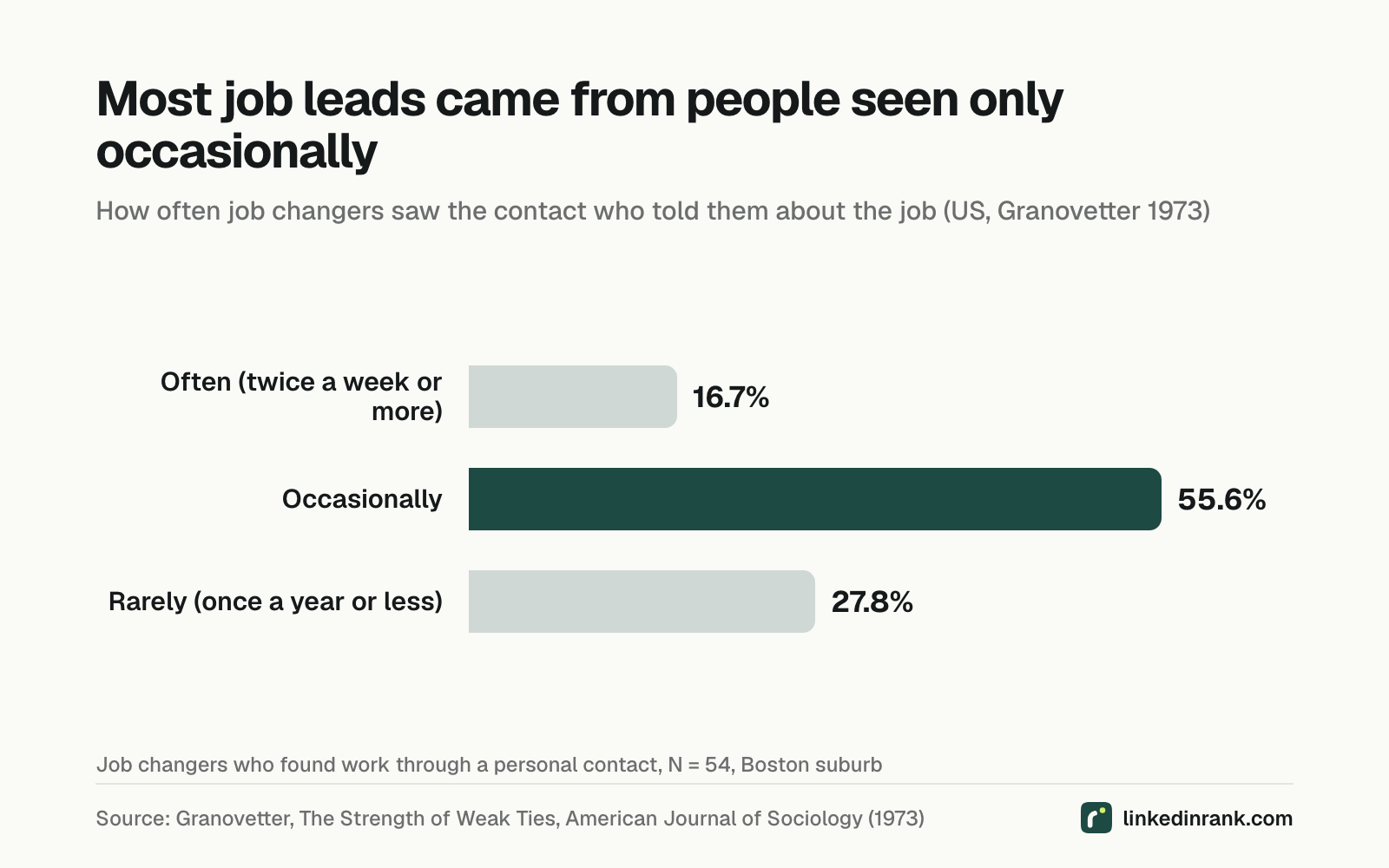
He asked the people who found work through a personal contact one simple question: how often were you seeing this person when they told you about the job? Only 16.7% said "often", meaning at least twice a week. Most, 55.6%, said "occasionally". Another 27.8% said "rarely", once a year or less.
The contacts were, in his words, people like "an old college friend or a former workmate or employer". Many had not been close even when the relationship began. His explanation was structural. Your close friends know the people you know and hear the news you hear. An acquaintance sits in a different part of the network, so they carry information you would not otherwise get.
"It is remarkable that people receive crucial information from individuals whose very existence they have forgotten." (Mark Granovetter, 1973)
The sample was small (54 people answered that question), American and all from one suburb. For 50 years the theory was cited far more than it was tested.
Try it on your profile
The free LinkedIn Connection Message Generator applies this in a minute.
The paradox: why close friends looked more useful
When researchers finally got large datasets, the theory seemed to wobble. Big correlational studies, described in the Science paper as "the largest, most direct empirical examinations" before it, found that strong ties were more often linked to someone getting a job. This became known as the "paradox of weak ties".
The common belief has a point here. Close friends do care more. They will push your resume, vouch for you and chase a hiring manager. And if you simply count who helped whom, close ties look powerful.
The trouble with counting is that it cannot separate cause from circumstance. People who are about to change jobs may also be the people who spend more time with colleagues. Ambitious people may build both stronger ties and better careers. To know whether the type of contact causes the job, you need someone to change people's networks at random. That is what the LinkedIn experiments did.
What LinkedIn's People You May Know experiment actually changed
The paper, "A causal test of the strength of weak ties" by Karthik Rajkumar, Guillaume Saint-Jacques, Iavor Bojinov, Erik Brynjolfsson and Sinan Aral, analysed two waves. A 2015 experiment involved over 4 million members, 98.8% of them in the US. A 2019 wave involved more than 16 million members on every continent, created about 2 billion new connections, and recorded more than 70 million job applications that led to 600,000 new jobs.
The researchers measured tie strength two ways: how many mutual connections two people had, and how much they messaged each other. A "job transmission" was counted when one person later joined the company where a connection already worked, at least a year after they connected.
Three results matter for anyone looking for work.
- Weak ties won, once the bias was removed. When the authors ran the ordinary correlational analysis on their own data, they reproduced the paradox: strong ties looked better. When they used the random variation from the experiments, the result reversed.
- The best contact sat in the middle. Measured by mutual connections, the relationship was an inverted U. New connections with a few mutual friends raised the chance of a job transmission. Past roughly ten mutual connections, adding closer ties reduced it. Measured by messaging, the people you talked to least helped most.
- It depended on the industry. Weak ties led to more job applications in more digital industries, those heavy in IT, software and remote work. Strong ties led to more applications in industries that relied less on software. (This industry analysis covered applications only, not jobs, because the 2019 data was too recent.)
Put together: the most useful new connection is someone you share a handful of contacts with but rarely talk to. Close enough that the introduction is not cold. Far enough that they know about jobs you don't.
The ethics question the study raised
The study also drew criticism. In September 2022, Natasha Singer reported in The New York Times (read here via the NZ Herald syndication) that LinkedIn had not told members the tests were under way. Michael Zimmer, a data ethics researcher at Marquette University, said the findings suggested "some users had better access to job opportunities" than others during the experiments.
LinkedIn said it had acted consistently with its user agreement, privacy policy and member settings, and one of the authors said no one was put at a disadvantage in finding a job. The paper itself states it was approved by MIT's Institutional Review Board.
Both things can be true at once. The research is some of the best evidence we have on networks and jobs. And the fact that a platform can shift who gets job opportunities by changing one recommendation box is exactly why it is worth understanding how that box works. Your network is partly built for you. The rest is up to you.
What this means for your job search on LinkedIn this week
Most freshers network at the two ends. They message close friends, who already share their information, or they send hundreds of requests to senior strangers, who have no reason to reply. The evidence points at the middle ring. Here is how to work it.
- List your middle ring. Write down 25 people you have met but rarely speak to: seniors from your college, people from an internship batch, someone from a hackathon team, a former teacher's other students, a manager from a part-time job. These are Granovetter's "old college friend or former workmate".
- Check the mutual connections. On LinkedIn, the number appears on each profile. A person with a few shared connections is a better first message than someone with none, and often more useful than someone who shares 40 with you, because you already hear what they hear.
- Reactivate before you ask. Granovetter's respondents often reconnected through chance meetings. Online, the equivalent is a short, specific message: congratulate them on a new role, reply thoughtfully to something they posted, or tell them what you are working on. Our LinkedIn networking guide has the etiquette.
- Ask for information, not a job. Weak ties are valuable because of what they know: which team is hiring, what the manager cares about, whether the posting is real. "What does a first year in your team look like?" gets more replies than "Can you get me in?"
- Make new connections with context. When you connect with someone new, mention the mutual connection or shared context in one line. These connection request message templates show the format.
- Match the tie to the industry. If you are aiming at software, analytics or remote-friendly roles, spend more time on the wider ring. If you are aiming at a less digital sector, the study suggests close contacts may matter more, so do not neglect family friends and relatives in that field.
What the data can't tell us
The study measured job moves to a company where a connection already worked. It cannot tell us whether that connection passed on the job, referred the person, or simply made the company feel familiar. The 2015 wave was almost entirely American, and the members most exposed to the experiments were slightly younger and more active job seekers than average. LinkedIn also over-represents finance, technology and professional services. There is no India-specific breakdown in the paper.
Nor does it say anything about how you treat people. A weak tie you message only when you need something is a weak tie that stops replying.
The person who changes your career is probably already in your list of connections. Not the one you talk to every day. The one you have been meaning to message for a year.
Sources
- Rajkumar, K., Saint-Jacques, G., Bojinov, I., Brynjolfsson, E., Aral, S., "A causal test of the strength of weak ties", Science 377(6612), 2022. https://ide.mit.edu/wp-content/uploads/2022/09/abl4476.pdf (publisher page: https://www.science.org/doi/10.1126/science.abl4476)
- Granovetter, M., "The Strength of Weak Ties", American Journal of Sociology 78(6), 1973. https://smg.media.mit.edu/classes/library/granovetter.weak.ties/gra…
- Granovetter, M., Getting a Job: A Study of Contacts and Careers, Harvard University Press, 1974 (2nd ed. University of Chicago Press, 1995). https://sociology.stanford.edu/publications/getting-job-study-conta…
- Singer, N., "LinkedIn Ran Social Experiments on 20 Million Users Over Five Years", The New York Times, 2022 (syndicated by NZ Herald). https://nzherald.co.nz/business/linkedin-ran-social-experiments-on-…
Questions people ask
Should I add a note to LinkedIn connection requests?
Yes. Personalized connection requests are 2-3x more likely to be accepted than blank requests.
What should I write in a LinkedIn connection message?
Mention why you want to connect specifically, reference something about their profile, and keep it under 300 characters.
Written by Bhavishya Singla
Founder of LinkedInRank. Writes about how recruiters search LinkedIn and what makes a profile show up.
Add LinkedInRank as a preferred source on Google
See our new LinkedIn guides first in Google results.