In short
Structured interviews predict job performance better than any other common method. How the scoring works, and how to give answers a rubric can score.
On this page
- Your interviewer is holding a scoring sheet
- What is a structured interview?
- Why structured interviews predict job performance best
- But plenty of interviews are still a chat
- How to answer structured interview questions so they can be scored
- What this means for you this week
- What the data can't tell us
- Sources
- Questions people ask
Your interviewer is holding a scoring sheet
In 1979, a change in state law forced the University of Texas Medical School at Houston to admit 50 more students, late in the admissions season. The only applicants left were ones the school had already rejected, largely on the strength of unstructured interviews in which each interviewer asked whatever they liked.
By the end of medical school and one year of postgraduate training, the researchers who followed them up found no meaningful differences between the rejected group and the accepted one: not in drop-out rates, academic performance, clinical performance or honours.
That story, retold by the psychologists Jason Dana, Robyn Dawes and Nathanial Peterson in 2013, is the best introduction to what decades of hiring research have found. Interviews that feel like a good conversation predict surprisingly little. Interviews run like a scoring exercise predict more than almost anything else. Which means your job in a good interview is not to be charming. It is to hand the interviewer evidence they can score.
What is a structured interview?
Google, in the hiring guidance it publishes on its re:Work site, defines structured interviewing as "using the uniform methods to assess candidates applying for the same job". In practice it has four parts:
- every candidate for a role gets the same, job-relevant questions;
- the interviewer writes down what the candidate actually said;
- answers are scored against a rubric that describes what an outstanding, solid, borderline and poor answer looks like;
- interviewers are trained and calibrated so their scores mean the same thing.
The questions come in two kinds. Behavioural questions ask what you did: "Tell me about a time you had to deliver with incomplete information." Hypothetical questions ask what you would do: "A customer says our report is wrong an hour before a deadline. Walk me through your next steps." In both, the interviewer is not deciding whether they like you. They are deciding which box on the rubric your answer lands in.
Try it on your profile
The free Cover Letter Generator applies this in a minute.
Why structured interviews predict job performance best
In 1998, Frank Schmidt and John Hunter summarised 85 years of research on selection methods in Psychological Bulletin, and their table of which methods predict performance was quoted for decades. In 2022, Paul Sackett and colleagues re-ran the numbers in the Journal of Applied Psychology, correcting what they showed was a systematic over-adjustment in the older estimates. Most methods got weaker. The ranking changed. And structured interviews came out on top.
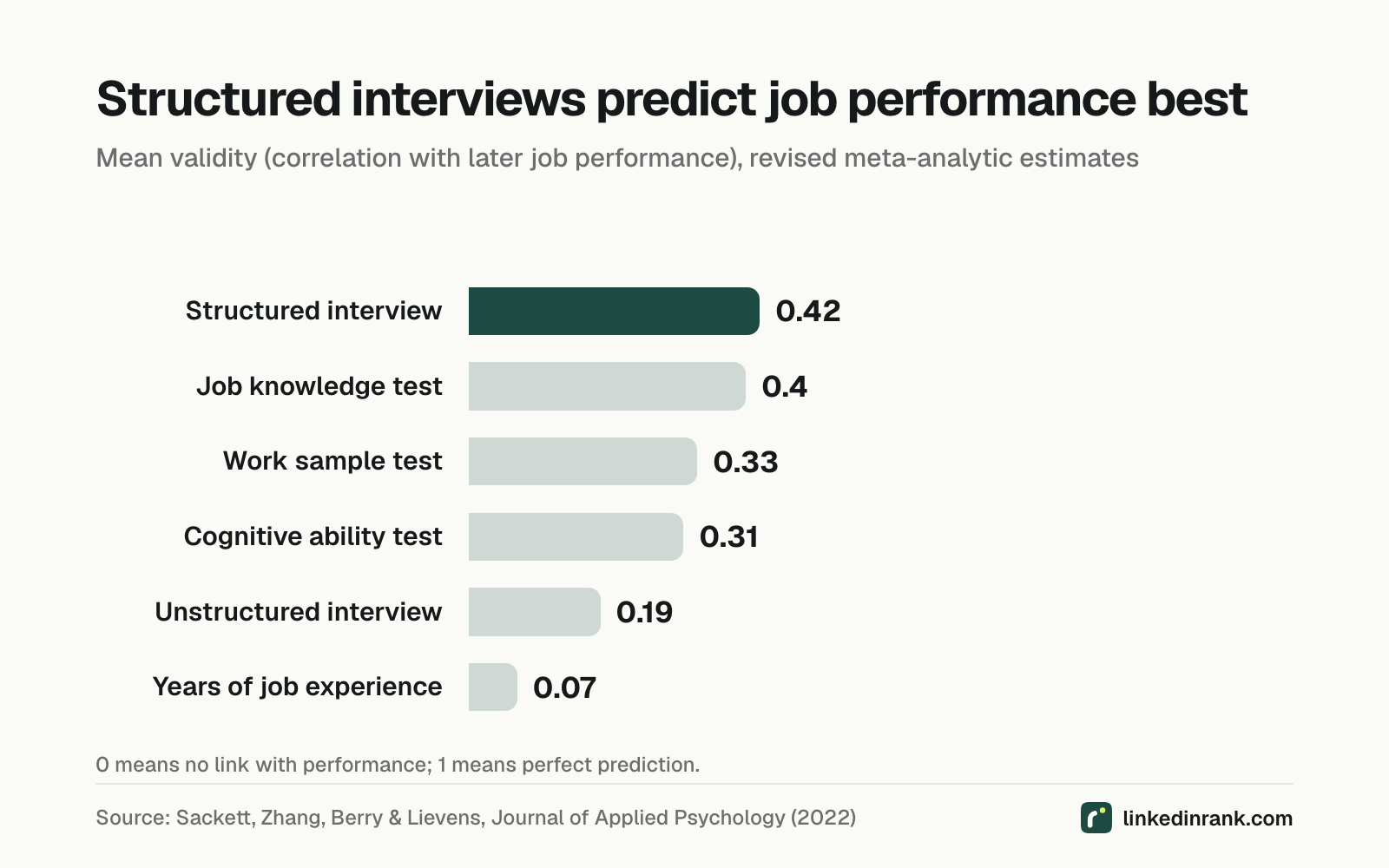
These numbers are correlations between a method's score and later job performance, where 0 means no link and 1 means perfect prediction. Structured interviews reached .42. Unstructured interviews managed .19, less than half. Years of job experience came in at .07. In Sackett's comparison table, Schmidt and Hunter's older figures were .51 for structured interviews and .38 for unstructured ones, so the gap between the two has widened as the estimates got more careful.
The Dana study explains why the casual interview does so badly. In one experiment, students interviewed a fellow student and then predicted that student's grades. Some of the interviewees were secretly answering with a random-response system: their answers were nonsense. The interviewers formed impressions just as confidently after the random interviews as after real ones, and the interviews made their predictions worse, not better. Humans are brilliant at making a story out of whatever a person says. That is the problem a rubric exists to fix.
Charm is something an interviewer remembers. Evidence is something they can write down.
But plenty of interviews are still a chat
The common belief, that interviews are about chemistry and confidence, is not wrong about the interviews many freshers actually face. A lot of hiring managers have never seen a rubric. Some panels still ask "Where do you see yourself in five years?" and decide in the first two minutes. And even within structured interviews, quality varies a lot: Sackett's team found a wide spread around that .42, and the weakest structured interviews predicted about as well as a chat.
Here is why that does not change your strategy. An answer built to be scored works in both rooms. In a structured interview, it lands in the top box. In an unstructured one, it gives the interviewer something concrete to remember and repeat to the next person in the hiring loop. A charming answer with no evidence works in only one of the two, and only if the chemistry happens to be there.
How to answer structured interview questions so they can be scored
Think about the interviewer's form. For a question about handling a deadline, the rubric for a strong answer will say something like: identified the real priority, took a specific action themselves, communicated early, and can show the result. Each of those is a box. Your answer should tick them out loud.
A useful pattern, often called STAR (situation, task, action, result), works if you weight it correctly. Many candidates spend most of their answer setting the scene. Flip it.
- Situation and task, in one or two sentences. "In my final-year project, our team of four had to deliver a working prototype to our guide in three weeks."
- Action, in detail, in the first person. What you did, not what "we" did. "I split the backend into three modules, took the payment one myself, and set a check-in every second evening."
- Result, with a number. "We demoed on day 19; the guide asked us to present it to the department." If you can add what you would do differently, add it. It shows you learn, which is much of what a fresher is hired for.
Here is the same story told badly, for contrast (an illustration, not a real transcript): "We had a tough project and a tight deadline, but I'm a team player and I work well under pressure, so we managed it." Nothing in that answer can be scored. No action, no result, no "I".
Hypothetical questions are scored differently. The rubric is likely to reward a sensible process, not a magic answer. Say your steps in order: what you would check first, who you would tell, what you would do if the first step failed.
What this means for you this week
- Build an evidence bank. Write six to eight short stories from college, internships, projects or part-time work. Tag each with the skills it shows: ownership, teamwork, handling a mistake, learning something fast, a conflict, a result you measured.
- Put one number in every story. Users, marks, hours saved, rupees raised, people trained, days early. If you do not have a number, find one.
- Rehearse the 90-second version. Say each story aloud with one sentence of situation, most of the time on action, and the number at the end.
- Rewrite your introduction as evidence. "Tell me about yourself" is often the first scored question. Our guide on how to answer "tell me about yourself" shows how to turn it into three proof points rather than a biography.
- Practise on the questions you will actually get. Our list of interview questions for freshers maps common questions to the skills they test.
- Ask the scoring question. At the end, ask: "What would a strong performance in the first three months look like?" It tells you what the team values, and gives you one last chance to point to a matching story.
What the data can't tell us
A validity of .42 is the best of the common methods, not a crystal ball: plenty of people who interview well struggle in the job, and the reverse. The meta-analyses draw mostly on US and European studies, and we do not have comparable published data on how Indian campus or off-campus interviews are run. Google's figures on time saved and candidate satisfaction come from its own internal data. And you will rarely know whether your interviewer has a rubric in front of them. You do not need to know. Answer as if they do.
The most boring interview in the world is the one with a form. It is also the fairest one you will face, as long as you give it something to write down.
Sources
- Dana, Dawes & Peterson, "Belief in the unstructured interview: The persistence of an illusion", Judgment and Decision Making, 2013. https://www.gwern.net/doc/psychology/cognitive-bias/2013-dana.pdf
- Sackett, Zhang, Berry & Lievens, "Revisiting meta-analytic estimates of validity in personnel selection: Addressing systematic overcorrection for restriction of range", Journal of Applied Psychology, 2022. https://www.gwern.net/doc/statistics/meta-analysis/2021-sackett.pdf
- Schmidt & Hunter, "The validity and utility of selection methods in personnel psychology: Practical and theoretical implications of 85 years of research findings", Psychological Bulletin, 1998 (figures as listed in source 2, Table 3). https://doi.org/10.1037/0033-2909.124.2.262
- Google re:Work, "A guide to structured interviewing for better hiring practices", updated 2026. https://rework.withgoogle.com/intl/en/guides/a-guide-to-structured-…
Questions people ask
How long should a cover letter be?
Three or four short paragraphs on one page is enough: why this role, two or three things you have done that the job asks for, and a short close. Recruiters skim, so every sentence should be specific.
Does the generator make things up?
No. It writes only from your LinkedIn PDF and what you type. If a number or name appears that we could not find in what you gave us, it is flagged so you can check it before you send.
Do I need a different cover letter for every job?
Yes, ideally. A letter that answers the specific job ad reads far better than a generic one. Paste each new ad and the letter changes to match what that job asks for.
What if I have no experience yet?
Use what you do have: projects, internships, coursework, volunteering or results from a part-time job. Type them in the experience box; the letter is built only from them.
Can I get a tailored resume for the same job?
Yes. The free resume maker turns your LinkedIn PDF into an ATS-friendly resume, and the Job Pack writes a resume and cover letter for each job ad you paste, with your match score and the gaps to fix.
Written by Bhavishya Singla
Founder of LinkedInRank. Writes about how recruiters search LinkedIn and what makes a profile show up.
Add LinkedInRank as a preferred source on Google
See our new LinkedIn guides first in Google results.