In short
AI is hitting young workers first, Stanford's payroll study finds, but only where AI replaces tasks. What that split means for your first job choice.
On this page
AI isn't firing the young. It's not hiring them.
ADP is an American payroll company. Every pay cycle it processes paycheques for millions of US workers, which means it knows, almost in real time, who got hired, who left and how old they are. In August 2025, three Stanford economists, Erik Brynjolfsson, Bharat Chandar and Ruyu Chen, used that data to ask a simple question: since ChatGPT arrived, who has AI actually touched?
Their answer became a widely discussed paper, "Canaries in the Coal Mine?" Most people remember one line from it: AI is hurting young workers. That line is true, but it is the least useful part of the paper.
The useful part is the split inside it. Young workers lost ground where AI is used to replace tasks. Where AI is used to help people do their work, employment was flat or rising. For a fresher choosing a first job, that distinction matters more than any headline.
What the Stanford canaries paper found
The paper was revised in August 2026 with data through June 2026. Its six findings, in the authors' words where it matters:
- There is "no evidence of widespread, economy-wide job displacement."
- Employment of 22–25-year-olds in the most AI-exposed occupations "now stands 19% below where it would be had it kept pace with that of their less-exposed peers." Experienced workers in the same occupations show no comparable gap.
- The gap has widened steadily since it was first documented in August 2025.
- It works "primarily through reduced hiring of young workers rather than increased separations."
- Declines are concentrated where AI substitutes for human tasks. Where AI complements workers, employment is flat or rising.
- The adjustment is showing up in the number of jobs, not in pay.
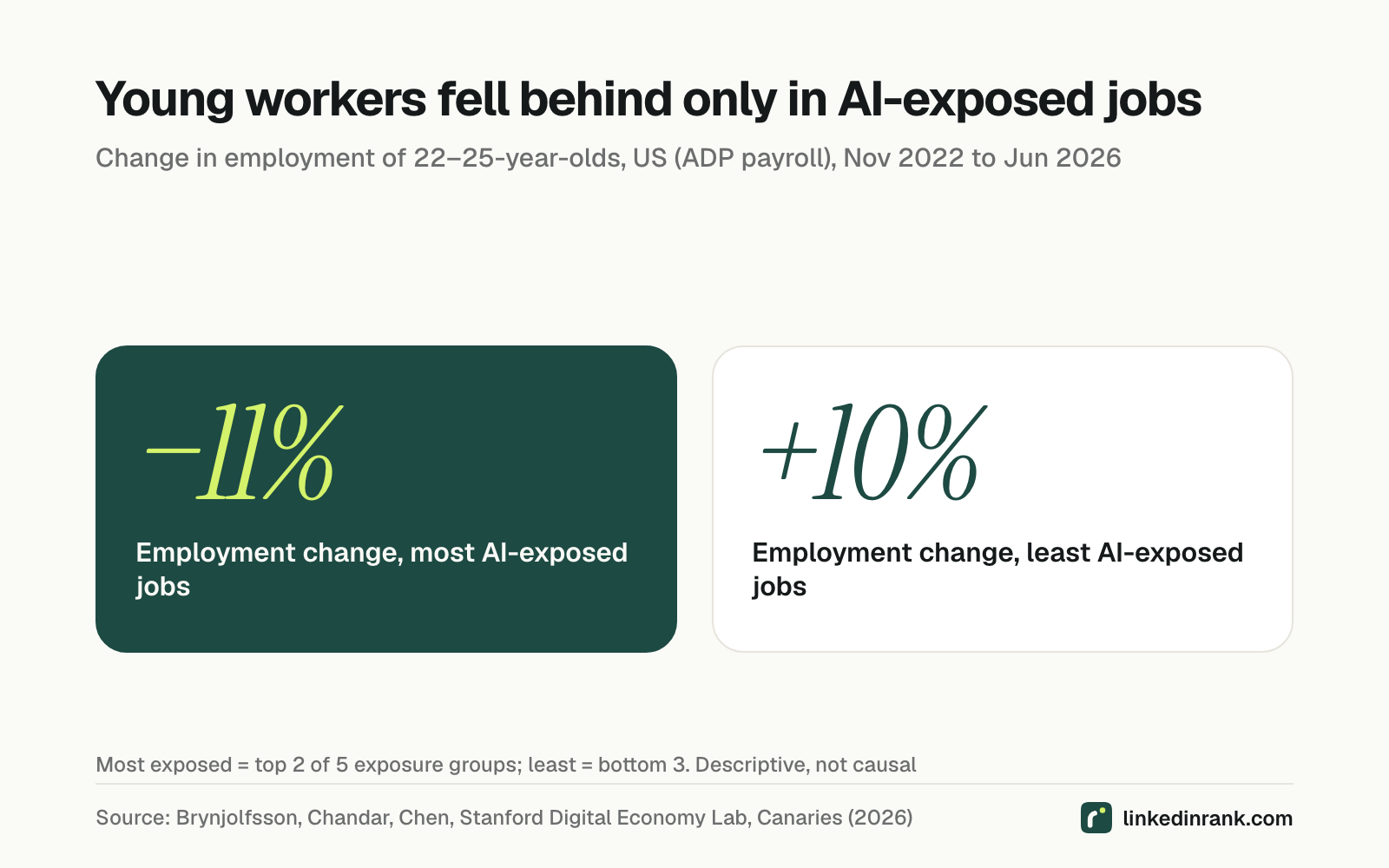
In plain numbers: between November 2022 and June 2026, employment of 22–25-year-olds in the two most exposed groups of occupations fell about 11%. In the three least exposed groups, it grew about 10%.
A note on the number you may have seen before. The first version, in August 2025, headlined a 13% relative decline. That used a statistical model adjusting for company-level shocks. The latest version emphasises a simpler comparison, which put the gap at 15% on mid-2025 data and 19% now. Different methods, same direction, and the gap is growing.
Try it on your profile
The free LinkedIn Keyword Finder applies this in a minute.
Not fired, just not hired
Fact 4 deserves more attention than it gets. The data does not show young workers being pushed out in large numbers. Separations fell for young workers in both exposed and less exposed jobs. What changed is the front door: fewer 22-year-olds are being let in.
That explains why the effect hides so well. Unemployment numbers barely move, companies can truthfully say they have not laid anyone off because of AI, and yet a graduating class finds fewer openings in exactly the roles that used to absorb them. If you are a fresher who feels the market is harder than the statistics admit, this is one reason why.
Automation vs augmentation: the split that matters
To separate the two kinds of AI use, the authors used the Anthropic Economic Index, which classifies real conversations with the Claude chatbot by occupation and task. Some are "automative": the person hands the task over and takes the output. Others are "augmentative": the person works with the AI, checking, iterating and learning. The paper now calls these automation and complementary use.
The age pattern is the striking part. Automation-heavy occupations are associated with declines for the young. Complementary use is associated with gains for experienced workers. The authors call this age gradient "the paper's most direct evidence on mechanism".
Why would the same technology treat a 23-year-old and a 45-year-old so differently? The paper offers an explanation that should change how every student thinks about their degree. AI, the authors suggest, substitutes most easily for codified knowledge: "formal, standardized, documented knowledge that can be taught through education, textbooks, or written procedures." It complements tacit knowledge: what you learn "through practice, mentorship, and repeated exposure to real situations."
What a fresh graduate mostly brings is codified knowledge. That is exactly the layer AI is cheapest at.
Seniors carry tacit knowledge, so AI makes them more productive. Entry-level roles were often built around what the authors call "the checkable, process-intensive tasks that historically justified entry-level headcount". Those are the tasks being automated first.
The critics, and what they get right
This is not a settled result, and the authors say so. They describe their findings as "early, descriptive indicators" rather than proof that AI caused the decline.
Other researchers have pushed back. The Yale Budget Lab, in an October 2025 analysis by Martha Gimbel and colleagues, found that "the broader labor market has not experienced a discernible disruption since ChatGPT's release 33 months ago." It saw a slightly faster shift for recent graduates aged 20–24, which it said could be consistent with the Stanford paper or "could also simply reflect a slowing labor market."
The Stanford team responded in a February 2026 note. They argued that interest rates do not explain the pattern well, but conceded something important: with their strictest controls, the AI-linked decline "becomes significant only in 2024", and earlier declines were likely "at least partly" due to other factors. Their own revised paper also notes that the effect shrinks when you control for education levels and is stronger in ADP's sample than in national surveys.
So the fair summary is this. Something real is happening to young workers in AI-exposed jobs in the US, it is growing, and AI is the leading suspect but not a convicted one.
What this means for your first job
You cannot control the labour market. You can control which side of the split you start on. Here is how to use the paper this week.
- Test each role you apply to with one question: does AI do this job's core task, or help someone do it? If the role's whole value is producing a checkable output from a written procedure, such as first-pass data entry, template reports or routine ticket replies, the paper suggests that is where young hiring is falling. If the role puts you next to customers, messy situations or decisions that need judgement, you are closer to the complementary side.
- Choose roles that buy tacit knowledge. Pick the job where you will sit near experienced people, handle real cases and get feedback, even if the title is less shiny. A role that teaches you how a business actually works compounds. A role that only uses what you already know from textbooks competes with software. Our guide to AI jobs for beginners lists entry roles built around working with AI rather than being replaced by it.
- Show you use AI the complementary way. In your projects, describe how you checked and corrected AI output, not just that you used it. "Used an LLM to draft 40 test cases, rejected 12 as wrong, and here is why" is evidence of judgement. That is the skill the complementary side rewards.
- Pick sectors with tacit-heavy work. Healthcare operations, sales, field roles, manufacturing quality, client-facing consulting: jobs where context matters more than the textbook. Within any sector, look for the version of the role that faces people and problems rather than templates.
- Watch the India data, not just the US. Our fresher job market 2026 guide tracks which sectors are still hiring freshers here.
What the data can't tell us
This is US payroll data from firms that use ADP, which may not represent every employer. India has no comparable real-time dataset of hires by age and occupation, so nobody can say yet whether the same split is happening here, or how fast. The exposure measures come from how people use one chatbot, which is a reasonable but imperfect map of real jobs. And the authors are clear that they have documented a pattern, not proven a cause.
The canary in a coal mine was never the danger itself. It was the early warning that told miners which tunnel to leave. This paper is that kind of warning. It does not say young people have no future in an AI economy. It says the tunnel marked "do the textbook task" is getting narrower, and the one marked "learn what the textbook can't teach" is still open.
Sources
- Brynjolfsson, Chandar, Chen, Stanford Digital Economy Lab, "Canaries in the Coal Mine? Six Facts about the Recent Employment Effects of Artificial Intelligence" (revised August 2026), 2026. https://digitaleconomy.stanford.edu/publication/canaries-in-the-coa…
- Brynjolfsson, Chandar, Chen, "Canaries in the Coal Mine?" full paper PDF, August 2026 version, 2026. https://digitaleconomy.stanford.edu/app/uploads/2026/08/Canaries_Au…
- Brynjolfsson, Chandar, Chen, Stanford Digital Economy Lab, "Canaries, Interest Rates, and Timing: More on the Recent Drivers of Employment Changes for Young Workers", 2026. https://digitaleconomy.stanford.edu/news/canaries-interest-rates-an…
- Gimbel, Kinder, Kendall, Lee, Yale Budget Lab, "Evaluating the Impact of AI on the Labor Market: Current State of Affairs", 2025. https://budgetlab.yale.edu/research/evaluating-impact-ai-labor-mark…
Questions people ask
What are the best keywords for a LinkedIn profile?
The job title you want and the hard skills and tools from job posts for that title. Generic words like "hardworking" or "team player" are rarely searched.
Where should I put keywords on LinkedIn?
In order of weight: your headline, your current job title, the Skills section, your About section and your experience bullets. Use the job post's exact words, for example "Power BI", not "BI tools".
How many job posts should I paste?
3 to 5 posts for the same role give a reliable list. A keyword that appears in most of them is a must-have.
Should I add keywords I do not have?
No. Recruiters and interviewers check. Add only skills you can talk about, and learn the ones that keep coming up.
Is my data stored?
No. The analysis runs in your browser. If you drop your LinkedIn PDF it is read once to extract text and never stored.
Written by Bhavishya Singla
Founder of LinkedInRank. Writes about how recruiters search LinkedIn and what makes a profile show up.
Add LinkedInRank as a preferred source on Google
See our new LinkedIn guides first in Google results.