In short
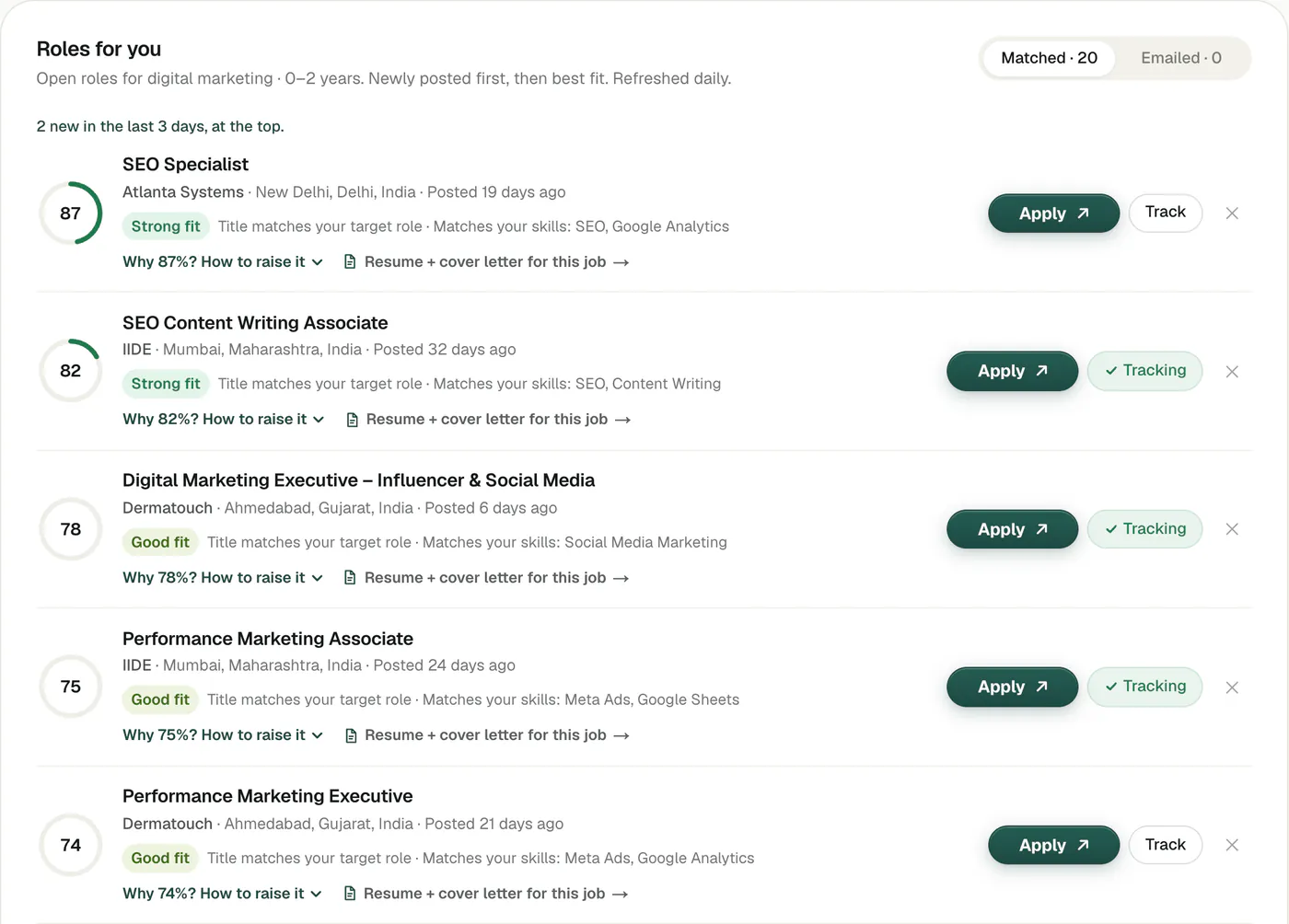
LinkedInRank reads employers’ own career boards through the day and rebuilds your list of matched roles daily, newest first. A role is shown only if it is open, close to your target role, at your level and somewhere you can work. It is then scored out of 100: title 40, skills 30, level 15, place 12, recency 8, and every part is shown under “Why”. The score is a guide to fit, not a hiring probability.
On this page
Where the roles come from
Every role comes from an employer’s own career board, read through the applicant tracking system behind it: Greenhouse, Lever, Ashby, Workable, SmartRecruiters, Workday, Keka, Darwinbox, Zoho Recruit, Recruitee, Personio, Teamtailor, Rippling and others. At the time of writing we read 2,678 boards, from big employers to startups, schools, hospitals and retailers, plus startups hiring in Hacker News’ monthly “Who is hiring?” thread.
We don’t copy listings from LinkedIn, Naukri, Indeed or any other job board, and we don’t take agency ads. The live count of open roles, employers and countries is on the job matching page.
How roles stay fresh
- Boards are read in rotation, a few at a time, around the clock, every day.
- Closed roles drop out. When a board no longer lists a role, it is closed the next time that board is read (usually within a day or two). A role its board hasn’t shown for 48 hours is shown only if its apply link still works.
- A role is shown only while it is open: its board listed it in the last 48 hours, or its apply link still works when we check.
- Your list refreshes daily. Roles posted in the last 3 days come first and are marked new. A full list still makes room each day: up to a quarter of it can be replaced by new roles, taking the place of the weakest ones posted over a week ago.
- Age limit. Roles posted in the last 30 days are preferred; older ones (up to 60 days) are shown only while their board still lists them, with the posting date.
Try it on your profile
The free Cover Letter Generator applies this in a minute.
What we read from you
From your account and your LinkedIn PDF or resume:
- Target role, and up to 5 specific job titles you pick for it (for example “digital marketing”, “social media”, “SEO”).
- Level: student or intern, 0–2 years, 3–5 years or 6+ years. If you don’t pick one, the level read from your LinkedIn PDF is used.
- Place: country and, optionally, city. Roles in your city come first, then your country, then remote roles open to you.
- Optional filters: job type (full-time, internship, contract), work mode (remote, hybrid, on-site), and industries to prefer or avoid.
- Skills: up to 5 key skills you choose, which weigh most, plus the skills on your resume and LinkedIn.
We store short preference values and skill keywords for matching. Your profile is never sent to employers.
The rules a role must pass
Before any scoring, a role has to pass four rules. These are why lists are short and why we don’t pad them:
- Title. The title is your target role or one of the titles you picked, or close to it.
- Level. It is pitched at your level. For students and freshers, roles asking for more years than the level has (more than 1 year for students, more than 2 for 0–2 years) are left out, and people-manager titles (manager, director, head of) are left out for students, freshers and the 3–5 years level, unless the role you want is itself a manager role.
- Place. It is in your country, or remote and open to people where you are. On-site roles in other countries are left out.
- Work mode. If you chose remote, hybrid or on-site, it matches.
One exception helps students and career changers: when the titles you picked match only a few open roles at your level, the list continues with other roles in the same field at that level, marked “More marketing roles at your level” (or your field), so you can see why each is there.
The fit score, part by part
Roles that pass are scored out of 100. The code adds up five parts and shows each one:
| Part | Points | What earns them |
|---|---|---|
| Title | 40 | How close the title is to your target role and picked titles |
| Skills | 30 | Your skills the posting names; missing required skills lower it |
| Level | 15 | The posting is pitched at your level |
| Place | 12 | Your city, country, or remote and open to you |
| Recency | 8 | How recently it was posted |
Industries you prefer or avoid add or take away a few points. Roles scoring under 40 are not shown.
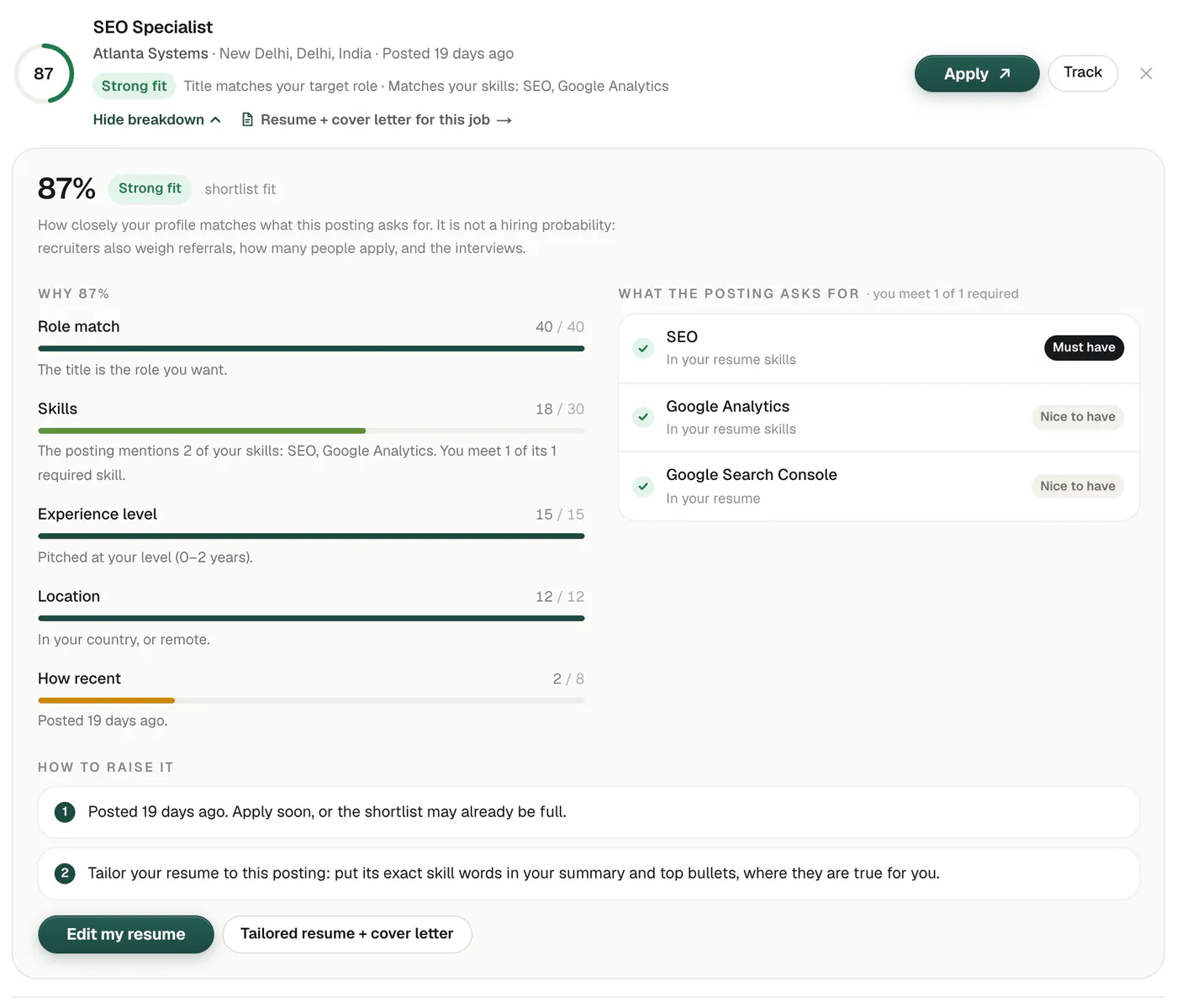
Under “Why”, the requirements table lists the skills the posting asks for, must-haves first, with where your resume or LinkedIn shows each one or that it is missing. “How to raise it” gives the edits that would add points; the points are computed by re-scoring with the change, not guessed.
Strong fit, good fit, stretch
- Strong fit: 75 or more, and at least half of the skills part confirmed. A role with a high total but skills we couldn’t confirm is shown as a good fit instead.
- Good fit: 60 to 74.
- Stretch: 45 to 59.
- Long shot: under 45.
Apply to strong and good fits first, with a resume and cover letter written for each. Stretches are worth it when the gap is one or two skills you actually have but haven’t written down.
How many roles you get
Free accounts see 15 matched roles and can get up to 15 a week by email for their first month; the 5-day free trial shows up to 50; the Job Pack (₹299 in India, $9 in the US, once, for 30 days) shows every role that fits, up to 1,000 (fewer in small fields). Every list refreshes daily.
To keep lists varied, one company has at most 4 roles in a Job Pack list (3 in a trial, 2 on the free plan). The trial and the Job Pack can also keep up to 3 saved searches, for another role, city or level, each topped up with new roles once a day.
What matching doesn’t do
- It is not a hiring probability. Referrals, the number of applicants and interviews decide hiring. The score says how closely your profile matches the posting.
- It does not cover every job. Small employers without a careers page, and roles posted only on job boards, are not in the list.
- It reads the posting text. Some postings are vague about level or place. “Why” shows what we read so you can judge.
- It doesn’t apply for you, and it doesn’t send your profile anywhere. You apply on the employer’s site.
Compare it with the big job sites: LinkedIn Jobs, Naukri and Indeed. Or read how to read a job ad’s must-haves and match scores.
Questions people ask
How often does LinkedInRank refresh job matches?
Employer career boards are read through the day, every day, and your list of matched roles is rebuilt daily with roles posted in the last 3 days first. Roles that close drop out when their board is next read, usually within a day or two.
Is the fit score the chance I will get the job?
No. It shows how closely your profile matches what the posting asks for: title 40 points, skills 30, level 15, place 12 and recency 8. Hiring also depends on referrals, the number of applicants and interviews.
Why do I see only a few roles?
A role has to be open, close to your target role, at your level and somewhere you can work. If few roles pass, you see few; we don’t pad the list. Try adding related titles, a neighbouring level or remote work.
Does LinkedInRank use AI to match jobs?
The matching and the fit score are plain code with fixed rules and weights, so every number can be explained. AI is used to write your resume, cover letter and LinkedIn rewrite, only from your real experience.
Written by Bhavishya Singla
Founder of LinkedInRank. Writes about how recruiters search LinkedIn and what makes a profile show up.
Add LinkedInRank as a preferred source on Google
See our new LinkedIn guides first in Google results.